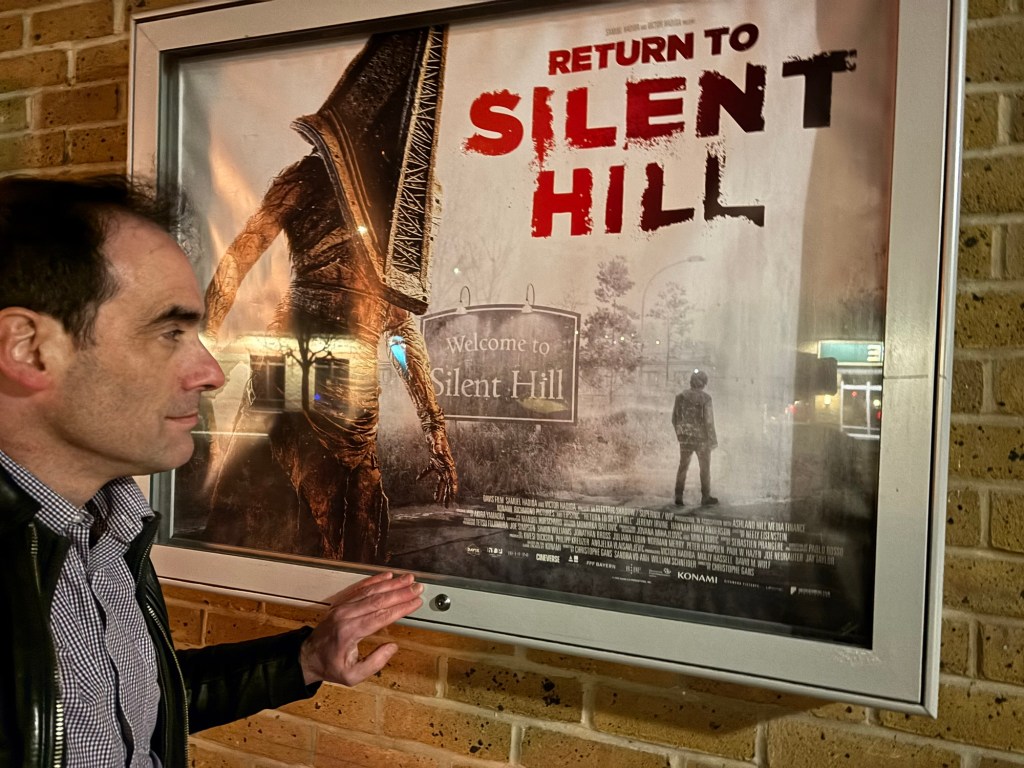
‘Return to Silent Hill’ is based on a video game – and, importantly, a sequel to a video game. The first ‘Silent Hill’ film came out in 2006, and I’m not sure many people would call it a classic, so the question of whether there’s any real need for a follow-up hangs over this from the start. But the premise is undeniably intriguing: a man, James (Jeremy Irvine), is drawn back to a town that feels like a rupture in reality, compelled by the memory – or the lingering presence – of a woman who entered his life and has since died. And what follows plays like a mythic underworld odyssey: a descent into something infernal, Eurydice-style, in which the act of trying to rescue her becomes inseparable from the act of trying to rescue himself.
Silent Hill itself is presented as a place of rot and aftermath. It’s full of faceless bodies, and there’s the sense of refuse and decay rising out of the streets. The town feels sparsely populated, as though a war has happened and everyone has vanished. There are hospital beds lying outside buildings as if the structures have been evacuated mid-crisis – an image that’s both grotesque and strangely poetic. It doesn’t just feel abandoned; it feels cursed, as though the town has been left behind by life but is still busy with death.
It’s essentially a ghost story, but one framed like a parallel-universe narrative: a man crossing over into a realm he shouldn’t be in, a place that has its own rules, its own geography of dread. And there are shades of ‘What Dreams May Come’ here – the idea of a protagonist being pulled toward the afterlife, or into an underworld landscape, by grief and love, and the desperation to reunite with someone taken too soon. The central character in this film is an artist – and that matters, because artists, in stories like this, are often treated as porous people: more vulnerable to visions, memory, obsession, and haunting. He feels as though he’s already had some kind of breakdown, and the film underscores this through his psychiatrist repeatedly trying to contact him and warn him off going back. But, of course, the more the world tells him not to go, the more inevitable the journey becomes. His pursuit is arguably misguided, but it’s also emotionally coherent: grief does not respond well to logic.
One of the more interesting motifs is the way the film seems to fragment the beloved woman into multiple versions (archetypes, indeed) of herself and set them in his path. It’s like the town keeps offering him alternate figures: a young girl, an emaciated or damaged presence, a darker variation of the blonde woman he loved. That idea puts me in mind of something like ‘Sliding Doors’ – not in tone, but in the sense that life is filled with branching possibilities, different ‘versions’ of a person or a relationship, and the challenge is figuring out who is real, who is safe, and who is a trap. One of these figures is called Angela, and even the name feels loaded: angelic guidance, or false salvation.
The decay and atmosphere do the heavy lifting here. The streets are far more interesting than the dialogue, which isn’t especially sophisticated – but then, this is a video game adaptation, so we are not exactly turning up for Shakespearean prose. What I found fascinating is that when I saw the film, I didn’t have a clear grasp of the religious icons and rituals and symbolic gestures – axes, signs, allusions – but I also felt that the protagonist didn’t really know what was going on either. And that’s crucial: the film makes disorientation part of the experience. These symbols, these figures, these obstacles – they aren’t there to be neatly understood. They’re there to block the path, to stop him from entering deeper into this town, deeper into what feels like successive circles of hell, deeper into the mystery of why he lost his love in the first place.
In that respect, it reminded me at times of ‘Labyrinth’: the sense of moving through staged challenges, each one a little different, each one testing resolve, each one threatening to divert you. But because this is horror, not fantasy, the whimsy is replaced with grime and menace. The town is a trap that keeps reconfiguring itself, and the protagonist is the sort of person who knows he shouldn’t be there – and yet can’t stop. Even when the film introduces practical details, they feel like part of the curse: no mobile signal, a dead phone battery, the sense that modern tools of escape don’t function in a place like this. And even when he tries to get out, it’s as though the film keeps suggesting he may already be too late.
I’m not entirely sure there’s a coherent “solution” to the puzzle – and perhaps that’s the point. The film seems less interested in clarity than in compulsion: why people return to places that hurt them, why love can turn into obsession, why grief can feel like a mission. But it does hold out the possibility that something larger is going on – something cyclical, maybe even something like reincarnation – a hint of starting over, beginning again, the way ‘What Dreams May Come’ ends with a kind of metaphysical reset.
So I’m not convinced it all adds up in a neat way. But there’s an appeal in that sense of forbidden territory, of a man walking willingly into a place he knows is dangerous because he cannot live with the alternative. And to be fair, I was hooked right to the end.



Leave a Reply