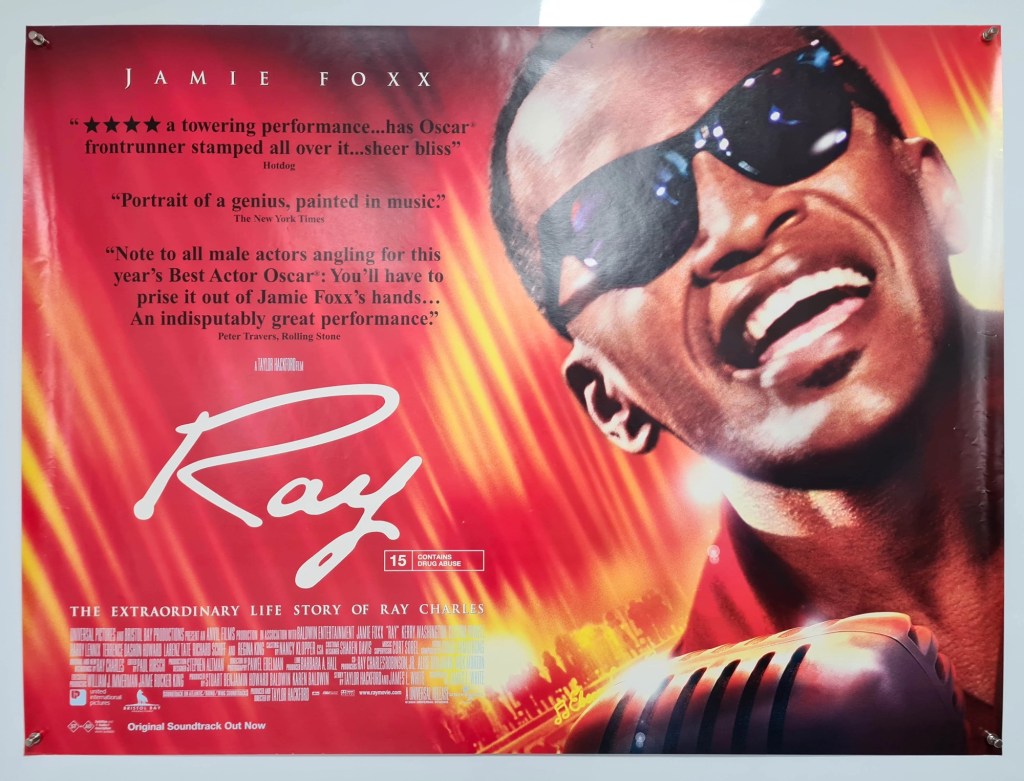
I always have mixed feelings about biopics. They tend to follow a familiar formula: adversity propels someone into the spotlight, often against the odds, and almost in spite of themselves they achieve greatness. There’s usually an element of mystery we want to preserve, and a risk that we’re simply taken on a whistle-stop tour of the highlights rather than getting to the heart of the person. But ‘Ray’ stands out for two key reasons: a superb central performance by Jamie Foxx, which won him an Oscar, and its willingness to present Ray Charles in a far less flattering light – as a drug addict and serial adulterer.
I’m not sure I fully appreciated those aspects of Ray Charles’s life before seeing the film. We see him using heroin, but also as someone who is highly astute, even manipulative when necessary. As a young man, he understands how to navigate the system – for instance, claiming to be a war veteran in order to secure transport across America, knowing that this will win him sympathy and assistance. There’s a sharp business instinct there too: he may be blind, but he is never unaware of when he’s being exploited.
There are some powerful moments, particularly when he refuses to perform in a segregated venue in Georgia, leading to a lifetime ban – one that, unsurprisingly, is lifted by the end, a ‘Georgia on My Mind’ becomes the state’s official song. The film traces his roots in poverty, disability and rural life, and shows how his mother instilled in him a fierce independence. The traumatic death of his brother is also presented as a formative moment, perhaps underpinning his later struggles with addiction.
What the film doesn’t fully explore is whether his blindness shaped his musical genius – whether it heightened his sensitivity to sound and allowed him to connect with music in a unique way. My own feeling is that, while the film is undeniably well made, it doesn’t quite penetrate to the core of who Ray Charles really was. But that may be the limitation of the genre itself – we inevitably project our own expectations onto figures we admire.
Where the film does succeed is in charting Ray Charles’s artistic development. We see him move beyond imitation – Initially echoing artists like Nat ‘King’ Cole – and begin to forge his own distinctive sound, blending gospel, jazz and country influences. Even then, his success is not without controversy, with some critics accusing him of selling out. In that sense, ‘Ray’ captures both the triumph and the tension of a career built on constant reinvention.




Leave a Reply