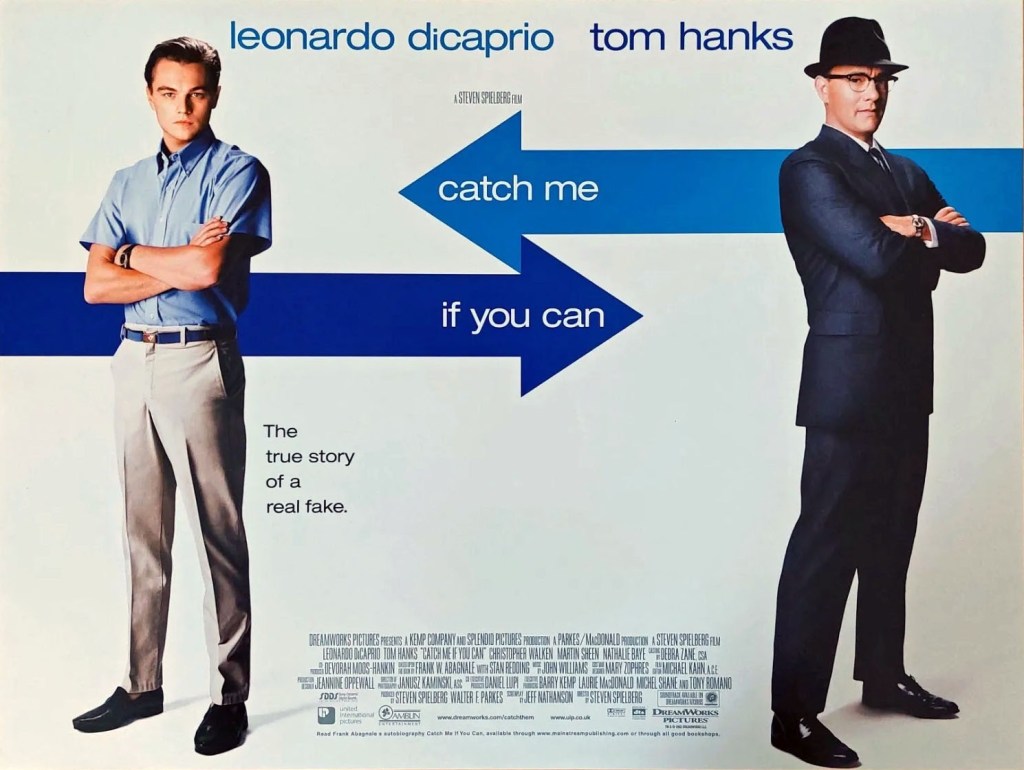
There is something slightly flimsy about ‘Catch Me If You Can’, though I mean that less as a criticism than as a reflection of its breezy, old-fashioned quality. With its caper-style score by John Williams, echoing the jazzy sensibility of Henry Mancini, the film feels like a throwback to the stylish ‘man on the run’ pictures of the 1960s. Here, Leonardo DiCaprio plays Frank Abagnale Jr., a teenager so shaken by his parents’ divorce that he turns, in a way reminiscent of Matt Damon in ‘The Talented Mr. Ripley’, into a chameleon-like conman.
Frank reinvents himself repeatedly – posing as a schoolteacher, airline pilot, doctor and lawyer, all while pretending to be years older than he really is. Remarkably, before the age of 21 he had forged millions of dollars in cheques. In some respects the film risks becoming repetitive, offering variations on the same trick again and again, but it also gives the material considerable emotional weight and time to breathe.
Every film needs an opposing force, and here that role is filled by Tom Hanks as FBI agent Carl Hanratty. What becomes increasingly fascinating is that their relationship evolves into something almost symbiotic. Frank seems energized by the pursuit itself. As long as someone is chasing him, there is purpose to his deception, another challenge to overcome. Indeed, as the film later suggests, when the chase disappears, something in him also begins to fade.
That strange emotional dependence between the pursued and the pursuer gives the film much of its texture. Ironically, the one person Frank may be closest to being honest with is the very man trying to catch him. Hanratty himself is lonely, detached and quietly sad, and there’s a sense that both men recognize something of themselves in the other.
This is also Steven Spielberg operating in familiar territory, with themes of absent or disappointing fathers recurring once again. At its heart, Frank’s journey feels like an attempt to prove something – to show his father that life could have turned out differently, that failure could somehow be rewritten.
There is also something revealing in Frank’s ability to slip so effortlessly into different identities, almost in a ‘Zelig’-like fashion. The film quietly suggests that people often see what they want to see. If a sixteen-year-old can convincingly present himself as a confident twenty-something pilot, perhaps that says as much about the world around him as it does about him. We all, to some degree, participate in the illusion.




Leave a Reply