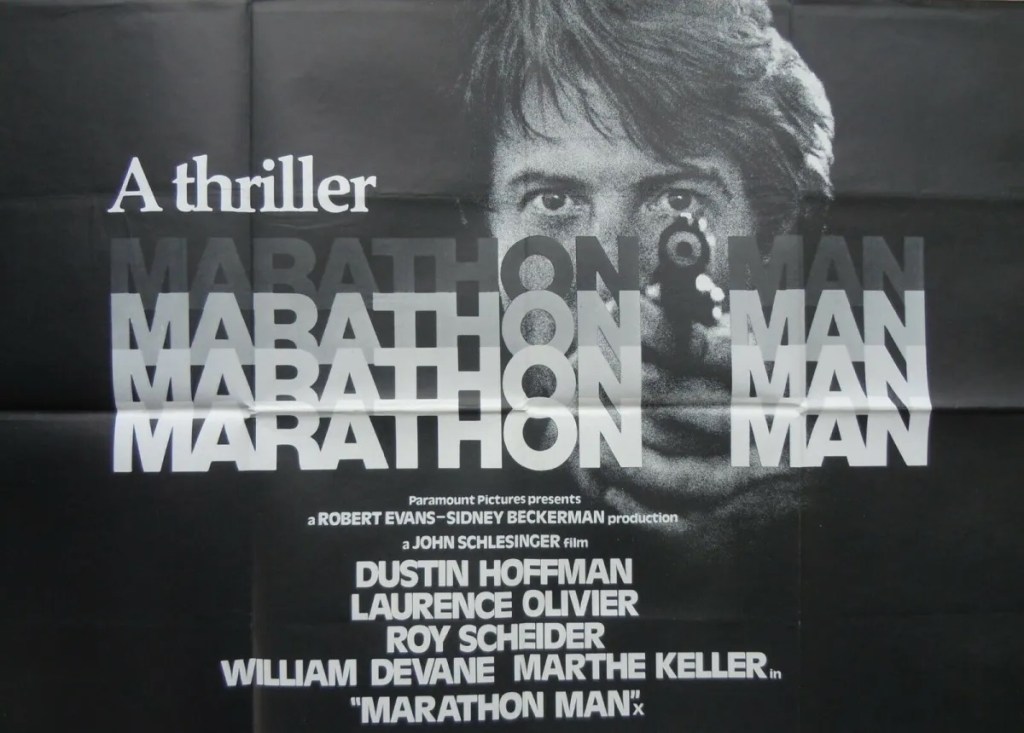
‘Marathon Man’ marks a fascinating turning point in the career of John Schlesinger. Having made kitchen-sink dramas such as ‘Billy Liar’ and ‘Darling’, which explored class, social mobility and the difficulty of escaping one’s roots, before moving on to ‘Midnight Cowboy’ and its dissection of the failed American Dream, Schlesinger here embraces the paranoid conspiracy thriller that flourished in 1970s American cinema. It sits comfortably alongside films such as ‘All the President’s Men’ and ‘Three Days of the Condor’, asking unsettling questions about trust, institutions and the hidden forces operating beneath everyday life.
At its centre is Dustin Hoffman’s Babe Levy, a Columbia University graduate student researching political conspiracies and assassinations. His own father was destroyed during the McCarthy era, giving Babe a personal connection to questions of political persecution. Before long he is drawn into a far more dangerous conspiracy involving the murder of his own brother and a notorious Nazi war criminal, Christian Szell, chillingly played by Laurence Olivier. Szell returns to New York to retrieve a cache of diamonds stolen from Holocaust victims, despite the enormous risk that survivors may recognize him.
What follows is one of the great suspense thrillers of the decade. Olivier’s Szell is a dentist who employs torture as a means of extracting information, resulting in scenes that remain genuinely painful to watch. The famous interrogation sequence is not simply shocking because of what we see but because of what we hear. Schlesinger’s use of sound – drills, metallic noises, shrill effects and an oppressive score – places the audience inside Babe’s terror, making us feel almost as though we too are being subjected to psychological torture.
The Holocaust hangs heavily over the film. Szell’s fortune has been amassed from valuables stolen from Jewish concentration camp victims, and one of the film’s most unnerving sequences comes when he walks through New York only to be recognised by survivors who loudly denounce him in the street. In another filmmaker’s hands this might have seemed contrived, yet Schlesinger makes the encounter feel horrifyingly plausible, suggesting that history can never remain buried and that evil can unexpectedly resurface in the most ordinary of places.
The narrative is full of double-crosses, betrayals and shifting allegiances. Characters repeatedly reveal themselves to be something other than they first appear, and the audience is kept in a constant state of uncertainty. We never quite know whom to trust, and that atmosphere of paranoia becomes the film’s defining quality. By the climax, the hunter has become the hunted, with Babe finally turning the tables on his tormentor in a satisfying reversal of power.
‘Marathon Man’ remains one of the finest conspiracy thrillers of the 1970s. It combines political paranoia, Holocaust memory and psychological horror into a dark, intelligent and deeply unsettling film that continually wrong-foots both its protagonist and its audience. It is a gripping reminder that the past is never truly past, and that beneath the apparent order of modern society lie histories capable of erupting with terrifying force.



Leave a Reply