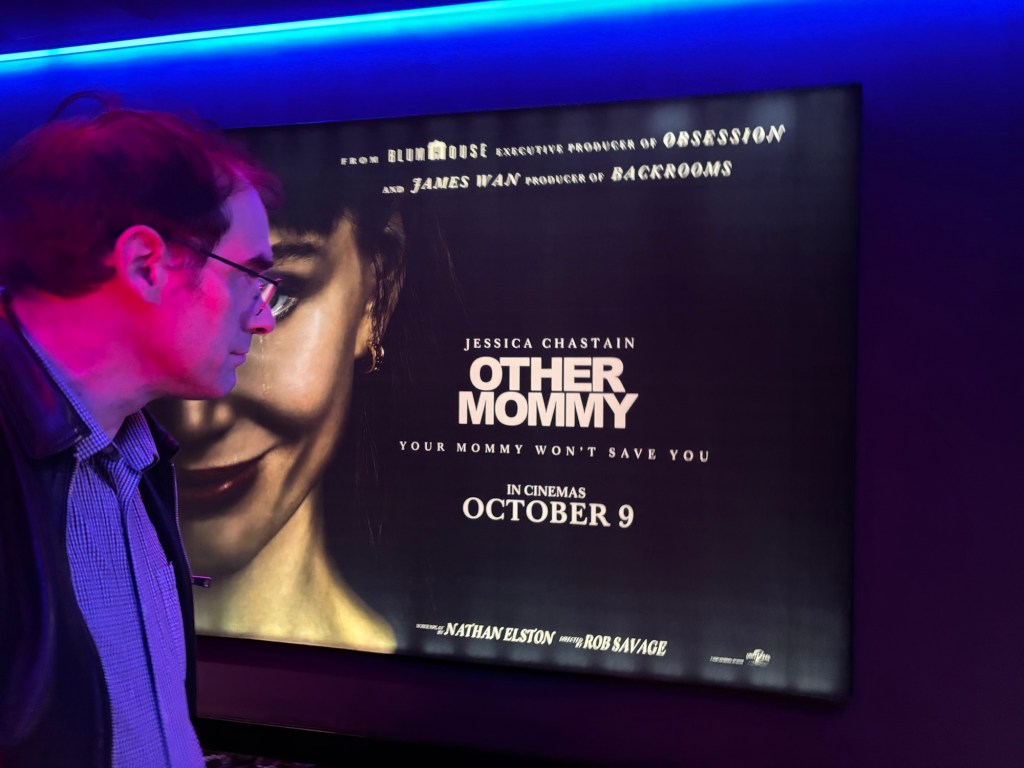
‘Other Mommy’ is a rather disappointing horror film, particularly given that it has an Oscar-winning actress in Jessica Chastain and a premise that ought to be considerably more disturbing than it ultimately proves to be.
At its centre is a young girl, Bela (Arabella Olivia Clark), who effectively finds herself with two mothers. There’s her actual mother, a hard-working woman who struggles to find the right emotional connection with her daughter, and then there’s the Other Mommy, a strange, almost robotic presence whose apparently nurturing instincts conceal something considerably more sinister.
It’s a fascinating starting point. After all, what could be more unsettling for a child than discovering that the person who looks like her mother may not actually be her mother at all? And what could be more disturbing for a parent than the possibility that somebody – or something – might understand their child better than they do?
Unfortunately, the film is much more interested in exploiting these possibilities for jump scares than in examining what they might mean. Bela begins confiding in the Other Mommy almost as though she’s a child therapist, sharing feelings and anxieties that she perhaps cannot express to her real mother.
There’s something of ‘M3GAN’ about this relationship: a seemingly supportive alternative caregiver gradually exploiting the emotional dependence of a vulnerable child. But where ‘M3GAN’ had something to say about technology, attachment and the outsourcing of parenting, ‘Other Mommy’ seems content merely to suggest these ideas before moving on to another frightening encounter.
Jessica Chastain effectively has two roles: the emotionally strained human mother and the malevolent imitation who must find exactly the right expression, tone of voice and degree of tenderness to persuade Bela that she can be trusted. Both versions, in different ways, are trying to influence the child’s emotions.
That could have made for a particularly interesting examination of maternal guilt. What happens when a mother fears she’s not giving her child what she needs? And what if something monstrous exploits precisely that insecurity? There are hints of buried trauma and family secrets that might explain why this alternative mother has appeared. Perhaps the Other Mommy is a manifestation of something the family has been unable to confront.
But the film never develops these possibilities with much conviction. Instead, we get repeated variations on the same question: which mother are we looking at? I was reminded of the ‘Smile’ films, particularly in the way an apparently familiar person can suddenly become something threatening. The trouble is that the Other Mommy’s abilities become so extensive, and her disguises so varied, that she gradually loses any distinctive identity.
A really effective horror villain needs recognisable characteristics, even if its origins remain mysterious. Here, the creature can apparently become almost anything, and seems to appear or disappear whenever the screenplay requires it. That makes it difficult to understand the rules governing the threat, let alone become emotionally invested in it.
I also wondered whether the film might have been more effective had Bela’s parents remained unaware of the Other Mommy for longer, dismissing their daughter’s experiences as fantasy or delusion. Instead, they encounter the threat relatively early, and much of the film becomes an exercise in trying to outrun it. What might have been a disturbing psychological horror about childhood vulnerability and parental inadequacy turns into a fairly generic chase movie.
Ultimately, the most frightening idea isn’t that Bela has two mothers. It’s that neither may be giving her what she actually needs. And, sadly, most of the film’s best moments are already in the trailer.


Leave a Reply