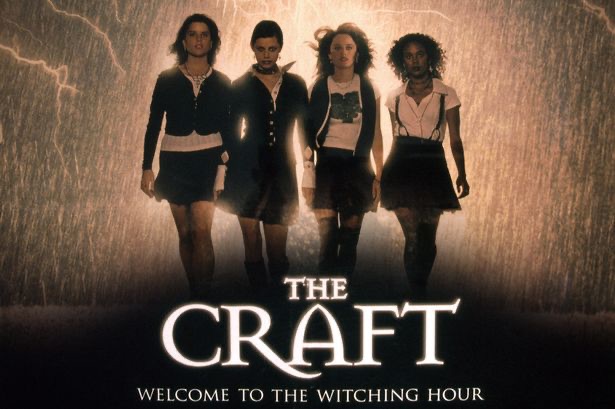
I first saw ‘The Craft’ at the cinema in November 1996, and I remember thinking it was perhaps a little on the lame side. After all, this was essentially a film about teenage girls at school dabbling in the occult while trying to find their way through adolescence.
Watching it again nearly thirty years later, however, I found it considerably more transgressive than I remembered. This is ‘Mean Girls’ with supernatural powers, except that the consequences of teenage cruelty are rather more serious. At the centre is Sarah (Robin Tunney), a shy, troubled teenager who arrives in Los Angeles for a fresh start with her father and stepmother. She’s struggling with depression, the loss of her mother and the difficulties of fitting into a new school.
There she encounters three outsiders: the formidable goth Nancy (Fairuza Balk), Rochelle (Rachel True) and Bonnie (Neve Campbell). Together they become a coven – or the “Bitches of Eastwick”, as they’re described at one point. What begins as a teenage experiment in witchcraft soon becomes something altogether more dangerous. The girls discover that their combined powers allow them to take revenge upon the people who have humiliated, bullied or abused them.
A particularly unpleasant schoolgirl begins losing her hair. Nancy’s abusive stepfather suffers a fatal heart attack. Even a disturbing stranger who appears to offer a warning meets a grisly fate. Suddenly the fantasies of powerless teenagers have real-world consequences. And that’s what makes the film more interesting than its supernatural premise might suggest.
Watching it now, particularly from the perspective of somebody who works in a school, I was struck by how little support these girls seem to have. Today we’re far more accustomed to talking about teenage mental health, safeguarding, bullying and the importance of pastoral care. Schools have systems, however imperfect, intended to identify and support vulnerable young people.
In ‘The Craft’, the girls are largely left to fend for themselves. They don’t have meaningful interventions or supportive adults guiding them through their difficulties. Instead, they create their own solution. And that solution is witchcraft.
It’s an unusually potent metaphor for adolescent anger. The girls have been made to feel powerless, so they acquire power. They’ve been victimized, so they become capable of victimizing others.
But liberation very quickly turns into domination. Nancy becomes increasingly intoxicated by her abilities. She’s the film’s most charismatic character, but also its most frightening. Sarah, meanwhile, begins to recognize that having the power to punish people doesn’t necessarily mean having the right to do so.
What develops is effectively a battle between good and evil, with Sarah becoming something like the good witch in ‘The Wizard of Oz’, confronting the increasingly malevolent Nancy. By the climax, the girls are turning their powers against one another, and the film erupts into a frenzy of supernatural special effects.
Unfortunately, I think this does it something of a disservice. The more spectacular the witchcraft becomes, the less interesting the film is. Its real strength lies not in the visual effects but in the psychological and social tensions between four damaged teenagers. What makes ‘The Craft’ endure is its understanding that teenage friendship can be both a refuge and a form of tyranny. The coven initially offers these girls belonging, solidarity and the possibility of controlling their own lives. But once power enters the equation, friendship becomes something considerably more dangerous.
It’s tempting to see ‘The Craft’ simply as a piece of 1990s girl-power entertainment. But beneath the goth fashion, school corridors and occult rituals is a darker question about what happens when young people who have been hurt finally acquire the means to hurt others. Crucially, these girls don’t turn to witchcraft because they’re evil. They turn to it because they’re powerless. The horror begins when they discover how much they enjoy having that power.



Leave a Reply