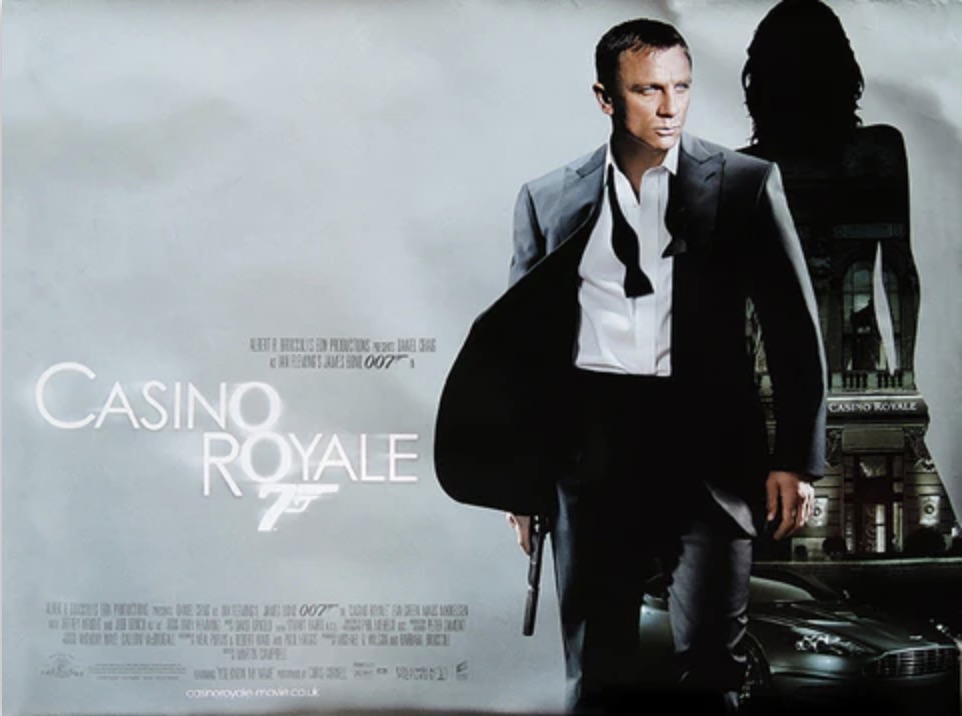
‘Casino Royale’ gives us a very different James Bond. He’s tougher, more muscular and considerably less interested in the traditional pleasures of being 007. But he’s also surprisingly anguished, emotionally vulnerable and capable of falling in love. Let’s just say that Daniel Craig’s Bond is a long way from Roger Moore.
We know that almost immediately when an early assassination takes place in a public lavatory, filmed in grainy black and white. There’s nothing remotely glamorous about it. This is killing as an ugly, physical business rather than an opportunity for a witty one-liner. Indeed, Craig’s Bond is essentially a product of the SAS school of who dares wins: a no-nonsense, Mondeo-driving bruiser who survives through sheer determination.
In one particularly outstanding sequence in Madagascar, he pursues a suspect across a building site, leaping between cranes and hurling himself through obstacles with an almost suicidal disregard for his own safety. And when a bartender asks whether he’d like his martini shaken or stirred, he responds: ‘Do I look like I give a damn?’ It’s difficult to imagine Roger Moore saying that.
There’s also something refreshingly unglamorous about the villain. Le Chiffre (Mads Mikkelsen) isn’t a megalomaniac plotting world domination from an underground fortress. He’s a rather unpleasant, bleeding-eyed financier who has lost money belonging to terrorists. And now they want it back. This makes him interesting because he’s not really in control of events either. He’s frightened, desperate and needs to win a high-stakes poker tournament to recover the money. Bond’s assignment is to make sure he doesn’t.
I must confess that I found the intricacies of the poker rather difficult to follow. Everybody around the table seemed to know exactly what was happening, and I was happy to take their word for it. But the atmosphere is wonderful: tense, sophisticated and rather classy.
What distinguishes this Bond, though, is the punishment he takes. He’s beaten senseless, thrown from great heights, poisoned and tortured. At one point his heart almost gives out, requiring a defibrillator to bring him back from the brink. And then, astonishingly, he’s back at the poker table.
There’s something almost absurd about his resilience, but unlike earlier Bonds, Craig makes us feel the physical cost of his adventures. His body isn’t simply an instrument for performing spectacular stunts. It’s something that can be broken.
His relationship with M, played by Judi Dench, is equally interesting. There’s considerable hostility between them, particularly when Bond casually breaks into her apartment, but beneath her exasperation there’s a growing admiration for his abilities. He’s reckless, insubordinate and frequently impossible to control, but she recognises his potential.
Yet the film’s real departure from the formula is emotional. Bond falls in love with Vesper Lynd (Eva Green), a woman who may not be quite what she appears. For perhaps the first time, we see a Bond whose emotional judgement is far less reliable than his physical instincts. He can survive torture, poison and almost impossible falls, but he has no real defence against betrayal.
And that’s what makes ‘Casino Royale’ such an effective reinvention. It strips away much of the gadgetry, camp humour and increasingly extravagant CGI spectacle associated with the franchise, replacing them with a more grounded world of violence, espionage and personal consequences. There are still spectacular action sequences, of course, but they feel more immediate and dangerous.
Craig is a remarkably physical Bond, yet his greatest achievement is making the character emotionally credible. This is a man who can apparently withstand almost anything the world throws at him. Except, perhaps, having his heart broken.





Leave a Reply