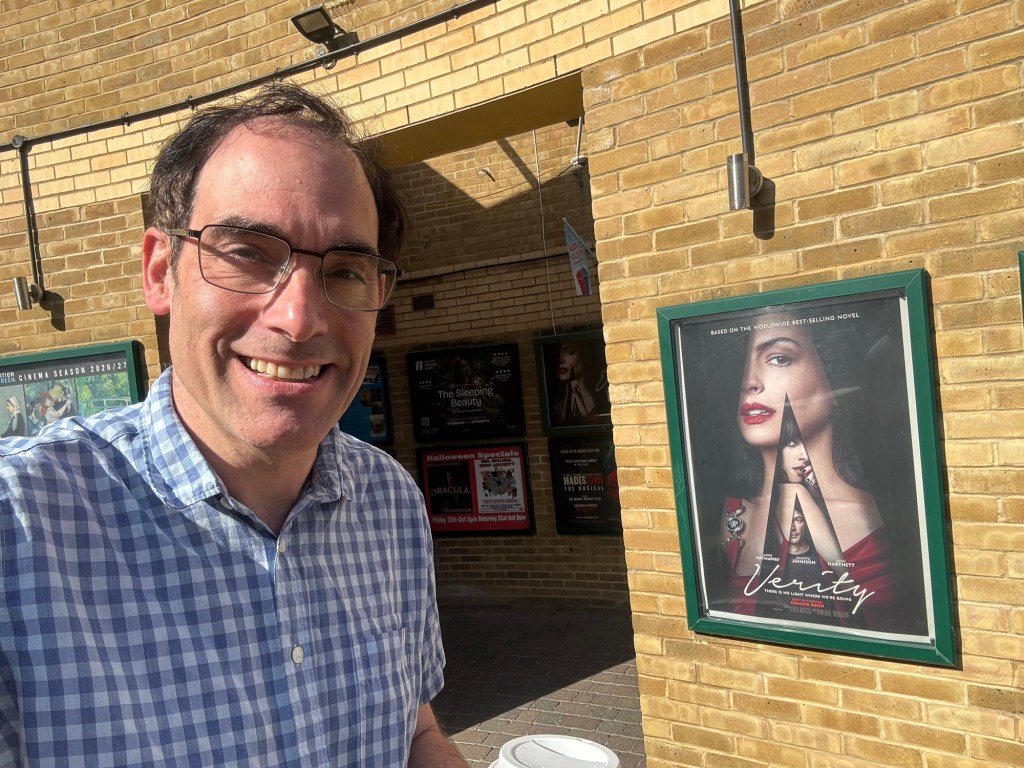
For those of us who grew up with the erotic thrillers of the 1990s – ‘Basic Instinct’, ‘Body of Evidence’ and their many imitators – ‘Verity’ looks like a must-see. It certainly has all the ingredients. Beautiful people who aren’t what they appear to be. An isolated mansion. Sex. Secrets. An unreliable narrator. Hidden documents. A mysterious husband. And the constant suspicion that virtually everybody on screen is lying. What more could you want?
Dakota Johnson plays Lowen, a struggling writer who is offered the opportunity of a lifetime. Successful novelist Verity Crawford (Anne Hathaway), has been left apparently incapacitated following a car accident and is unable to complete her bestselling series. Verity’s husband recruits Lowen to finish the books. This requires her to move into the secluded family home and immerse herself in Verity’s work. Obviously nothing could possibly go wrong.
There’s more than a touch of ‘Rebecca’ about the set-up: the younger woman entering an imposing house and finding herself increasingly haunted by the presence of another woman who, despite being supposedly absent from proceedings, dominates everything.
Except Verity isn’t actually absent. She’s upstairs. And increasingly Lowen begins to wonder exactly how incapacitated she really is. We glimpse Verity apparently moving, walking or watching when nobody else is looking. Are these things actually happening? Is Lowen imagining them? Is Verity manipulating her? Or has Lowen been brought to the house for reasons that have nothing whatsoever to do with writing novels?
The film repeatedly asks us the classic unreliable-narrator question: Who do you believe? Unfortunately, it asks it so many times that eventually my answer became: I’m not sure I care.
The plot depends upon increasingly ridiculous discoveries, such as concealed thumb drives, hidden letters and conveniently uncovered pieces of evidence, each promising to reveal what is “really” happening. Except that every revelation simply leads to another one. Lurid twist follows lurid twist, each apparently designed to make us reconsider everything we’ve just watched. Then another twist arrives and asks us to reconsider the reconsideration.
There’s nothing inherently wrong with that. The erotic thriller has always thrived on excess. ‘Basic Instinct’ wasn’t exactly a model of documentary realism. But the best examples make their preposterousness irresistible. Earlier this year, ‘The Housemaid’ demonstrated how hugely enjoyable glossy nonsense can be when the machinery underneath it is sufficiently well constructed. Its twists reward looking back at what we’ve already seen.
With ‘Verity’, I was less convinced. Dakota Johnson is nevertheless well cast as Lowen. She has that ability to appear fragile, anxious and slightly detached while leaving open the possibility that something considerably darker may be happening underneath. Lowen doesn’t trust Verity. She doesn’t entirely trust Verity’s husband. And, eventually, she doesn’t even trust herself.
Is she losing her mind? Is she being manipulated? Is there a secret reason she has been lured into this mansion? These are familiar devices, and ‘Verity’ uses virtually all of them.
Anne Hathaway, meanwhile, has the enjoyably peculiar challenge of playing somebody whose very stillness becomes threatening. Because Verity is supposedly incapacitated, the slightest suggestion that she might be moving independently becomes significant. A look suddenly matters. A movement matters. The possibility that she might have been standing somewhere becomes practically a jump scare.
The trouble is that the film keeps piling mystery upon mystery until uncertainty stops being intriguing and becomes exhausting. And there’s also a rather amusing contemporary problem with the entire premise. Lowen is supposedly required because somebody needs to continue Verity Crawford’s bestselling novels in the distinctive style readers expect.
But would a publishing company really go through all this trouble now? Surely somebody would feed ‘Verity’s’ back catalogue into an AI system and ask it to produce another 90,000 words in approximately the same style. Admittedly, that would make for a considerably shorter film.
Ultimately, ‘Verity’ wants to revive the gloriously overheated erotic thriller: everybody is attractive, everybody has secrets, sex and danger are closely connected, and nobody should be trusted until the final credits.
The problem isn’t that it’s ridiculous. The problem is that the ridiculousness needs to be constructed tightly enough that when the final revelation arrives, you want to go back and discover all the clues you missed. Here, I was more inclined to wonder whether any of it actually withstands scrutiny. As a throwback to the erotic thrillers of the 1990s, there’s certainly some fun to be had. But ‘Verity’ is less ‘Basic Instinct’ than basic plotting: glossy,
steamy, preposterous and so determined to pull the rug from underneath us that eventually one begins wondering whether there was ever a floor there in the first place.



Leave a Reply