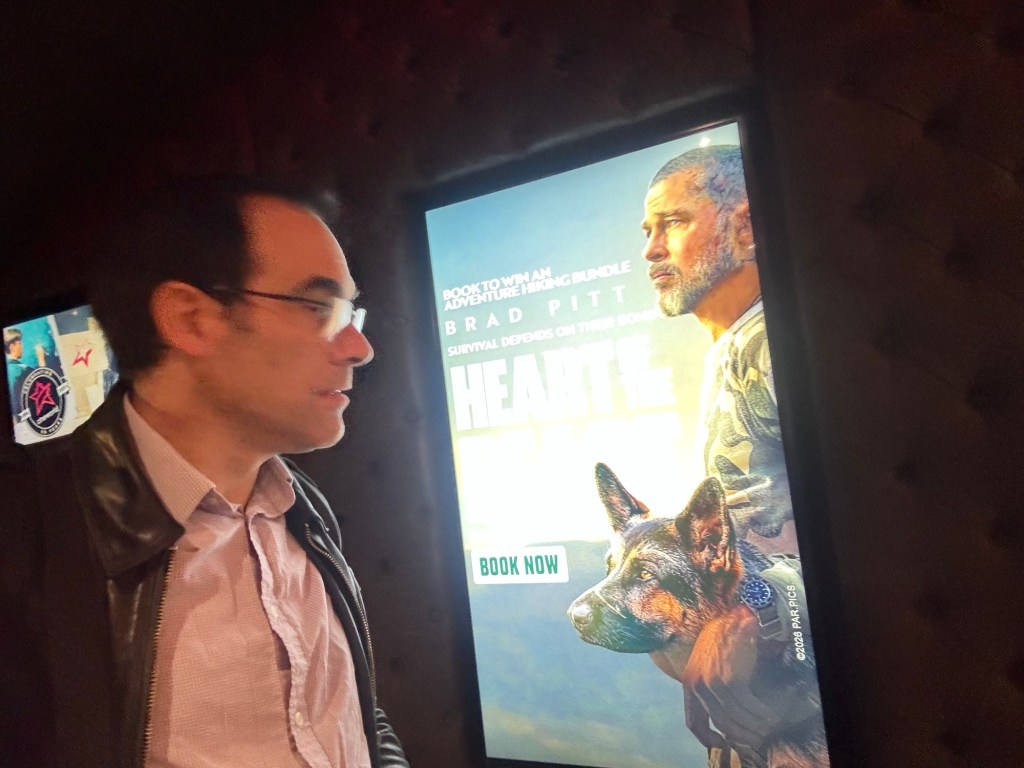
‘Heart of the Beast’ is essentially a man-and-his-dog survival movie set against the spectacular but thoroughly unforgiving wilderness of Alaska, with Brad Pitt playing James, a former US Special Forces soldier who has retreated almost completely from civilization.
But James isn’t the only veteran. His dog, Odie, served alongside him in the Middle East and lost a front leg, while James returned with wounds that are physical, psychological and spiritual. Both suffer from nightmares about their deployment, and there’s something rather affecting about the idea that trauma has strengthened the bond between them. They have survived something together that nobody else can entirely understand.
A journey into the Alaskan wilderness is apparently intended to offer some kind of healing. Inevitably, the idyll doesn’t last very long. James suffers a heart attack while flying, and soon man and dog have lost virtually everything they need to survive. From there, the film becomes a sparse wilderness adventure in which one obstacle follows another.
There are freezing conditions, a terrifying plunge into a river – which for me evoked Meryl Streep battling the rapids in ‘The River Wild’ – and encounters with both a bear and a pack of wolves. James and Odie survive situations that increasingly stretch credibility, but that’s part of the territory with this kind of film.
What distinguishes it is the relationship between them. Dogs are naturally expressive on screen, but it takes considerable craft to make those expressions appear to signify exactly what the story requires. Odie isn’t simply James’s companion or an adorable animal placed in jeopardy to manipulate the audience. He feels like another damaged survivor.
James, meanwhile, barely speaks. His silence seems to originate in what he has witnessed – and perpetrated – during his military service. Flashbacks give us glimpses of those experiences in kinetically edited, sepia-tinged sequences, but the film is more interested in the consequences of violence than in explaining everything James has done.
In one sense, he is remarkably resilient from the beginning. This isn’t a story about an inexperienced city dweller suddenly having to learn how to survive in the wilderness. James already possesses the necessary skills.
So what exactly is the journey changing? After several near-death experiences – and a number of plunges into and out of water – we could interpret James’s survival as a series of symbolic rebirths. But there’s another possibility: perhaps James is already, metaphorically at least, dead. He has withdrawn from the conventional structures of human existence. He is off the grid in almost every sense, living on borrowed time and apparently more comfortable with Odie than with other people. The wilderness isn’t simply somewhere he goes to escape civilization. It may be the only place where his damaged existence makes sense.
That gives ‘Heart of the Beast’ more thematic ambition than its fairly conventional survival narrative might initially suggest. Ultimately, though, it remains a relatively generic wilderness adventure. There are only so many ways a film can threaten people in Alaska before the familiar checklist emerges: freezing temperatures, raging water, missing supplies, bears and wolves.
But the emotional hook works. This isn’t simply a story about whether a man and his dog can survive the wilderness. It’s about two veterans who survived a war, came home damaged by it and discovered that their most dependable connection to the world was each other.
The wilderness may threaten to kill them. But in some ways, it is human civilization they have been trying to survive all along.




Leave a comment