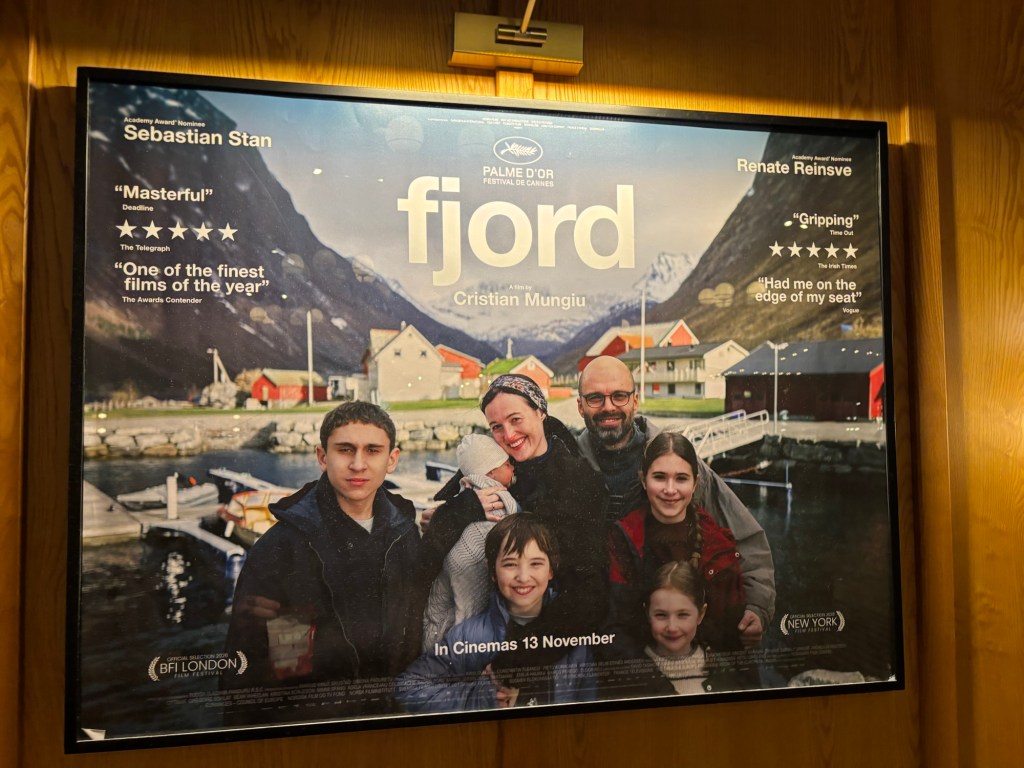
‘Fjord’ is a quietly devastating drama about a family whose lives are torn apart by a child protection investigation, but it is also something considerably more complicated: an anthropological study of what happens when one culture’s understanding of morality collides with another’s.
Set in a small Norwegian community, the film follows Mihai and Lisbet Gheorghiu, a devout Pentecostal Christian couple raising five young children, including a baby only a few months old. Mihai (Sebastian Stan), is of Romanian descent, and the family’s religious conservatism sets them apart from their largely secular neighbours. They’re not necessarily disliked. Indeed, the community initially seems remarkably tolerant.
But there’s a difference between accepting somebody’s right to be different and accepting the consequences of that difference. The trouble begins when a teacher notices unexplained bruising on one of the children and reports her concerns to the authorities. The parents freely acknowledge that they sometimes use mild physical discipline, something Mihai regards as consistent with his upbringing.
But what precisely has happened? Was there deliberate violence? A protective push away from a boiling pot? Or something more troubling that we’re not being shown? The film refuses to provide the reassuring certainty we might expect. Indeed, what follows is an increasingly alarming sequence of investigations and interventions, culminating in the children being removed from their parents and placed with foster families.
What is astonishing is the speed with which this happens, despite the apparent absence of clear evidence establishing serious abuse. And that’s where ‘Fjord’ becomes genuinely unsettling. We’re accustomed to regarding child protection authorities as institutions whose purpose is unquestionably benevolent. But does the responsibility to protect children necessarily confer the wisdom to determine what’s best for every family? And how should the state balance its duty to safeguard children against the rights of parents to raise them according to their own beliefs?
The film doesn’t suggest that religious conviction should provide immunity from scrutiny. Nor does it excuse corporal punishment. Instead, it asks whether suspicion can gradually become indistinguishable from proof, particularly when the people under investigation already seem alien to the society judging them.
I was reminded of ‘Anatomy of a Fall’, another film in which legal proceedings become a kind of intellectual detective story, complicated by cultural differences and the difficulty of expressing oneself in a language that isn’t one’s own. In both films, we’re constantly wondering whether there’s some crucial revelation still to come.
Do we really understand these people? And, perhaps more importantly, can we ever fully understand what happens within somebody else’s family? Mihai is particularly fascinating because he doesn’t respond as we might expect. When his children are taken away, he doesn’t explode with righteous indignation or deliver impassioned speeches about injustice. Instead, he retreats inward.
There’s something emotionally remote about him, even faintly unlikeable, and Sebastian Stan’s restrained performance leaves us uncertain whether his reserve conceals something sinister or is simply the response of a man overwhelmed by circumstances. The absence of histrionics makes the drama more disturbing. Even the family’s legal representation raises interesting moral questions. A neighbouring woman becomes involved in defending them, despite not necessarily sharing their beliefs.
Would we be prepared to defend the rights of somebody whose values we fundamentally disagreed with? It’s an especially pertinent question in societies that pride themselves on tolerance while sometimes finding genuine difference difficult to accommodate. The Gheorghius might attract little attention in Romania, but in Norway their beliefs and parenting practices place them under intense scrutiny.
Their personal convictions seem to be on trial almost as much as their conduct. And the film’s treatment of the conflict between religious traditionalism and secular liberalism is impressively nuanced. It recognizes that progressive values can coexist with an overbearing bureaucracy, just as sincere religious belief can coexist with practices that deserve legitimate criticism. Neither side possesses a monopoly on virtue.
The ending is particularly effective. After one legal proceeding, with another criminal trial still looming, the family leaves on a ferry. There’s no grand revelation, no definitive verdict on everything we’ve witnessed, and no comforting assurance that justice has prevailed. We simply watch them disappear from view.
It’s an image that seems to encapsulate the film’s central concern. We have spent two hours observing these people, judging their actions and questioning their motives, yet there remains an enormous amount about their lives that exists beyond our understanding. Indeed, the most unsettling question in ‘Fjord’ isn’t whether we know enough to judge this family. It’s whether we recognize how much we don’t know before deciding that we do.



Leave a Reply