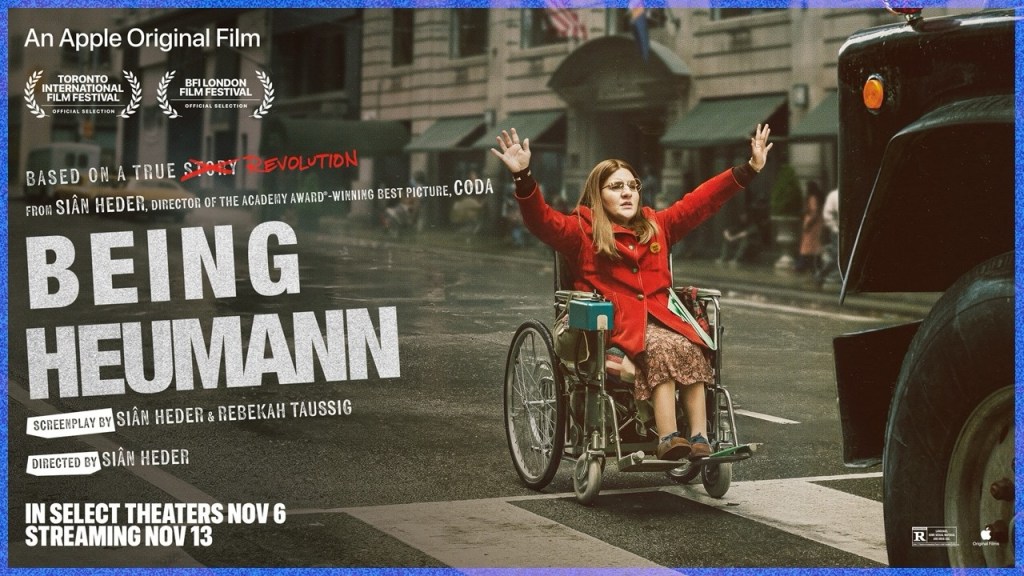
‘Being Heumann’, from the director of ‘CODA’, is another film about disability, but this time the story is rooted in real events and one of the most important civil rights struggles of 1970s America. It follows Judy Heumann (Ruth Madeley), the disability rights activist who helped lead the campaign to force the federal government to implement Section 504 of the Rehabilitation Act, legislation intended to prevent discrimination against disabled people.
The problem was that passing a law and actually enforcing it turned out to be two very different things. Making public buildings and services accessible meant providing ramps, kerb cuts, interpreters and numerous other accommodations. And all of these things cost money.
Suddenly, politicians who were perfectly happy to endorse equality as an abstract principle became considerably less enthusiastic when asked to pay for it. It’s a familiar story, of course, but ‘Being Heumann’ gives it a particularly powerful human dimension. The film concentrates on the infamous 1977 sit-in at the Department of Health, Education and Welfare offices in San Francisco, where disabled protesters occupied a federal building and refused to leave until their demands were met.
There’s something wonderfully subversive about the spectacle of people whom society has traditionally regarded as dependent or powerless bringing a government department to a standstill. It’s a classic underdog story, although the obstacles here aren’t simply bureaucratic. They’re physical, as the very buildings in which these people are expected to negotiate their rights have often been designed without considering their existence. And the protesters aren’t asking for special treatment. They’re demanding the opportunity to participate in society on equal terms.
Mark Ruffalo plays Joseph Califano, the Secretary of Health, Education and Welfare, whose reluctance to implement the regulations places him in direct conflict with the campaigners. What’s interesting is that Califano had a background in the civil rights movement and might reasonably have been expected to sympathise with their demands. But the film reveals how easily political idealism can become entangled in questions of budgets, administrative responsibility and institutional resistance.
Ruffalo doesn’t play him as an outright monster. He’s more of a hesitant, occasionally ineffectual bureaucrat, somebody who seems to understand the moral argument but struggles with its practical implications. In reality, the confrontation was considerably harsher than his rather mumbling portrayal might suggest. There’s also a pointed irony in the involvement of Jimmy Carter’s administration, which had come to power promising a renewed commitment to human rights.
The film suggests that even governments with ostensibly progressive ambitions can find themselves resisting change when it becomes financially or politically inconvenient. But what makes ‘Being Heumann’ most affecting is the determination of the protesters themselves. These are people who could have accepted another compromise, another delay or another promise that something would eventually be done.
Instead, they stayed. Days became weeks. And gradually, the occupation developed into a community, with people supporting one another, sharing responsibilities and finding ways to make themselves heard. Some of the protesters are deaf, and the film is particularly effective in showing how communication itself becomes part of the struggle. There’s an admirable continuity here with ‘CODA’ in that, once again, the director has made a conscious effort to cast disabled performers in disabled roles, allowing people whose experiences have so often been represented by others to tell their own stories.
That authenticity gives the film considerable emotional force. My reservation is that the narrative eventually begins to lose momentum. Once the sit-in has been established, we understand the protesters’ demands, the government’s resistance and the moral stakes. But the film continues through successive stages of campaigning, negotiations and journeys to other government buildings, increasingly repeating points it has already made.
There’s a certain inevitability about this, because the real struggle was prolonged and exhausting. Yet dramatically, endurance is difficult to portray without becoming repetitive, and the film occasionally succumbs to a familiar Hollywood tendency to turn political history into an uplifting story about inspirational individuals overcoming adversity. That isn’t entirely inappropriate, but it risks simplifying the institutional and ideological resistance that made their achievements so remarkable.
I also appreciated the decision to concentrate on this particular episode rather than attempting to encompass Heumann’s entire life. Her subsequent work in the Clinton and Obama administrations reminds us that the San Francisco protest was only one chapter in a much longer struggle.
Ultimately, ‘Being Heumann’ is a moving tribute to collective action and the huge persistence required to turn legal promises into lived reality. Indeed, its most powerful lesson is that equality isn’t achieved simply when a government declares that everybody has the same rights. Rather, it’s achieved when people can finally get through the door to exercise them.





Leave a Reply