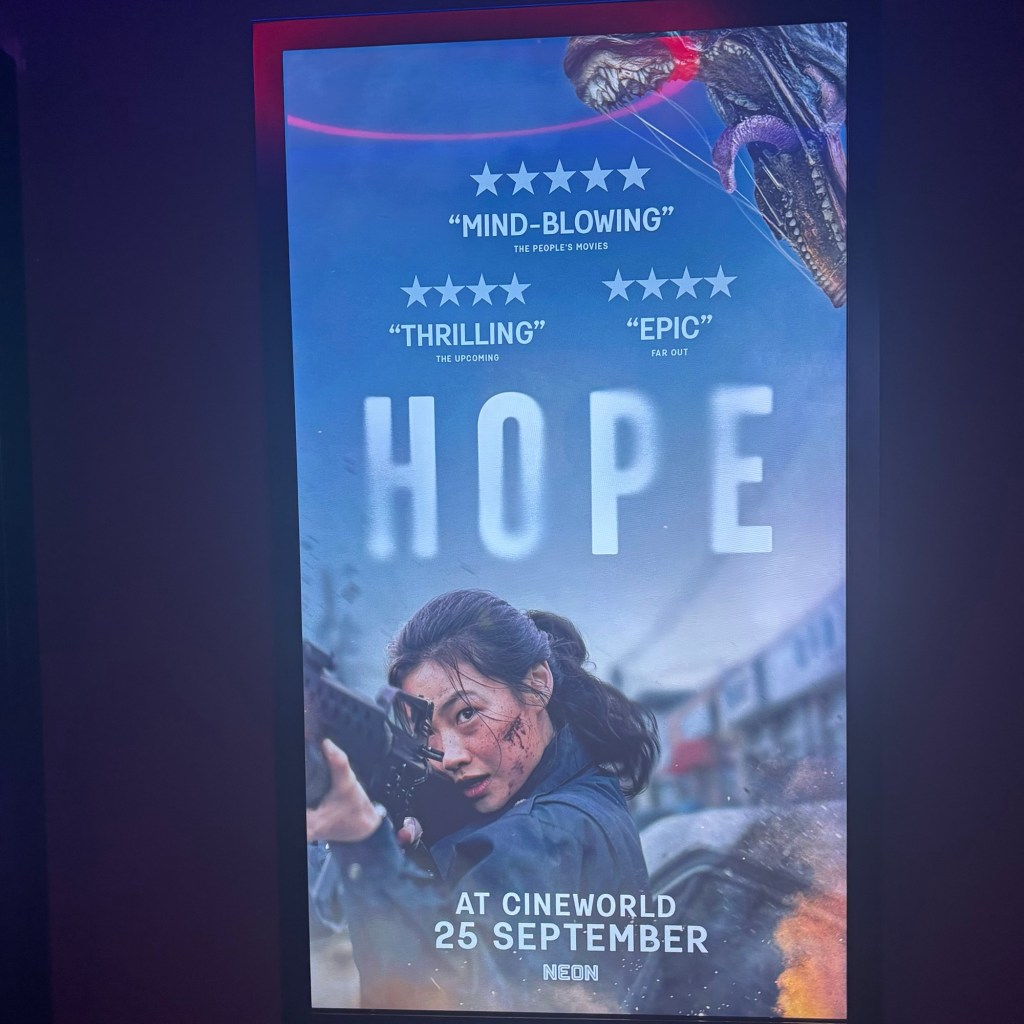
‘Hope’ is a genuinely odd South Korean movie that seems determined to resist categorization. It’s a monster movie, an alien conspiracy thriller, a police procedural, a piece of folklore and, occasionally, something resembling ‘Bullitt’ with monsters.
It begins with a local police chief investigating an animal mauling, only for the situation to escalate dramatically with the discovery of mutilated bodies, wrecked streets and damaged buildings. Something is out there, and nobody seems entirely sure what it is.
There were moments when I was reminded of ‘Tremors’. We have the equivalent of local country bumpkins, complete with decidedly parochial attitudes, suddenly confronted by something completely beyond their experience. Yet these aren’t entirely helpless people. Living close to the North Korean border means there are weapons and resources available, although presumably nobody stockpiled them in anticipation of an alien invasion.
Much of the action takes place in the forest, which gives the film a somewhat mythological and folkloric quality. The landscape itself begins to feel mysterious, as though whatever is happening might belong as much to ancient stories as to science fiction.
Then everybody starts shooting. And shooting. And shooting some more. At times, ‘Hope’ becomes an extended chase movie, where everyone is pursuing, or being pursued by, something they barely understand. The creature itself also has something of ‘The Terminator’ about it. Shoot it, run it over, apparently destroy it and somehow it keeps coming back.
Eventually this becomes rather indulgent. The film is simply too long, and there are only so many variations on humans attacking a monster before you begin wondering whether what’s around the next corner is really worth the wait.
The CGI doesn’t always help either and occasionally looks decidedly ropey. But there’s an undeniable energy to the whole thing. ‘Hope’ may be tonally all over the place, but that’s also what makes it so kinetic and exhilarating.
The violence operates on two completely different levels. Sometimes it’s disturbingly realistic, with decapitations, mutilated bodies and blood spraying everywhere. Then somebody will be hurled halfway across a forest, smash into a tree and somehow get back up again. Realistic violence and cartoon violence exist side by side.
There are traces of ‘A Quiet Place’, too, particularly in the idea of ordinary people trying to understand the rules governing a threat that doesn’t operate according to anything familiar.
But ‘Hope’ becomes more interesting when it begins questioning whether the creature is simply a monster at all. We gradually get the sense that it has feelings. It suffers. And that raises the possibility that much of the escalating destruction has been caused by human beings responding violently to something they haven’t even attempted to understand.
Perhaps the real problem isn’t that this alien presence is incomprehensible. It’s that humanity’s first response to the incomprehensible is to shoot it.
That makes the title particularly intriguing. In most end-of-the-world movies, ‘hope’ comes from human ingenuity: eventually we understand the threat, devise a plan and save ourselves. Here, whatever has arrived seems so far beyond our comprehension that human ingenuity may not be enough.
And then there’s that peculiar ending, which appears to leave us with the possibility of a second part rather than anything approaching conventional resolution. But perhaps the film’s darkest idea is that the monster might not actually be the thing we should be most frightened of. Maybe it’s us.



Leave a comment