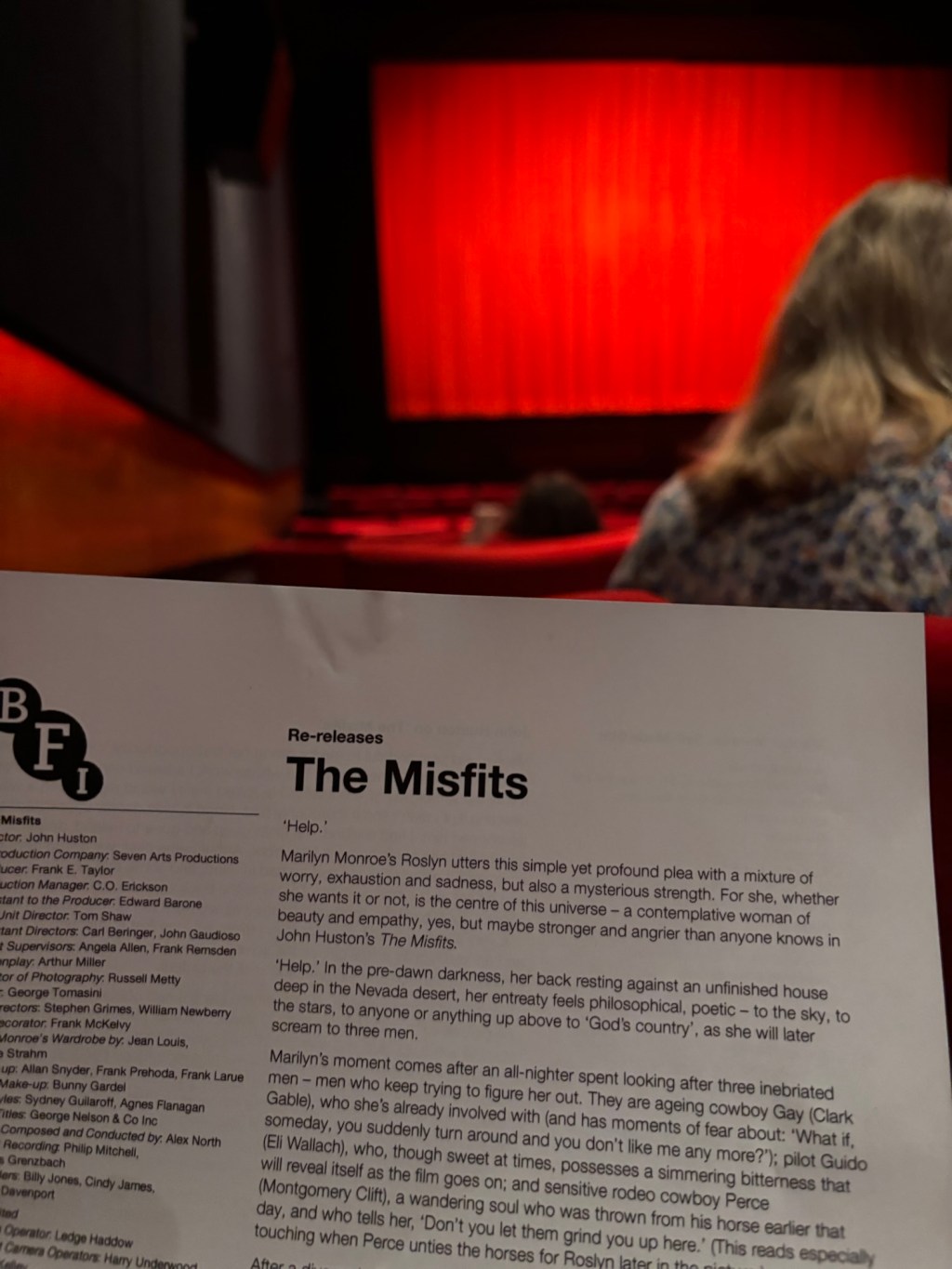
‘The Misfits’ could almost be categorized as an anti-Western, a film less interested in heroic frontiers than in characters who have seen better days and no longer quite belong to the world around them. In that sense, it reminded me of ‘The Last Showgirl’, with Pamela Anderson playing a performer whose glamour has faded and who is forced to confront the possibility that the life she understood has already passed her by. Here, Marilyn Monroe faces a similar kind of existential desolation against the twilight of the American West.
This is not the frontier as a place of possibility, but the last frontier: depleted, melancholy and running on nostalgia. The cowboys at the centre of the film seem to be eking out an existence rather than building one, clinging to a way of life that has already become obsolete. They were born into a world in which men were expected to be cowboys and providers, but society has moved on without them. They are living on the periphery, with more of the past behind them than any meaningful future ahead.
That gives the film an unusually introspective quality. Clark Gable plays a man who appears rugged and self-sufficient but is really struggling to understand what purpose he has left. Monroe’s character is similarly displaced. Like Pamela Anderson’s former showgirl, she is searching for something emotionally substantial and convinces herself that she may have found it in Gable. Yet the film never allows us to feel entirely confident that either of them can provide the other with the stability they need.
For me, Thelma Ritter is particularly important in the first half. She so often brought comic relief and sharp intelligence to films such as ‘Pillow Talk’, and here she provides a lovely counterpoint to the men and to their attempts to work out what remains of their destiny. She brings warmth, humour and a sense of grounded reality to a film that might otherwise have become oppressively mournful. Once she disappears from the story, I think the film loses some of its balance and begins to drag.
The central mustanging sequence is where the film’s moral and emotional concerns come into focus. Wild horses are roped together and dragged into captivity, and the cruelty of the ritual becomes impossible to ignore. These animals are misfits too: creatures who belong to an older, freer world and are being crushed by a harsher commercial reality. Monroe’s attempt to set them free is therefore not merely an act of kindness but a rebellion against the brutal values of the men around her. Her empathy becomes the film’s strongest moral force.
There is a suggestion at the end that Monroe has changed or even tamed Gable, because he finally agrees to release the horses. But whether the two of them genuinely have a future together is left open. The film offers the possibility of tenderness without fully convincing us that tenderness will be enough. These are people who want to begin again but may be too damaged, too lost or too rooted in the past to know how.
The context of the film makes it even more poignant. It was written by Arthur Miller while his marriage to Monroe was breaking down, and it became the final completed film for both Monroe and Gable. Reports of Monroe’s erratic behaviour during production inevitably colour the way we watch her, but what matters most is the emotional power of the performance itself. Her compassion is extraordinary. She has an almost childlike spirit, someone instinctively drawn towards freedom and incapable of accepting cruelty as normal.
At the same time, that innocence is inseparable from disillusionment. Monroe’s character is not simply fragile; she sees the world with a clarity the others have lost. She understands that the horses are being destroyed for no meaningful reason, just as the men are destroying themselves by clinging to identities that no longer sustain them.
The film is undeniably uneven, and its pacing can feel all over the place, but its melancholy has real force. These characters form a strange, temporary community of people who are misfits both individually and collectively. They are almost like the last family left at the end of the world, drawn together because there is nowhere else for them to go.
In that sense, ‘The Misfits’ becomes something close to an apocalyptic drama. The world they knew is ending, and they sense that they do not have very long left within it. They are yearning for something – love, freedom, purpose, redemption – without being able to name it. That uncertainty is what gives the film its haunting power. It is less a Western about survival than an elegy for people who have survived too long.




Leave a comment