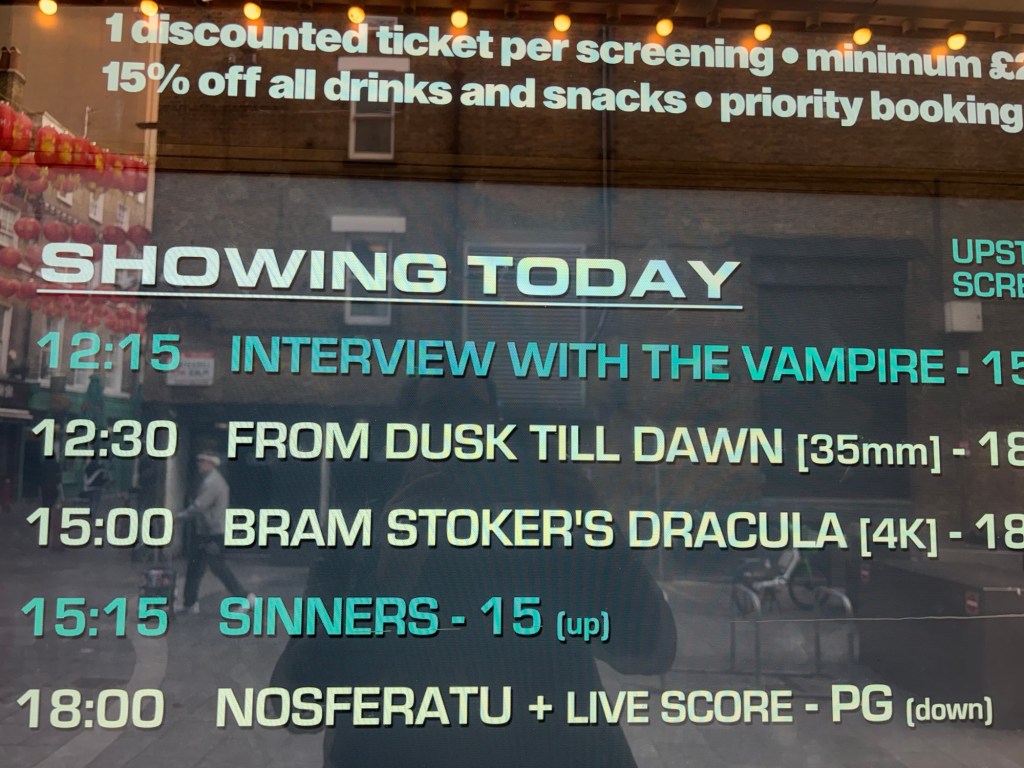
I’m going to go against the critical consensus here and suggest that Neil Jordan’s ‘Interview with the Vampire’ is a rather disappointing film. It certainly looks magnificent. There’s an extravagantly Gothic atmosphere, with lavish costumes, candlelit interiors and a pervasive sense of death and decay.
Indeed, when I saw it at the cinema, somebody sitting in front of me appeared to have arrived in full eighteenth-century Gothic regalia, complete with wig and cane. Unfortunately, his elaborate appearance meant that I couldn’t see the entire screen. Perhaps he was simply taking the film more seriously than I was.
The story itself is gloriously preposterous. Christian Slater plays a journalist interviewing Louis (Brad Pitt), who reveals that he’s a vampire more than two centuries old. Having lost his wife and child, Louis was offered immortality by the predatory Lestat (Tom Cruise). What follows is essentially the story of two men bound together by a relationship that’’s part companionship, part dependency and part mutual destruction.
There are shades of ‘Fight Club’, made five years later, in the strange symbiosis between the two central characters. Louis is tormented by his existence. He doesn’t want to kill human beings and attempts to resist the appetite that defines him. Lestat, by contrast, has no such reservations. He’s a creature of appetite, vanity and self-indulgence, apparently delighted by the opportunities that immortality affords him.
In theory, this contrast ought to be fascinating. Louis represents the burden of conscience, while Lestat embodies the liberation of having none. And the film raises some genuinely interesting questions about what it would mean to live forever. Would immortality be a gift, or an unbearable sentence? What happens when everybody you love eventually dies, while you’re condemned to continue existing?
The trouble is that Louis’s profound spiritual anguish, so central to Anne Rice’s novel, doesn’t translate particularly effectively to the screen, even though Rice adapted her own screenplay. Brad Pitt spends much of the film looking exquisitely miserable, while Cruise seems to be enjoying himself enormously. Pitt, who demonstrated in ‘Kalifornia’ and later ‘Fight Club’ that he could portray deeply disturbing characters, is cast as the comparatively innocent, morally troubled figure. It’s an interesting reversal, but I’m not convinced it entirely works.
Then there’s Claudia, played by the twelve-year-old Kirsten Dunst, a child transformed into a vampire who becomes part daughter, part companion and something altogether more unsettling within this strange household. Dunst is remarkably accomplished, but the character’s combination of childhood appearance, adult consciousness and increasingly insatiable appetites makes for deeply uncomfortable viewing. Perhaps that’s intentional, although the film doesn’t always seem to know quite what to do with the implications.
We are expected to identify so completely with the vampires, yet their victims are largely disposable figures, appearing briefly before being drained of blood and forgotten. The film invites us to contemplate the emotional suffering of immortal predators while showing relatively little interest in the human beings whose lives they destroy. That might have been an intriguing moral contradiction to explore, but the screenplay becomes increasingly repetitive. Louis suffers. Lestat indulges himself. They argue. Somebody dies. And the cycle continues.
For all its visual splendour, the film never quite develops the philosophical depth it seems to be reaching for. There’s a huge Gothic tragedy waiting to emerge from this material, but too often the costumes, performances and atmosphere overwhelm the ideas. Ultimately, ‘Interview with the Vampire’ is a film about the unbearable burden of living forever. My problem was that, long before it ended, I was beginning to feel the passage of time myself.



Leave a Reply