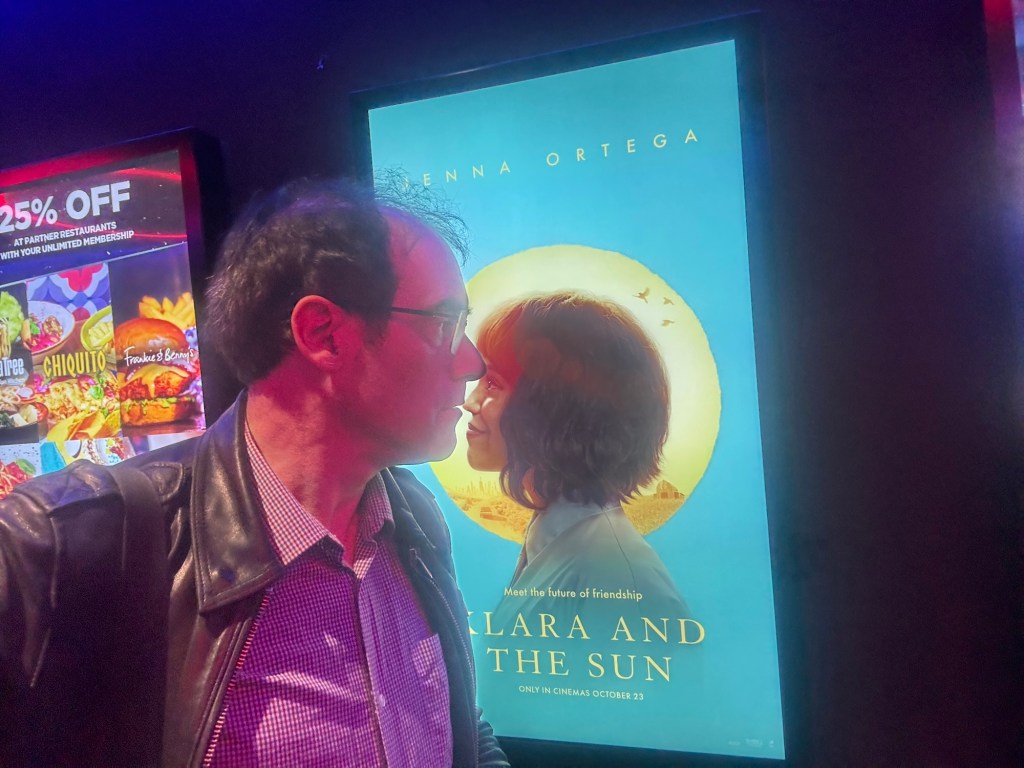
Based on Kazuo Ishiguro’s novel, ‘Klara and the Sun’ is a strangely whimsical, often elliptical science-fiction drama about what it means to be human, and whether the qualities that define humanity can ever be replicated by a machine.
It’s also, unfortunately, a rather frustrating film. At its centre is Klara (Jenna Ortega), a remarkably lifelike android purchased to provide companionship for a lonely teenage girl. She’s what this imagined future calls an Artificial Friend, designed to observe, understand and respond to human emotional needs.
Klara is curious, attentive and almost childlike in her understanding of the world. She also believes that the sun, which provides the energy she needs to function, is something approaching a deity. She prays to it, seeking its intervention in human affairs. It’s a rather touching idea: a machine developing something resembling religious faith because it cannot fully comprehend the world around it. But the film never quite knows what to do with such possibilities.
I was reminded of ‘Bicentennial Man’, the 1999 Robin Williams film about a robot who becomes part of a human family and gradually begins to explore the boundaries between artificial intelligence and genuine humanity. Both films ask whether a machine can love, experience grief or develop an identity beyond the purpose for which it was created. But where ‘Bicentennial Man’ embraced its sentimentality, ‘Klara and the Sun’ seems almost embarrassed by the prospect of becoming genuinely moving.
There’s a deeply tragic story beneath the surface, involving a family struggling with illness, loneliness and the possibility of loss. Yet the film approaches these subjects so obliquely that the emotional consequences rarely register. Amy Adams plays the girl’s mother, a busy, emotionally distant figure whose decisions raise uncomfortable questions about the relationship between parental love and parental control. Adams is normally really good at conveying empathy, but here she seems strangely anaemic, as though the film has deliberately drained the emotional life from her performance.
Characters cry, including the artificial ones, but I wasn’t convinced the film had done enough to make us share their feelings. And that’s a particular problem for a story supposedly concerned with the mystery of human emotion. Perhaps the most revealing comparison isn’t with another science-fiction film at all, but with Ishiguro’s ‘The Remains of the Day’. There, the butler Stevens devotes his life to serving a master whose moral worth he scarcely questions. His sense of duty becomes so absolute that he sacrifices his own emotional existence.
Klara’s devotion has something similar about it. She exists to serve, comfort and protect somebody else, apparently without questioning whether that person – or the family employing her – deserves such loyalty. Is that love? Or is it simply obedience so perfectly programmed that it becomes indistinguishable from love?
Ishiguro explored related questions in ‘Never Let Me Go’, another story about artificial or manufactured human existence, where the tragedy lies in the characters’ acceptance of a system that exploits them. What makes those works so affecting is their understanding that memory, repression, trauma and unspoken desire are fundamental to human experience.
‘The Remains of the Day’ is devastating precisely because Stevens cannot adequately express what he feels. In ‘Klara and the Sun’, however, emotional restraint too often becomes emotional emptiness. The film meanders through its ideas without really developing them, and its whimsical atmosphere increasingly feels like a substitute for dramatic substance.
There’s something intriguing about a robot who develops religious faith, and something potentially heartbreaking about a family seeking artificial solutions to profoundly human problems. But the film seems more interested in contemplating these mysteries than in confronting their implications.
The great irony of ‘Klara and the Sun’ is that it asks whether a machine can learn to feel like a human being, while leaving the human audience struggling to feel very much at all.




Leave a Reply