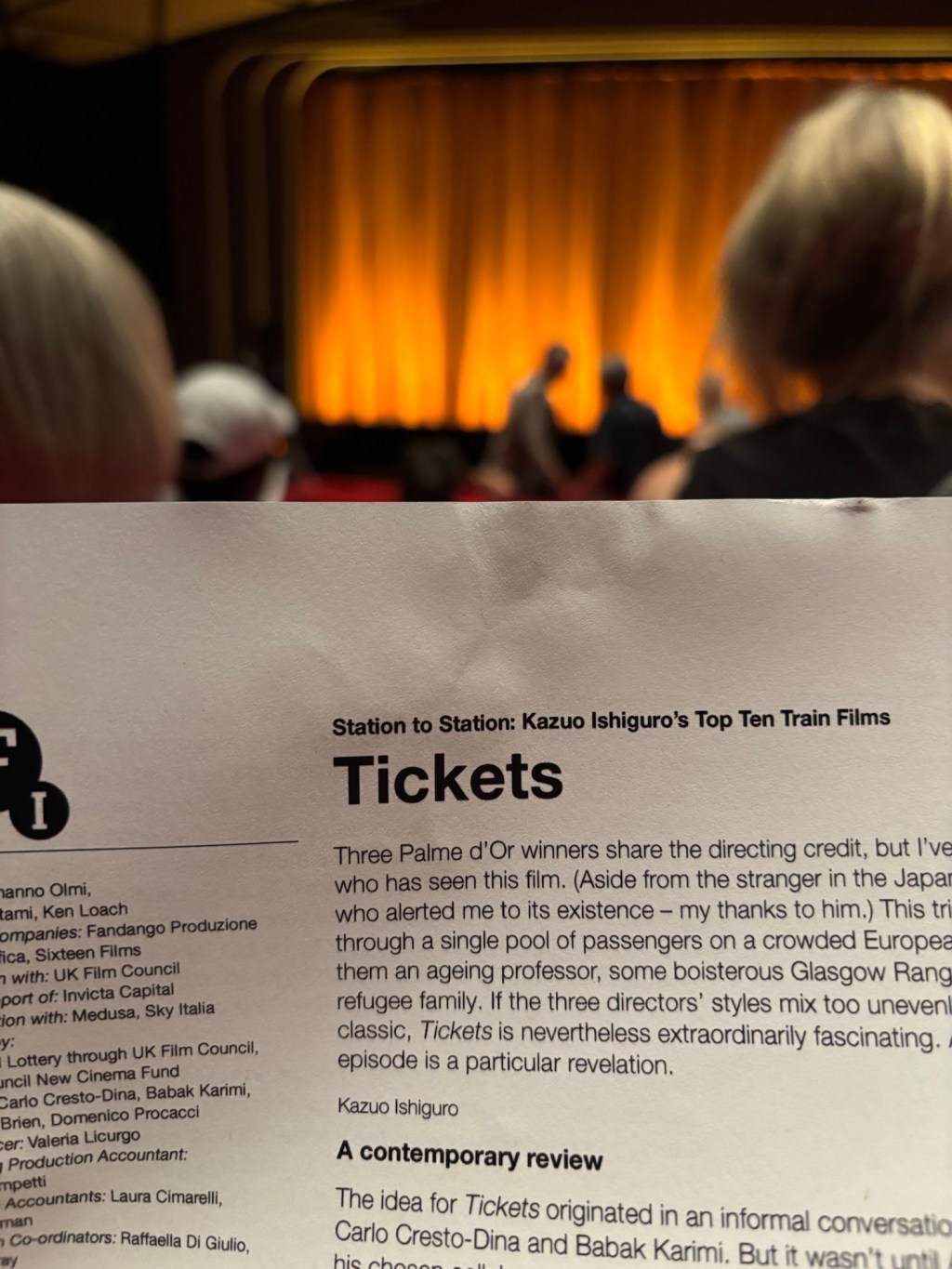
‘Tickets’ is a portmanteau film made by three directors working broadly within the realist tradition: Iran’s Abbas Kiarostami, Italy’s Ermanno Olmi and Britain’s Ken Loach. Although each section has its own visual texture and dramatic rhythm, the stories are connected by a common setting and theme. They all take place aboard the same train, travelling from Austria to Rome on the same day, and each explores questions of migration, privilege, displacement and moral responsibility.
The cinematography differs noticeably between the three episodes, particularly between the first and the later sections, which helps to give each director a distinctive voice. Yet the train itself becomes a unifying space: a temporary society in motion, filled with people from different backgrounds who are forced into proximity with one another. In that sense, the journey becomes a metaphor for Europe itself, with class, nationality and status compressed into the same carriages.
The first story, directed by Ermanno Olmi, follows an elderly Italian professor of medicine. He sits with his laptop in front of him and drifts into romantic fantasies about a public-relations woman who has clearly captivated him. He is also preoccupied by the fact that he may miss his grandson’s birthday, but his attention gradually turns to an Albanian refugee family travelling nearby. They are visibly struggling, while uniformed military personnel in the carriage offer them neither comfort nor practical support.
The professor’s response is quiet but deeply humane. His simple gesture involving a glass of milk becomes an act of recognition, acknowledging the family’s dignity in a situation where almost everyone else appears determined not to notice them. Olmi is less interested in grand statements than in the possibility that kindness may begin with something very small. The professor is not transformed into a hero, but for a moment he steps outside his own concerns and sees the vulnerability of others.
The second section, directed by Kiarostami, centres on an older woman who was once married to a general and is accustomed to being treated with deference. She is accompanied by a young man carrying out community service, whose role is essentially to assist her during the journey. However, she constantly criticizes and humiliates him, taking his patience for granted until he finally abandons her and leaves her to cope alone.
This episode is more abrasive and darkly comic, but it also develops the film’s wider argument about status. The woman begins the journey from a position of entitlement, convinced that her social standing should protect her from inconvenience. Once the young man walks away, however, she finds herself isolated, confused and unable to navigate a world that suddenly feels hostile and unfamiliar. Her situation begins to resemble that of the refugee family in the earlier story: displaced, unsupported and dependent upon the uncertain kindness of strangers.
The suggestion is that the distance between privilege and helplessness may be far smaller than we imagine. Someone who possesses status in one environment can become almost powerless in another. The film is not claiming that the woman’s discomfort is equivalent to the desperation of a refugee, but it does expose how fragile social identity can be. Rank, wealth and entitlement may disappear the moment the structures sustaining them are removed.
Ken Loach’s final section is the most immediately accessible and politically direct. It follows a group of young Glaswegian football supporters travelling to a match. Their noisy enthusiasm initially seems far removed from the quieter moral dilemmas of the earlier stories, but they soon become involved with another refugee family after a train ticket ends up in the wrong hands.
The young men must decide whether to help, knowing that doing so may come at a serious personal cost. The police are being called, and their intervention could prevent them from leaving the train and reaching the match they have travelled to see. What begins as a relatively minor problem becomes a test of solidarity. Are they prepared to sacrifice their own pleasure and freedom for strangers whose situation is far more precarious than their own?
Loach avoids portraying them as saints. Their response develops through hesitation, confusion and argument, which makes the eventual moral choice more convincing. Compassion is shown not as an abstract belief but as something that demands inconvenience and risk. It is easy to claim sympathy for refugees; it is far harder when helping them requires us to give up something we genuinely value.
Made in 2005, ‘Tickets’ predates Brexit by more than a decade, yet its concerns feel painfully current. The political language around borders, refugees and immigration may have intensified, but the fundamental questions remain unchanged. Who is permitted to move freely? Whose documents are accepted? Who is treated as a traveller, and who is treated as a threat?
The train journey allows the filmmakers to explore these questions without turning the film into a lecture. Each passenger is temporarily between places, but some travel by choice while others travel because they have no real alternative. That distinction becomes the moral centre of the film.
‘Tickets’ is uneven, as portmanteau films often are, and the three episodes do not always sit together seamlessly. Yet their differences are also part of the film’s strength. Olmi offers quiet compassion, Kiarostami exposes the instability of privilege, and Loach asks what solidarity actually costs. Together, they create a thoughtful and humane film about people sharing the same journey while inhabiting radically different worlds. Sadly, despite being made more than twenty years ago, it could just as easily have been made yesterday.





Leave a comment