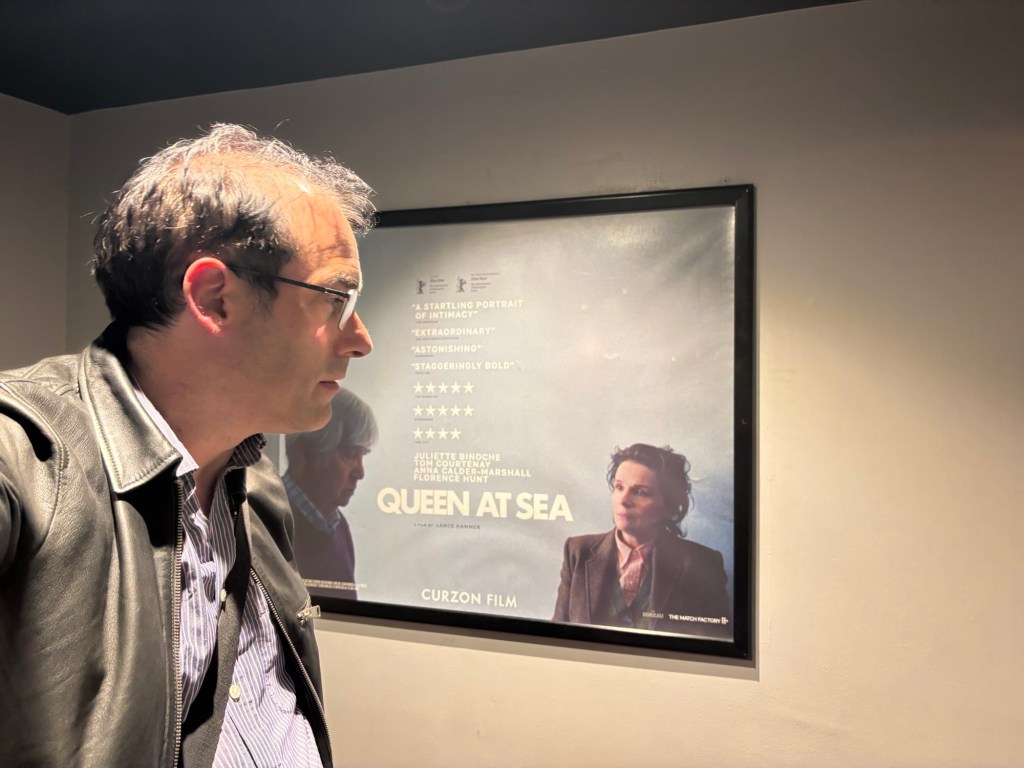
‘Queen at Sea’ is, at times, a gruesome watch. Not gruesome in the conventional sense, but because it forces us to confront questions about ageing, dementia, sex and consent that are incredibly difficult to resolve.
At the centre are Leslie and Martin, played by Anna Calder-Marshall and Tom Courtenay, who have been together for nearly 20 years. Leslie now has advanced dementia, and Martin is himself an ageing man trying to care for the woman he loves while the person she once was gradually becomes harder to reach. Then Leslie’s daughter, Amanda (Juliette Binoche), walks in on them having sex.
Immediately, the film presents us with an almost impossible question. Can Leslie consent? And if she cannot fully understand what is happening because of her dementia, what does that mean when she herself appears to initiate sexual contact with the man who has been her partner for nearly two decades? Amanda believes a line has been crossed and calls the police, and Martin is arrested.
But almost immediately, Amanda seems to realise that she has unleashed something she can no longer control. She wanted somebody to intervene, perhaps imagining that the involvement of the authorities would frighten Martin into stopping. Instead, their private family dilemma has become a legal and safeguarding matter. The bedroom effectively becomes a crime scene.
And this is where ‘Queen at Sea’ becomes so uncomfortable, because the film refuses to turn Martin into a straightforward villain. He loves Leslie. They have shared a life together. And yet love does not automatically answer the question of consent. Amanda therefore finds herself caught between two apparently incompatible instincts: protecting her mother from potential abuse while recognizing that separating Leslie and Martin may itself cause considerable distress.
What does protecting somebody actually mean when they can no longer clearly articulate what they want? There are no comfortable answers. Juliette Binoche is an interesting choice for Amanda because she is certainly no stranger to films about sexuality that push against social boundaries. There was ‘Damage’, while ‘Who You Think I Am’ explored an older woman’s sexual identity through online deception, and Claire Denis’s ‘High Life’ took questions of sex, reproduction and bodily autonomy into considerably darker territory.
Here, however, Binoche is largely the observer of somebody else’s transgression – if transgression is even the right word. Amanda wants certainty. But, the film won’t give it to her. And neither will her mother. That’s partly because dementia has robbed Leslie of the ability to explain herself in the terms everybody around her desperately needs. Other people therefore begin making decisions about her body, her home, her relationship and ultimately her life.
Martin believes he knows what she wants because he has loved her for years. Amanda believes she knows what is best because she is her daughter. Doctors, police officers, social workers and carers have their own responsibilities and definitions of safeguarding. But where is Leslie within all of this?
That’s the tragedy at the centre of the film. When Leslie eventually moves into residential care, the fundamental problem isn’t really resolved. Removing her from the situation may answer one safeguarding question, but it creates others. The relationship between Leslie and Martin hasn’t simply ceased to exist because an institution now has responsibility for her care.
And ‘Queen at Sea’ gradually reveals itself to be about something larger than dementia. It’s about generations. Amanda’s teenage daughter is beginning her own sexual life at precisely the moment her grandmother’s autonomy is disappearing. At one end of life, sexuality is being discovered; at the other, society is having to decide whether sexual autonomy can still exist at all.
There is also a deeper question running through the film about memory. How long are we entitled to treat somebody as the person they used to be? Martin remembers Leslie before dementia. He remembers the woman he fell in love with, their shared history, their intimacy and presumably thousands of conversations that nobody else witnessed. That history matters.
But can remembering who Leslie was prevent Martin from recognizing who Leslie is now? It’s a devastating question because most of us would probably want the people who love us to remember the person we once were rather than define us entirely by illness. But ‘Queen at Sea’ suggests that love can become dangerous if memory prevents us from recognizing present reality.
That ambiguity extends to Amanda. For, calling the police can be seen as an act of protection. But once the machinery of safeguarding begins operating, she discovers that good intentions don’t necessarily produce good outcomes. Nobody here appears to possess the complete answer, and it is this that prevents ‘Queen at Sea’ from becoming simply an ‘issues’ film.
Tom Courtenay is particularly important because Martin has to occupy an impossibly difficult position. If we simply regard him as a predator, the film collapses into something much simpler. But if we unquestioningly accept that decades of love give him the right to decide what Leslie wants, then the question of consent disappears. Courtenay keeps us somewhere painfully between those positions.
And Anna Calder-Marshall has perhaps the most difficult role of all because Leslie cannot simply explain the film to us. We have to watch her behaviour, her expressions and her physical relationship with Martin while knowing that interpreting those things from the outside is precisely the problem the film is examining. The director doesn’t allow us the comfort of certainty, and perhaps that is why the film’s final movement is so devastating.
It’s clear long before the ending that ‘Queen at Sea’ isn’t heading towards some reassuring resolution in which everybody learns to understand one another and finds a workable compromise. The ending is shocking precisely because the film has spent so long making us understand how desperately everybody is trying to do the right thing.





Leave a comment