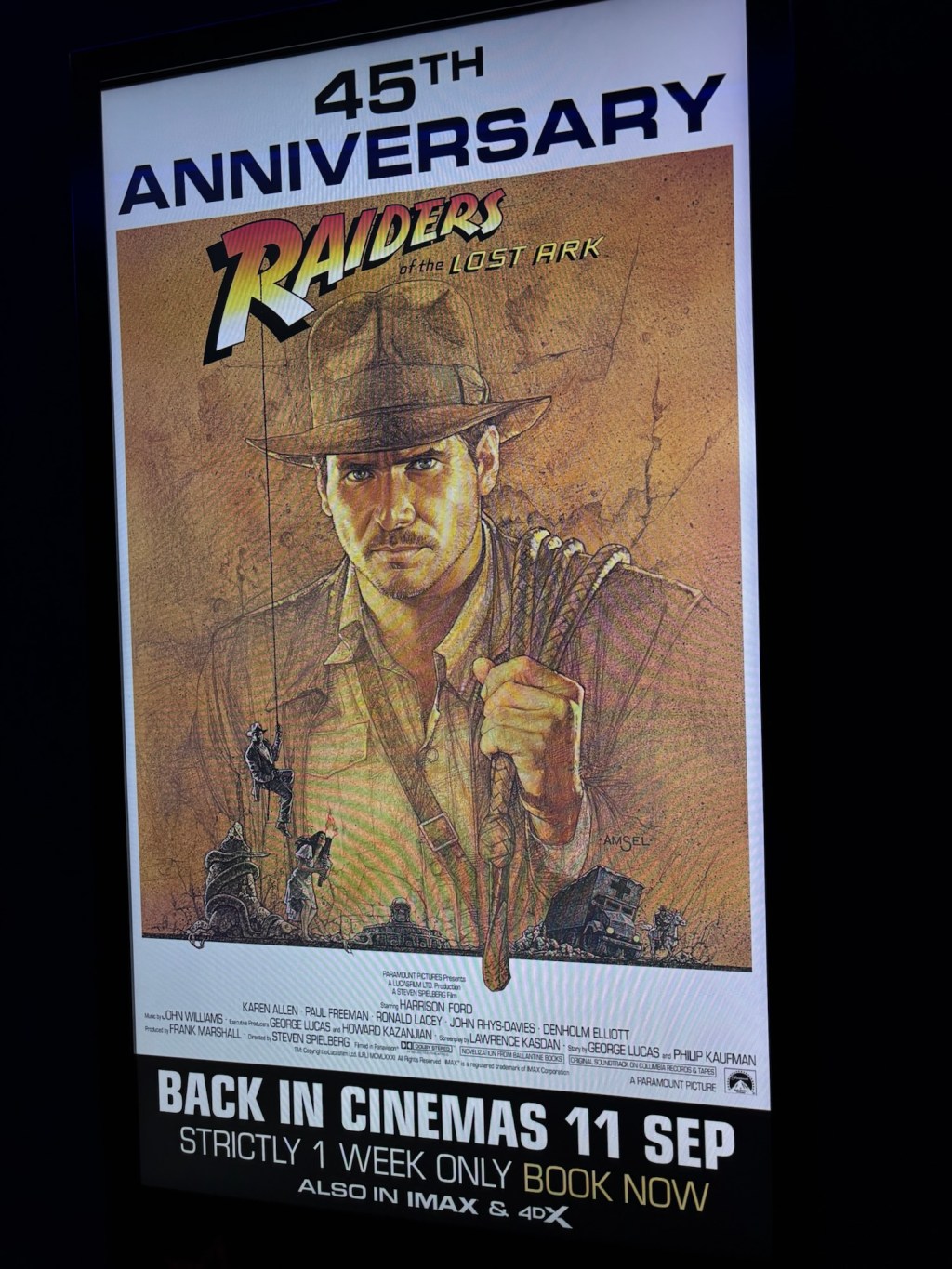
‘Raiders of the Lost Ark’ is Spielberg very much in his prime, making a film that is essentially a love letter to the old Saturday-morning adventure serials, complete with cliffhangers, exotic locations, ancient mysteries and apparently impossible escapes. And in doing so, he gets to the heart of something very simple: the sheer pleasure of going to the movies.
Set in the 1930s, before the outbreak of the Second World War, the film has Indiana Jones racing against the Nazis to find the Ark of the Covenant, which supposedly contains the tablets of the Ten Commandments. The Nazis believe the Ark possesses extraordinary powers, so the prospect of it falling into their hands turns an archaeological expedition into something approaching a mission to save the world.
At times, ‘Raiders’ feels remarkably like a James Bond film. Harrison Ford’s Indiana Jones has the exotic locations, the villains, the escapes, the women and one action set piece following another. There’s even something of the slightly tongue-in-cheek quality of the Roger Moore Bond films of the period, although ‘Raiders’ never really becomes camp.
What’s particularly enjoyable, though, is the contrast between the two versions of Indiana Jones. When he isn’t being dragged underneath trucks, escaping giant boulders or fighting Nazis, he’s a university lecturer. We see him standing in front of a classroom teaching archaeology, and his everyday existence appears almost comically ordinary. One of his female students has even written ‘LOVE YOU’ across her eyelids.
Then, almost at the drop of a hat, this rather conventional professor puts on the fedora and becomes the intrepid Indiana Jones.
There’s something irresistible about taking an academic out of the classroom and putting him into a world where archaeology isn’t about carefully cataloguing objects in museums but discovering lost civilizations, ancient talismans and artefacts that can literally mean the difference between life and death. And Spielberg understands exactly how to turn that into cinema.
The film is constructed around a succession of big-scale action sequences, beginning with that famous opening involving the golden idol and the enormous rolling boulder. There are chases, fights, snakes, collapsing temples, aeroplanes and trucks, with Indiana repeatedly surviving situations that should probably have killed him several times over.
Occasionally, it can become a little laborious. One miraculous escape is immediately followed by another predicament and then another escape. But that’s also the point. Spielberg and George Lucas are recreating the rhythm of those old serials where every episode had to leave the hero dangling over another precipice.
Harrison Ford is crucial to making it work because Indiana Jones isn’t an invulnerable superhero. He gets punched, battered, exhausted and frightened. He makes mistakes. Sometimes he survives as much through luck as skill.
There’s also something of an earlier generation of Hollywood stars in Ford’s performance. You can detect a little Humphrey Bogart – perhaps particularly Bogart in ‘The Treasure of the Sierra Madre’ – in this battered, cynical adventurer moving through dangerous and unfamiliar territory.
And, of course, there’s the Bond connection. Amusingly, a few years later Spielberg would cast Sean Connery himself as Indy’s father in ‘Indiana Jones and the Last Crusade’, making the relationship between the two franchises almost explicit.
But ‘Raiders’ has something Bond doesn’t, ‘Live and Let Die’ notwithstanding: a fascination with the supernatural. For much of the film, Indiana approaches these ancient legends as an archaeologist. He understands their historical significance but isn’t necessarily prepared to accept their mystical claims. Yet gradually the film moves from adventure into something stranger and darker.
And ultimately it ends with nothing less than the wrath of God. That’s quite a journey for a film which begins with a man stealing an idol from a cave.
And perhaps that’s the real achievement. Spielberg isn’t simply recreating the adventure films he loved as a child. He’s reminding us why we loved this kind of thing in the first place. Sometimes you go to the cinema to be challenged, disturbed or made to think. And sometimes you just want the lights to go down, the music to start and to enjoy Indy running away from an enormous boulder.





Leave a comment