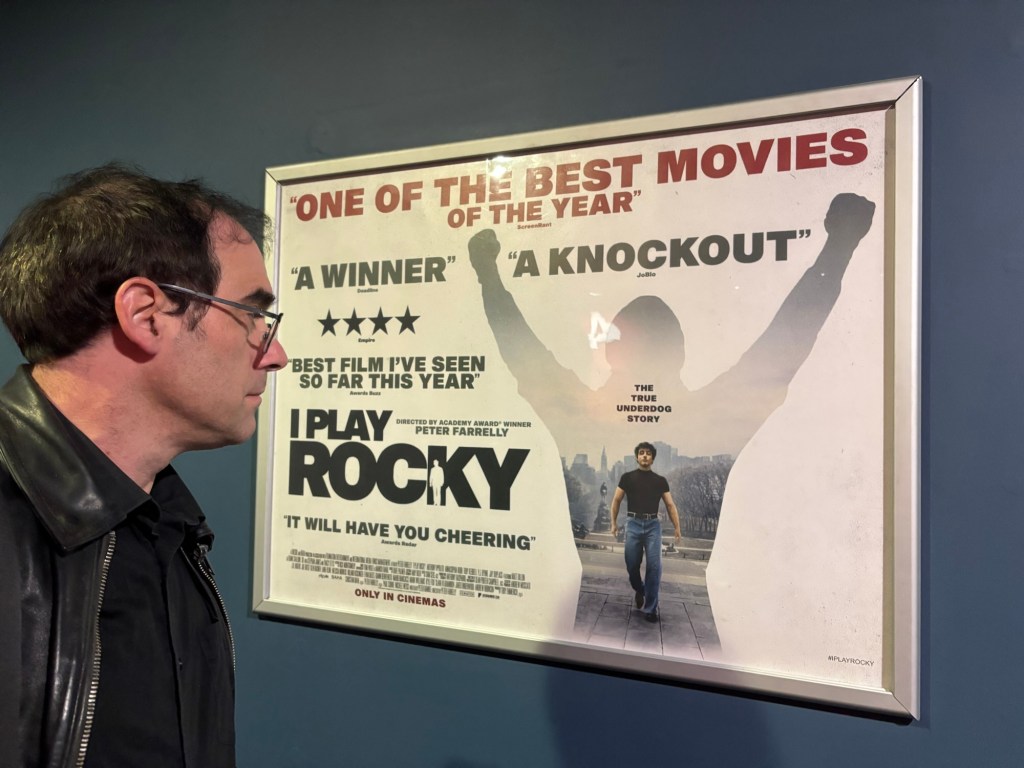
‘I Play Rocky’ is one of those Hollywood stories that seems almost too improbable to be true. It’s about the making of the 1976 film ‘Rocky’, but what is fascinating is that the story of how Sylvester Stallone got the film made is almost as extraordinary as the fictional story he wrote.
In many respects, it’s the same story twice. Stallone was a struggling actor who had appeared in a handful of minor roles, often playing thugs, and had even worked in soft-core pornography to make ends meet. Then, inspired partly by a 1975 Muhammad Ali fight, he wrote the screenplay for ‘Rocky’ in just three and a half days.
The script attracted the attention of legendary producers Robert Chartoff and Irwin Winkler, who recognized its commercial potential. There was, however, one rather substantial problem. Stallone insisted that he, and nobody else, would play the leading role. For the producers, this was an almost incomprehensible demand. Why take a chance on an unknown actor when the screenplay could be sold for a considerable sum and developed around an established star?
But Stallone refused to compromise. Even with a pregnant wife and very little money, he turned down increasingly lucrative offers. He was prepared to lose everything rather than surrender the one thing that mattered most to him.
And that’s where ‘I Play Rocky’ becomes something more interesting than a conventional Hollywood biopic. It’s a film about the consequences of refusing to sell out. Anthony Ippolito plays Stallone, and his resemblance to the young actor is remarkable, right down to the distinctive slurred voice and slightly awkward physical mannerisms. The performance is frequently very funny, and Peter Farrelly directs much of the film as a comedy about an apparently hopeless outsider trying to force his way into the Hollywood establishment.
I was reminded of Farrelly’s ‘Green Book’, which also derives much of its humour from a character who seems unsophisticated, out of his depth and completely unsuited to the sophisticated world he’s entering. But what looks like naivety can also be a form of determination. Stallone doesn’t understand why everybody thinks his demands are unreasonable, because from his perspective there’s nothing to negotiate. He wrote Rocky Balboa for himself. And he’s going to play him.
The film also offers some fascinating glimpses into the practical ingenuity behind the original production. Director John G. Avildsen insists that he’s not making a boxing film but a character study about a man who happens to box. It’s a crucial distinction, for ‘Rocky’ isn’t really about whether its hero can defeat Apollo Creed. It’s about whether somebody who has spent his life being overlooked can finally prove that he matters.
The modest budget also produces some inspired improvisation. The use of the Steadicam gives the film a visual freedom that would otherwise have been difficult to achieve, while the performers have to learn skills their characters supposedly possess. Neither Stallone nor Talia Shire could skate, and Stallone and Carl Weathers were hardly accomplished boxers when they began preparing for their roles.
Somehow, these limitations become part of the film’s charm. And the same could be said of ‘I Play Rocky’ itself. It’s not particularly subtle about the parallels between Stallone and his creation, but why should it be? Both are underdogs who refuse to accept the limitations imposed upon them by more powerful people.
Both are told that they don’t belong. And both discover that winning isn’t necessarily the same thing as defeating an opponent. There’s something about ‘Rocky’, like ‘Star Wars’ the following year, that captures Hollywood’s ability to manufacture modern myths. We remember the emotional triumph rather than the precise outcome. Indeed, people sometimes talk about ‘Rocky’ as though its hero wins the championship, when of course he actually loses the fight. But he wins something much more important.
The film concludes (if you stay to the very end credits) with footage of the real Stallone being interviewed by Johnny Carson following ‘Rocky’s’ release. It’s a wonderful reminder that the improbable story we’ve just watched really did happen. And perhaps that’s the most appealing thing about ‘I Play Rocky’. Hollywood has spent decades telling us that dreams can come true if we refuse to give up. Here, unusually, it has a story from its own history to prove the point.
Rocky Balboa didn’t have to win the fight to become a champion. Sylvester Stallone didn’t have to beat Hollywood at its own game either. He just had to persuade Hollywood to let him play his.


Leave a Reply