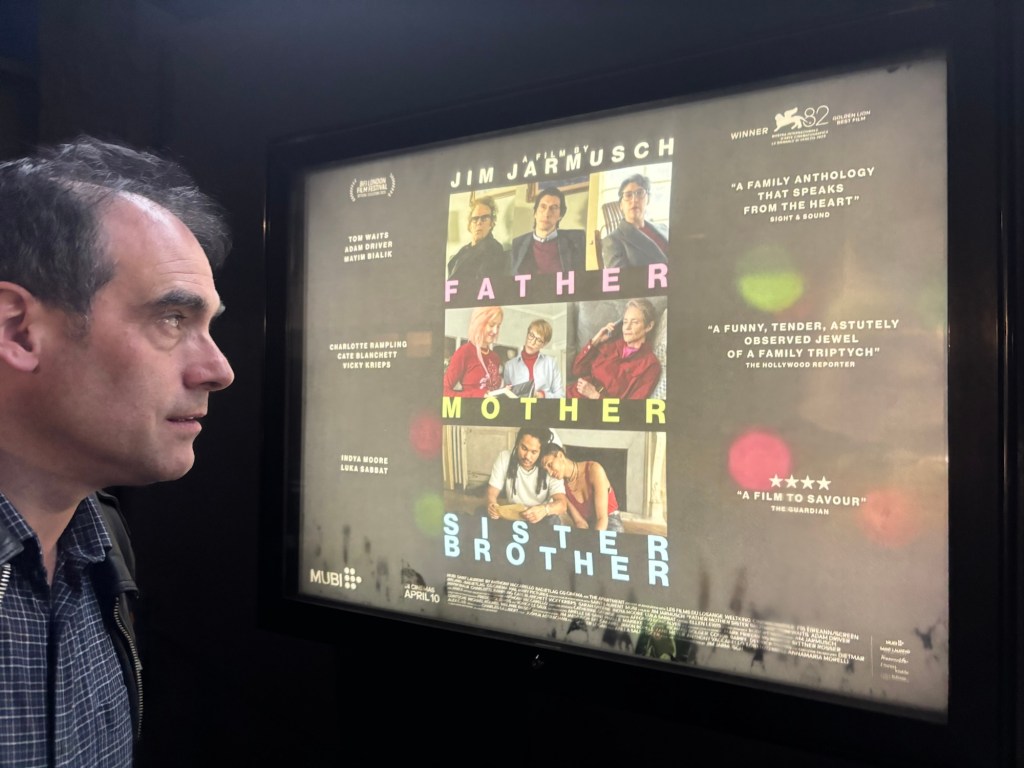
This is a film that reminds me of watching ‘Broken Flowers’ at a film festival in 2005 – the best way to describe ‘Father Mother Sister Brother’ is that it is somewhat skew-whiff. It is the polar opposite of a blockbuster or superhero film, focusing instead on a very niche, eccentric variation of the everyday. There’s a moment where a character waits for an Uber during an awkward family exchange, and we’re told it will arrive in seven minutes – and for a moment it genuinely feels as though the film might make us sit through that entire stretch in real time. I almost felt cheated when it didn’t. There are long silences throughout, but at no point does the film feel dull.
The structure consists of three interwoven stories involving different family members. They dovetail through recurring motifs – a Rolex watch that may or may not be genuine, themes of water, madness, duplicity, and, above all, miscommunication and generational disconnect. We are dropped into these lives mid-flow, left to piece together context through ellipses and gaps, and much of what we see feels unreliable, or at least incomplete. The stories span different locations – the East Coast of America, Ireland, Paris – and often begin with characters in transit, driving toward encounters that feel like emotional thresholds.
There is a persistent sense of awkwardness, loss and disconnection. This is not a redemption narrative, in the respect that there is no expectation that old wounds will be healed. Jim Jarmusch offers no easy answers. The first two stories are steeped in the weight of past histories, with Tom Waits in the first as an ageing father who appears eccentric, possibly unstable, perhaps even performing a version of himself to keep others at a distance. The second centres on Charlotte Rampling as an imperious, emotionally distant novelist – an icy matriarch who summons her children annually, only for the visits to feel like interrogations rather than reunions. There’s a sense that once the visit ends, nothing meaningful will have changed.
The third story shifts tone. Set in Paris, it follows two New Yorkers reflecting on the loss of their parents in a plane crash. Here, there is a warmth and openness largely absent from the earlier segments. Through photographs and memory, they attempt to reconstruct the people they thought they knew, and in doing so, the film becomes more forward-looking, even quietly hopeful.
In many ways, this is the antithesis of a conventional Hollywood drama. It put me in mind of ‘The Family Stone’, though Jarmusch’s film offers no catharsis or reconciliation. There are no shouting matches, no dramatic confrontations – instead, a quieter register of resignation, populated by people accustomed to disconnection, managing it rather than resolving it.
There’s also an undercurrent of performance. Tom Waits’ character feels consciously theatrical, perhaps using that as a shield, while Rampling’s character embodies a striking contradiction: an emotionally inaccessible mother who writes passionate novels, recalling figures like Jack Nicholson’s character in ‘As Good as It Gets’ in terms of how the mismatch between inner life and outward expression is central.
Ultimately, ‘Father Mother Sister Brother’ suggests that we never fully know our parents, nor they us. Even when they are alive, we are left interpreting them at a distance, and when they are gone, all that remains are stories and fragments. The first two segments dwell in that unresolved past, while the third gestures toward something more accepting. It’s a quiet, almost Zen-like film – unconventional, elusive, and all the more enriching for refusing to behave like a film we think we recognize.


Leave a Reply