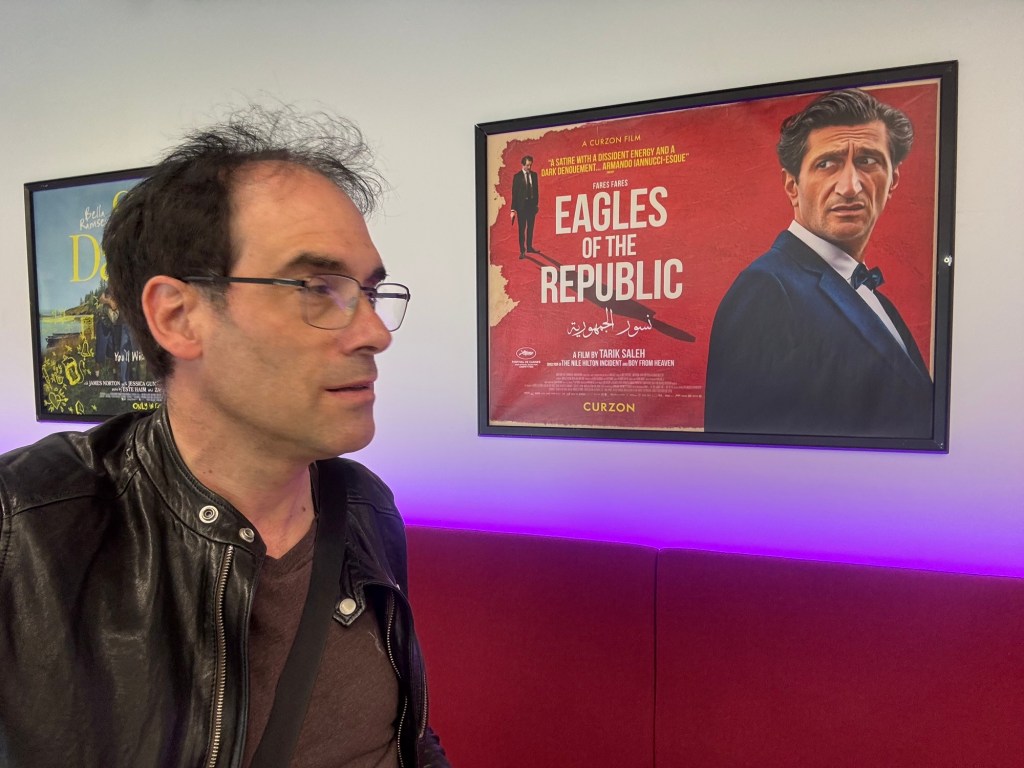
‘Eagles of the Republic’ is a biting and intelligent political drama that explores the uneasy relationship between art and authoritarian power. At its centre is George (Fares Fares), a successful middle-aged Egyptian actor who finds himself recruited by the regime to star in a state-sponsored film portraying the country’s president. It is less an invitation than a command. Refusal is not really an option, and the threats soon become deeply personal, with sinister suggestions that his teenage son might conveniently be involved in a road accident if he fails to cooperate.
George’s private life is hardly straightforward either. He is having an affair with an actress young enough to be his daughter while also embarking on an even more reckless relationship with the Defence Minister’s wife. In a society where surveillance is pervasive and very little remains secret, his personal indiscretions become another means by which the authorities are able to exert pressure. The regime disapproves of his lifestyle, and there is a sense that his enforced participation in the propaganda film is as much a punishment as it is a patriotic duty.
The film was shot largely outside Egypt, including in Istanbul, for obvious reasons. It is difficult to imagine a film this openly critical of the Egyptian authorities being produced on Egyptian soil, and that gives it an added urgency. What emerges is a portrait of a society where fear has become normalized, where an ill-judged social media post or an inconvenient opinion can easily be construed as treason.
One aspect I particularly admired was the way the film examines the vanity of performers themselves. Actors often inhabit worlds in which they are admired, celebrated and accustomed to believing their own publicity. ‘Eagles of the Republic’ suggests that such personalities may be especially susceptible to authoritarian systems, because propaganda itself depends upon performance, image and the careful construction of public identity. George is not simply a victim of the regime; he is also someone whose own narcissism leaves him vulnerable to manipulation. The line between acting and political theatre becomes increasingly blurred.
The film changes direction quite dramatically during its final half hour. What initially appears to be a character study suddenly develops into a full-blown conspiracy thriller, recalling the director’s previous film, ‘Cairo Conspiracy’. George finds himself drawn into events far beyond his control, and the atmosphere becomes increasingly paranoid as questions of loyalty, betrayal and survival come to the fore.
I did feel, however, that the ending was less satisfying than it might have been. There are intriguing ideas introduced in the final act that are never quite fully developed, and I was left wondering whether material had been trimmed or simplified. The conclusion is intentionally bleak and somewhat ambiguous, but it doesn’t quite provide the emotional or intellectual resolution that the earlier parts of the film seem to promise.
It hardly matters that George bears little physical resemblance to the president he is supposed to portray. In fact, that almost becomes part of the point. Dictatorship is itself a form of performance, where appearances matter more than authenticity and image becomes a substitute for truth. George is simply another actor cast in a role written by those in power.
Ultimately, ‘Eagles of the Republic’ is an absorbing exploration of censorship, propaganda and the compromises artists are forced to make under authoritarian regimes. It asks where performance ends and complicity begins, and whether an artist can ever remain politically neutral when every role they accept has become part of a much larger script.


Leave a Reply