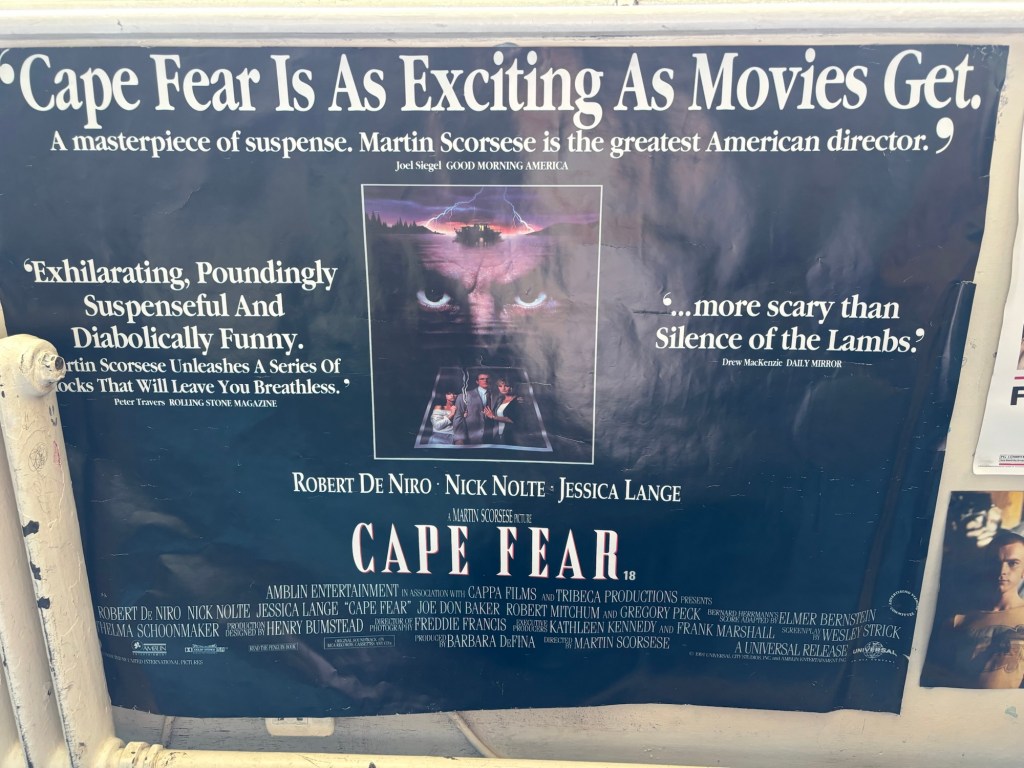
‘Cape Fear’ is ostensibly one of Martin Scorsese’s most conventional films: a big, glossy 1991 Hollywood thriller in which a respectable lawyer and his family are terrorized by a psychotic ex-convict. Yet beneath all the violence, suspense and Robert De Niro’s spectacularly unhinged performance as Max Cady, it may also be one of Scorsese’s most explicitly religious films. This is a story about sin, guilt, judgement, punishment and the uncomfortable possibility that redemption can only begin once people have been forced to confront the things they would rather keep buried.
That is what makes Scorsese’s film so different from J. Lee Thompson’s 1962 original. There, Gregory Peck’s Sam Bowden is essentially a decent family man whose peaceful existence is invaded by Robert Mitchum’s menacing Cady. Good and evil are reassuringly easy to identify: the family is good and the monster comes from outside.
Scorsese is interested in something considerably murkier.
His Bowdens are already falling apart before Cady arrives. Sam (Nick Nolte) is a public defender whose marriage to Leigh (Jessica Lange) has been damaged by his infidelities, while their teenage daughter Danielle (Juliette Lewis) is increasingly estranged from both of them. They occupy the same home without really functioning as a family. As Scorsese’s editor Thelma Schoonmaker succinctly put it, ‘Everyone is guilty.’
Most importantly, Sam himself has committed the act which creates the monster who comes looking for him.
Fourteen years earlier, he represented Cady after Cady raped and violently assaulted a sixteen-year-old girl. Convinced of his client’s guilt, Sam deliberately suppressed evidence concerning the victim which could have been used by the defence and might have reduced Cady’s sentence. Morally, we may understand exactly why he did it. Legally and professionally, it was an extraordinary betrayal.
And therein lies the film’s trap for us.
We know Cady is a sadistic and terrifying man whom we certainly don’t want released into society. But we also know that even such a man is entitled to proper legal representation. Scorsese therefore denies us the comfortable moral certainties of the original. Sam is simultaneously Cady’s victim and the architect of his grievance.
Cady consequently enters the film almost like some demonic Old Testament prophet of vengeance. De Niro’s body is covered in religious tattoos: biblical quotations, a cross and scales representing truth and justice. ‘Vengeance is mine’, ‘My time is at hand’ and ‘Time the Avenger’ have effectively been written onto his flesh. He doesn’t merely want revenge; he has transformed revenge into theology. He believes himself to be an instrument of divine judgement.
De Niro plays him at a pitch bordering on the supernatural. He is intelligent, articulate, physically formidable and seemingly indestructible. He can withstand extraordinary amounts of pain. He appears and disappears almost at will and repeatedly demonstrates that he knows more about the Bowdens than they know about one another.
And Scorsese constantly plays with the idea that Sam and Cady are doubles.
Sam’s adultery becomes particularly important. When Cady horrifically attacks Sam’s colleague Lori (Illeana Douglas), with whom Sam has been having a clandestine relationship, the distinction between respectable lawyer and convicted sexual predator becomes deliberately uncomfortable. Obviously their crimes are not morally equivalent, but both men have used women according to their own desires. Scorsese keeps finding visual and thematic ways of connecting them. Sam watches Cady through a one-way mirror; later he secretly watches as hired thugs attack him. Yet somehow Cady always seems to know Sam is there.
It is almost as though Sam cannot escape Cady because Cady represents something within Sam himself.
This is where ‘Cape Fear’ becomes particularly interesting as a religious film. Cady tells Sam to look in the Bible at the book between Esther and Psalms: the Book of Job. Job is the righteous man whose comfortable existence is systematically destroyed as his faith is subjected to an almost unimaginable test. His family, possessions, health and security are stripped away.
The Bowdens undergo something comparable, although unlike Job they are certainly not blameless. Cady progressively removes everything that allows them to maintain the illusion that their lives are functioning normally. Their home is no longer safe. The law cannot adequately protect them. Sam’s professional status offers no protection. Eventually even the family itself threatens to disintegrate.
Leigh understands the point when, seeing Sam reading Job, she wonders how strong or weak they really are, and concludes that the only way they will discover the answer is by going through the ordeal.
That could almost stand as the theological thesis of the entire film.
Cady himself makes it explicit when talking to Danielle. Every person, he tells her, carries a circle of hell around their head and must go through hell to reach paradise. And what is paradise? Salvation.
The disturbing proposition at the heart of ‘Cape Fear’ is therefore that Cady may actually be the instrument through which the Bowdens are forced to change.
This certainly does not make him good. His sexual violence, sadism and desire to terrorize Danielle make that impossible. Rather, Scorsese blurs the categories of destroyer and redeemer. Cady’s motives are monstrous, but his presence forces the family to acknowledge truths they have spent years avoiding.
There is something comparable here with Travis Bickle in ‘Taxi Driver’. Travis believes himself called to cleanse New York of its corruption. Cady likewise casts himself as an agent of judgement. Both appropriate religious language to legitimize violence. Yet whereas Travis imagines himself saving another person, Cady believes he can actually save his victims through their suffering.
His theology is completely deranged, but not entirely incoherent.
The climax takes this idea to extraordinary lengths. On the Bowdens’ houseboat, Cady transforms himself into judge, prosecutor and executioner. He tells Sam that he is Virgil guiding him into Dante’s Ninth Circle of Hell – the circle reserved for traitors – and conducts what amounts to a grotesque trial.
Sam is charged with betraying his profession, his client and ultimately his own moral principles.
Cady finds him guilty.
Yet Cady regards the punishment not merely as vengeance but purification. Strip Sam of everything, his logic runs, and perhaps there will eventually be nothing left preventing him from entering heaven. Cady is simultaneously devil, preacher and self-appointed agent of God.
The whole sequence is wildly melodramatic. Indeed, the final half-hour pushes credibility almost to breaking point, with storms, raging water, fire, violence and De Niro operating at a level of theatrical intensity that makes everything which preceded it seem restrained.
But perhaps realism isn’t really the point by then.
The Bowdens have entered an almost biblical landscape. Their supposedly safe houseboat is destroyed, leaving them immersed in the muddy waters of Cape Fear. Fire and water become the dominant images – judgement followed by something resembling baptism.
And each member of the family behaves differently because of the ordeal. Leigh, previously absorbed in her unhappy marriage and her own life, offers herself to Cady to protect Danielle. Danielle, who previously responded to her parents’ arguments by literally shutting the door on them, fights to protect them. And Sam finally acknowledges the original wrongdoing which set everything in motion.
After his brutal confrontation with Cady, Sam has blood on his hands.
Then the river washes it away.
Scorsese explicitly regarded the image as representing guilt being cleansed. The Bowdens emerge from the water filthy, exhausted and traumatized but together. It resembles a grotesque baptism: the destruction of the family has paradoxically created the possibility of its rebirth.
And yet Scorsese is far too interesting a filmmaker to leave us with a reassuring Hollywood ending.
Danielle tells us that afterwards the family never spoke about what happened. They don’t even mention Cady’s name because doing so might allow him back into their dreams.
That initially sounds understandable. But isn’t refusing to confront uncomfortable things exactly what was wrong with the Bowdens in the first place?
Perhaps they have learned nothing.
Or perhaps redemption isn’t something that happens instantaneously.
That ambiguity is crucial. Scorsese doesn’t present redemption as a magical transformation whereby damaged people undergo one terrible experience and emerge morally perfected. The Bowdens have begun a process. Whether they continue it is another question entirely.
It is also why the film’s excesses ultimately work for me. De Niro’s performance can seem enormous, the thunderous Bernard Herrmann score – adapted by Elmer Bernstein from Herrmann’s music for the original film – practically announces impending doom, and Scorsese fills the picture with strange angles, lurid colours and images that sometimes border on horror-movie expressionism.
But Cady should feel too large for the world around him.
He isn’t merely an escaped convict stalking a family. He increasingly resembles the physical manifestation of everything the Bowdens have suppressed: adultery, dishonesty, resentment, sexual unease, professional betrayal and the family’s complete failure to communicate.
That makes ‘Cape Fear’ much more than a story about evil invading the American home.
The evil was already there.
Cady simply opens the door.
And that, for me, is what makes Scorsese’s remake considerably more disturbing than a conventional revenge thriller. The question isn’t simply whether the Bowdens can defeat Max Cady. It is whether they can survive being forced to look at themselves.
Cady believes every human being must pass through hell before reaching paradise. By the end of ‘Cape Fear’, the Bowdens have certainly been through hell. Whether what awaits them afterwards is salvation is something Scorsese wisely refuses to answer.





Leave a Reply