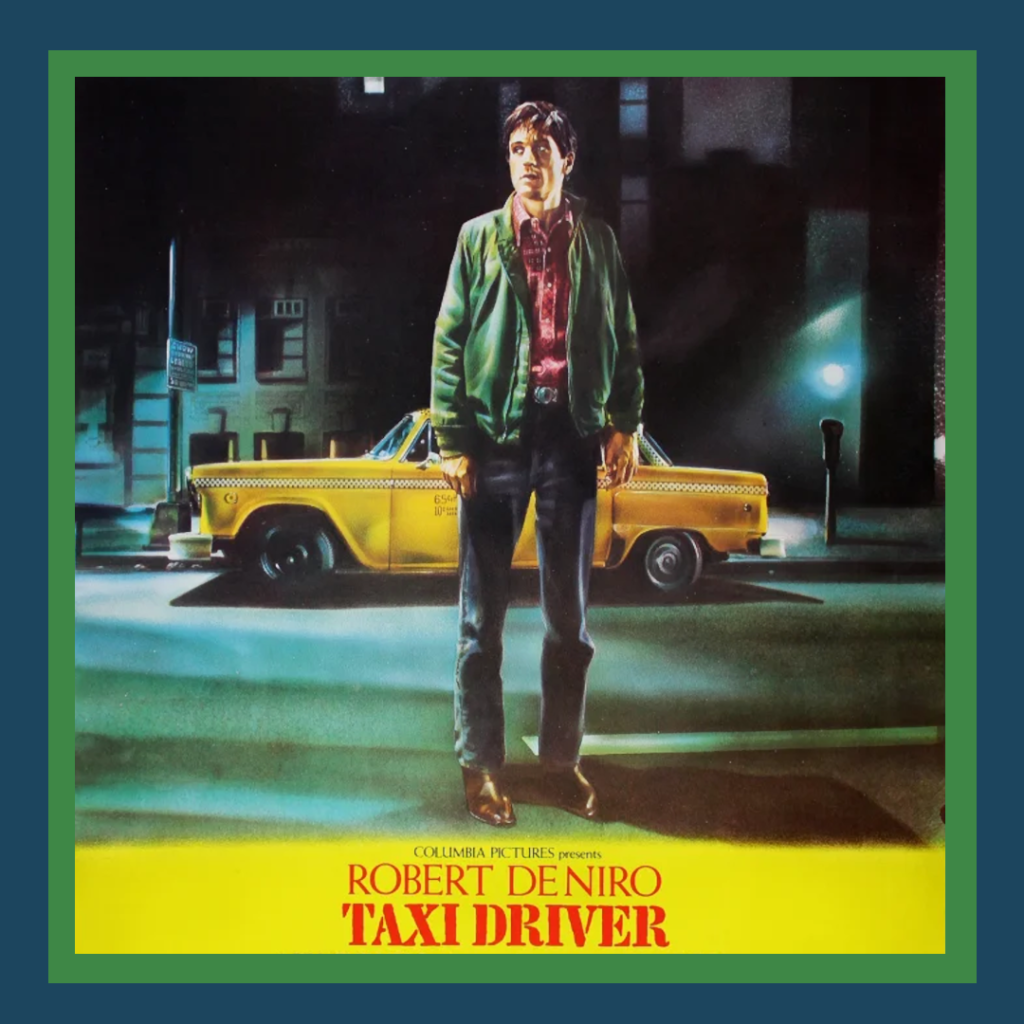
‘Taxi Driver’ is one of those films that seems simultaneously rooted in a very particular moment in American history and somehow permanently contemporary. Martin Scorsese’s 1976 masterpiece is ostensibly about Travis Bickle (Robert De Niro), a Vietnam veteran who takes a job driving a New York taxi because chronic insomnia means that he is awake throughout the night anyway. But it gradually becomes something much more disturbing: a film about loneliness, alienation and the dangerous point at which an individual decides that his inability to belong to the world actually gives him the authority to judge it.
Travis calls himself ‘God’s lonely man’, and that description is fundamental to understanding him. He drives endlessly through a New York he regards as diseased, populated by prostitutes, pimps, addicts and people he considers degenerate. Yet the paradox is that he is simultaneously repelled and fascinated by this world. When he isn’t driving through it, he frequents pornographic cinemas and cafés populated by precisely the sorts of people he claims to despise. He cannot remove himself from the environment he wants to cleanse. He is both observer and participant, condemning the city while being psychologically dependent upon it.
And New York itself is almost another character. Scorsese gives us steaming manholes, rain-soaked streets, glaring neon and distorted colours, while Bernard Herrmann’s extraordinary final score moves between seductive jazz and something much more discordant and threatening. The opening images make the taxi appear almost to emerge from the bowels of the earth. The city resembles a modern Dantean inferno, but the crucial point is that the hell Travis inhabits is as much internal as external. Milton’s Satan in ‘Paradise Lost’ declares, ‘myself am Hell’, and something similar could be said about Travis. Wherever he drives, he takes his hell with him.
That is why ‘Taxi Driver’ is much more complicated than a conventional vigilante movie. Travis gradually convinces himself that his disgust constitutes a moral vocation. At first he hopes that the rain will wash the filth from the streets; eventually he effectively decides that he himself must become the rain. Alienation turns into mission. He will be the person who finally stands up and does something.
There is something almost religious about this transformation. Travis begins to see himself simultaneously as scourge and redeemer, somebody capable of purifying the city through violence. Scorsese himself observed that Travis believes he is doing the right thing: he wants to clean up life, the mind and the soul. The problem, of course, is that this apparent moral clarity is emerging from somebody whose perception of reality is increasingly unstable. ‘Taxi Driver’ therefore asks a frightening question: what happens when psychological breakdown begins to masquerade as moral certainty?
Initially Travis attempts to connect with conventional society through Betsy (Cybill Shepherd), who works for presidential candidate Charles Palantine (Leonard Harris). He sees her almost as an immaculate figure emerging from the surrounding corruption, but his disastrous decision to take her to a pornographic cinema reveals just how incapable he is of understanding ordinary social codes. When she rejects him, admiration turns into resentment. Travis cannot comprehend why other people do not experience the world according to the categories he has constructed for it.
His fixation subsequently shifts towards politics and assassination. Yet when his attempt to kill Palantine fails, his energies are redirected towards Iris (Jodie Foster), the twelve-year-old prostitute he decides must be rescued from her pimp Sport (Harvey Keitel). This is one of the film’s most disturbing ambiguities because rescuing Iris is, objectively, a good thing. She is a child being sexually exploited. Yet Travis’s motivations are inseparable from his increasingly homicidal fantasies.
He needs somebody to save because he needs to become a saviour.
There is consequently something mythological as well as Christian about his descent into the underworld to retrieve Iris. Like Orpheus descending into Hades for Eurydice, Travis enters the darkest reaches of the city to bring somebody back. But Scorsese grotesquely inverts the traditional redemption story. Travis does not possess divine grace; he possesses guns. His sacrament is violence.
The climactic massacre consequently resembles some ghastly baptism in blood. Travis kills Sport and the others surrounding Iris before attempting to kill himself. Scorsese photographs the aftermath from above, the camera travelling back across the carnage almost as though examining the remains of some terrible ritual sacrifice. Scorsese himself described this sequence in explicitly religious terms, as a ritualistic experience comparable to the Mass. Travis apparently believes that purification requires sacrifice and that he himself must ultimately become part of that sacrifice.
What makes the ending so extraordinary, though, is what happens next.
Travis survives.
Not only does he survive, but society transforms him into a hero. Iris returns to her parents, who write thanking him. Newspaper reports celebrate the previously anonymous taxi driver. The man who was moments away from assassinating a presidential candidate has, through an accident of circumstance, become publicly recognized as a courageous rescuer.
That is surely one of the darkest jokes in American cinema.
Change the direction of Travis’s gun and exactly the same psychologically disturbed individual could have entered history as an assassin rather than a hero. Society judges him according to the outcome of his violence rather than the pathology that produced it. His attempted political murder disappears from the narrative because nobody knows about it. The subsequent bloodbath happens to produce a socially desirable result, and therefore Travis is redeemed in the eyes of the world.
There is even something resembling death and resurrection here. The Travis we see afterwards is superficially reintegrated into society. He chats comfortably with his fellow taxi drivers rather than standing completely outside human relationships. Betsy even gets into his cab again. The outcast has returned from the dead as a celebrity.
But has Travis actually changed?
The final moments suggest something much more unsettling. That sudden glance into the rear-view mirror, accompanied by Herrmann’s musical sting, hints that whatever was inside Travis has not disappeared. Redemption may itself be another illusion. The cycle could begin again.
This is also where Paul Schrader’s screenplay becomes intensely personal. Schrader developed the idea while living an isolated existence in Los Angeles, drinking heavily, sleeping in his car and frequenting pornographic cinemas. After ending up in hospital, he realized that he had barely spoken to another human being for weeks. The metaphor that occurred to him was the taxi driver: someone travelling around inside a metal box, surrounded constantly by millions of people yet completely alone.
That image is perhaps the key to the film’s enduring power.
Travis is terrifying not because he is completely alien to us but because elements of his condition are recognizable. Most people will never become Travis Bickle, but loneliness, rejection, resentment and the feeling of observing a society to which one does not entirely belong are hardly unusual experiences. Schrader drew upon Thomas Wolfe’s idea that loneliness is one of the central facts of human existence. Travis is the pathological extreme of something universal.
And this makes ‘Taxi Driver’ especially uncomfortable today. The isolated individual who develops an increasingly absolutist interpretation of the world, becomes obsessed with perceived social corruption, transforms personal grievance into ideology and finally imagines violence as an act of purification feels anything but confined to 1976. Travis would surely find an enormous ecosystem awaiting him in the age of social media.
Yet Scorsese never gives us the comfort of simply diagnosing him. We spend almost the entire film inside Travis’s consciousness. His diary becomes voice-over; we see the city through his taxi windows and effectively through his eyes. The film seduces us into sharing his perspective before making us recoil from where that perspective ultimately leads.
That may explain why audiences responded so intensely when the film originally appeared. Scorsese recalled spectators shouting at the screen, while contemporary accounts noted that its audience encompassed an extraordinarily broad cross-section of society. The poster’s famous proposition – that in every city there is one man like this – turned Travis from an isolated curiosity into something approaching an archetype.
The uncomfortable possibility is that the film isn’t ultimately asking us merely to look at Travis. It is asking us to recognize something of ourselves.
That is also why ‘Taxi Driver’ belongs firmly within the film noir tradition while taking it somewhere considerably darker. Classic noir frequently presented damaged individuals moving through corrupt environments searching for some possibility of redemption. Scorsese intensifies that idea until city and protagonist seem almost indivisible. Travis wants to cleanse New York, but the contamination he perceives outside himself has already become part of him.
Perhaps that is the film’s ultimate theological paradox. Travis desperately wants redemption but profoundly misunderstands what redemption means. He believes salvation can be achieved by identifying sinners and destroying them. His idea of cleansing is annihilation. And yet, through the bizarre contingencies of circumstance, his violent rampage actually does rescue Iris and returns her to her family.
The miracle is therefore indistinguishable from the atrocity.
Fifty years later, ‘Taxi Driver’ remains such an astonishing film because it refuses to tell us exactly what to do with Travis Bickle. He is victim and perpetrator, rescuer and potential assassin, sinner and would-be saviour. He inhabits hell and then appoints himself its avenging angel. Society ultimately declares him a hero without understanding anything about him.
And perhaps that final irony is Scorsese’s bleakest observation of all. Travis spends the film desperately wanting somebody to recognize his existence. In the end, the world finally sees him – but completely misunderstands what it is looking at.





Leave a Reply