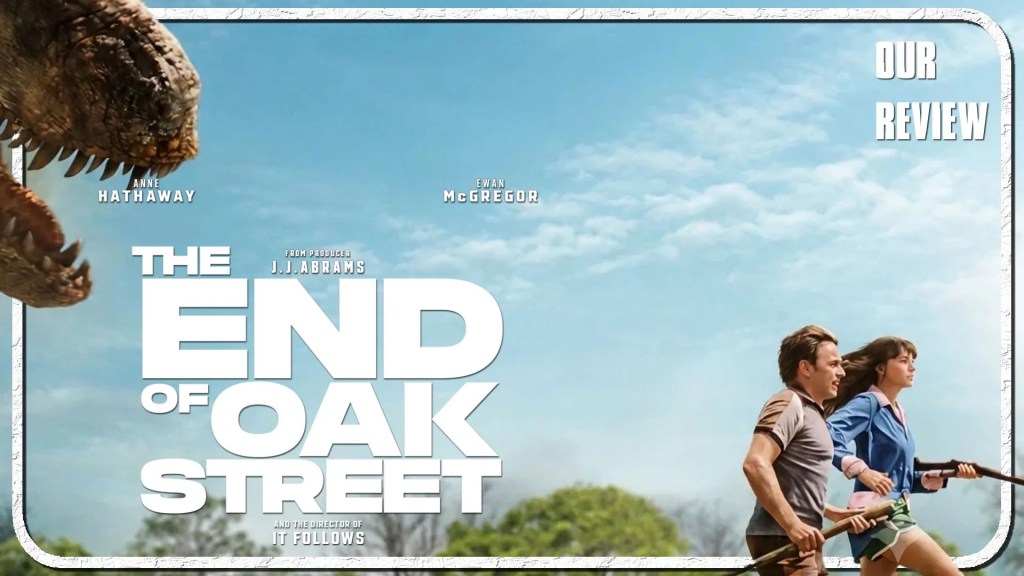
‘The End of Oak Street’ is a strange hybrid of a film, something of a cross between Spielberg’s ‘E.T.’ and ‘Jurassic Park’, but with occasional shades of ‘Poltergeist’ and even ‘The Twilight Zone’. It is set in 1982, the very year ‘E.T.’ was released, and deliberately evokes that earlier Spielbergian world of suburban American families encountering something inexplicable which completely disrupts the apparent security of everyday life. Only here, instead of a friendly extraterrestrial arriving in the neighbourhood, we get dinosaurs – and these are certainly not the cuddly variety.
Something strange is happening on Oak Street. Mysterious plants suddenly appear in gardens which turn out to be millions of years old, and there are indications that the normal rules of time and space are becoming unstable. Then comes a flash of lightning and suddenly the neighbourhood has effectively been transported into a prehistoric jungle.
It is an arresting premise. Familiar streets, gardens and homes are overrun by vegetation and vicious creatures which regard the human inhabitants principally as food. Nobody entirely understands what has happened or how they have become caught in this extraordinary time warp, and the film doesn’t seem particularly interested in providing us with a scientific explanation.
Perhaps that’s actually one of its strengths.
The space-time hiccup simply happens. In that respect it reminded me of ‘Groundhog Day’, which never explains why Bill Murray’s character becomes trapped in his temporal loop. Sometimes providing an elaborate explanation actually diminishes the possibilities of a story. By leaving the phenomenon mysterious, ‘The End of Oak Street’ allows us to concentrate instead on the people experiencing it.
And those people are primarily a nuclear family which we gradually realize wasn’t particularly functional even before the dinosaurs arrived.
That gives the film its most interesting dimension. The prehistoric incursion becomes an adversity which forces people who have emotionally drifted apart to depend upon one another again. There is something archetypally Spielbergian about that: the fantastical event ultimately becomes a mechanism for exploring the family. The dinosaurs may provide the spectacle, but the question underneath is whether these people can rediscover the bonds that ordinary suburban life has somehow allowed them to lose.
The film is rated 12A, although there were moments when I thought it was straddling the boundary with a 15. These dinosaurs aren’t simply magnificent creatures to be gazed upon in wonder. Characters are attacked, ripped apart and eaten, and there is a surprisingly brutal quality to some of the set pieces.
Unlike ‘Jurassic Park’, there is little suggestion that we should admire these creatures.
There is no sense that the dinosaurs might possess a heart or that humanity simply needs to learn how to coexist with them. They are vicious predators, and their arrival transforms suburbia into a battleground.
The family dog becomes important too, and this reminded me of ‘The River Wild’, where an animal which appears to have disappeared returns at precisely the crucial moment and helps protect the family. It is a familiar device, perhaps, but an effective one because the animal becomes another representation of home and loyalty in a world where virtually everything familiar has been stripped away.
There are hints throughout of larger questions concerning God, fate and even the multiverse, although I did wonder whether the film could have pushed these ideas further. What exactly does it mean to wake up and discover that you are no longer living in the time to which you belong?
That’s an extraordinary existential proposition.
If I woke tomorrow morning and discovered that I had somehow been transported millions of years into the past, would I remain the same person? How quickly would all the things that currently define my life become irrelevant? And how would the people around me change when the structures, technologies and assumptions upon which we depend had simply disappeared?
‘The End of Oak Street’ hints at these questions rather than really pursuing them because ultimately this is still a summer blockbuster. The emphasis remains on escape, pursuit and a succession of increasingly elaborate set pieces.
There are shades of ‘Don’t Worry Darling’ too, in the idea of a seemingly ordinary community gradually being revealed as something much stranger. Both films begin with a recognizable domestic environment and then allow science fiction to destabilise it until the genre itself seems to mutate.
The 1982 setting adds another intriguing layer. It is strange to realize just how technologically remote that world now appears. There are no smartphones, social media or instant access to information. The year in which Anne Hathaway herself was born now seems almost prehistoric in technological terms, which gives the film an amusing additional resonance. We are watching people from what now feels like an analogue civilization being thrown into an incomparably more ancient one.
There is even an entertaining musical detail involving Steve Winwood’s ‘Valerie’. My immediate reaction was that its inclusion seemed anachronistic because the hit version is so closely associated with the later 1980s, but the song was originally released in 1982. Hearing it playing from an old cassette in a garage after scenes of characters being pecked and torn apart creates exactly the kind of incongruity the film seems to enjoy.
Yet beneath all this, ‘The End of Oak Street’ is surprisingly interested in the interior lives of its characters.
In that sense, it is genuinely a human drama disguised as a dinosaur movie.
There is something here, too, about the destruction of suburbia representing the end of American innocence. The comfortable house and quiet street have traditionally represented safety, prosperity and the American family. Here those reassuring spaces become meaningless almost overnight. Nature quite literally reclaims them. The neatly maintained garden becomes jungle; the family home becomes merely another vulnerable shelter.
Eventually the story develops an ‘E.T.’-like yearning for home. A mysterious glowing ball of light appears and disappears, seemingly providing a possible route back to 1982. The characters have to reach it at precisely the right moment if they are to escape.
And this gives the film’s title an additional resonance. The end of Oak Street isn’t merely the geographical end of a suburban road. It is potentially the end of the entire world these characters recognise.
If they can return to 1982, they have another chance.
But they cannot necessarily prevent the apocalypse they have glimpsed. Perhaps all they can do is escape it, returning to their own lives with the extraordinary knowledge of what they have witnessed.
That is where I think ‘The End of Oak Street’ is potentially more interesting than its succession of dinosaur attacks might suggest. It is about people who are physically displaced in time but who were already emotionally displaced from one another. Only when their ordinary world disappears do they realise what home actually means.
The film could perhaps have explored its existential possibilities more deeply, but there is still something compelling in its central question: if everything familiar were suddenly taken away and we were somehow given the opportunity to return home, would we simply resume our old lives?
Or would seeing the end of our world finally teach us how to live in it?



Leave a Reply