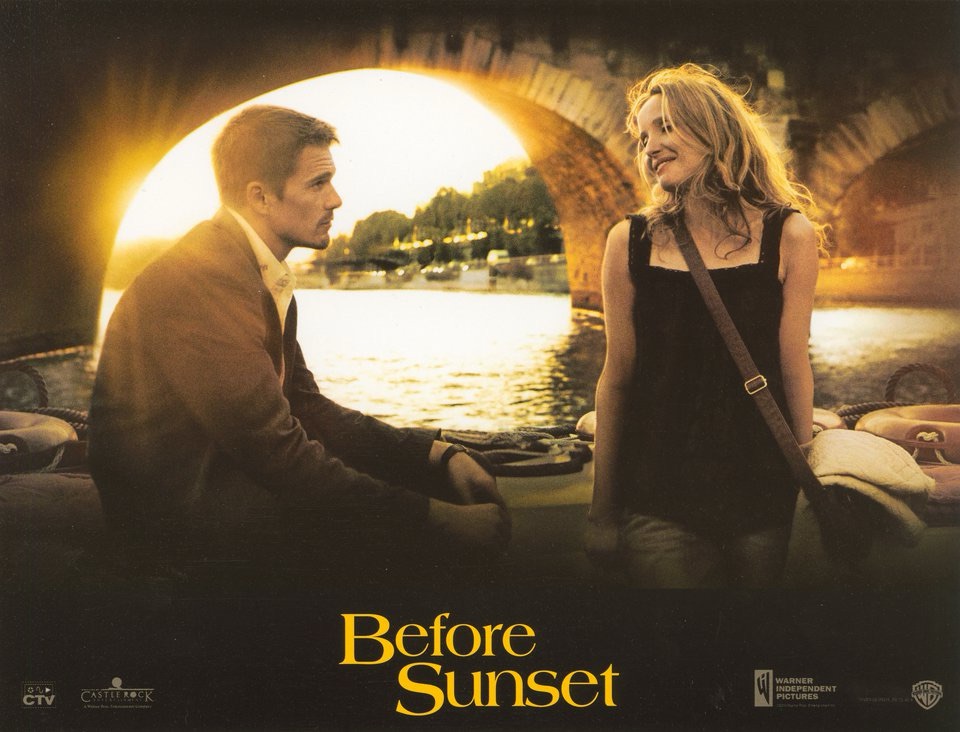
What a beguiling film Richard Linklater has made with ‘Before Sunset’. There is something wonderfully audacious about constructing almost an entire movie around two people wandering through the streets of Paris and talking. There are no great dramatic set pieces, no conventional romantic contrivances and hardly any plot in the traditional sense. Instead, Linklater asks a deceptively simple question: what happens when somebody who profoundly affected your life for just a few hours suddenly reappears nearly a decade later?
‘Before Sunset’ is, of course, the sequel to 1995’s ‘Before Sunrise’, in which American Jesse (Ethan Hawke) and Frenchwoman Céline (Julie Delpy) meet on a train and spend a night wandering around Vienna together. Romantic possibilities abound, but instead of exchanging contact details they agree to meet again six months later.
Nine years later, Jesse is in Paris promoting a successful novel which is transparently based upon that night. And then, wonderfully, Céline appears at his book signing.
Immediately, all sorts of questions emerge. How much do they actually remember? How much do they want the other person to know they remember? Are they nostalgic, disappointed or actually rather angry with one another?
At first, both are slightly coy about the impact that night had upon them. They don’t even initially seem to agree on exactly what happened between them, including whether they made love and, if they did, how many times. But gradually we realize that neither has forgotten anything of significance. What appeared to be a fleeting encounter became a defining moment in both their lives.
There is also something fascinating about Jesse having turned the experience into fiction. What happens when you write a novel which is obviously based upon somebody else and then that person suddenly appears in front of you at the book signing? Jesse has effectively preserved Céline as a character, perhaps partly because he assumed he would never see the real woman again. Now the fictional and actual Céline suddenly occupy the same space.
In a sense, they have both become characters in each other’s stories.
What also gives the film a particular poignancy today is that both ‘Before Sunrise’ and ‘Before Sunset’ were made before social media transformed relationships. Jesse and Céline don’t have WhatsApp, Facebook or Instagram through which they can casually keep track of one another’s lives. Their original agreement to meet six months later therefore carried enormous significance. If one person failed to appear, there was no easy mechanism for discovering why.
And one of them did fail to appear.
The gradual revelation of what happened becomes unexpectedly moving because both have carried their own interpretation of that absence for years. What might have been solved today with a text message instead becomes part of the mythology of their lives.
That leads to the central question of ‘Before Sunset’: are Jesse and Céline in love with one another, or are they in love with the memory of who they were that night?
Jesse is now married and has a child, but his marriage is unhappy. We begin to wonder whether he married partly because the woman he really wanted was somebody he assumed he would never see again. Céline has relationships of her own but also seems emotionally unsettled. Suddenly they are confronted not simply by an old flame but by the possibility of an alternative life.
Yet Linklater is much too intelligent to suggest that they simply made the wrong decision nine years earlier and should now correct it. If Jesse and Céline had remained together after Vienna, perhaps their relationship would have collapsed within weeks.
Maybe the reason their great romance has endured is precisely because it lasted only one night.
That’s what I find so fascinating about the film. Is a relationship somehow less important because it lasts a few hours rather than a lifetime? Or can something fleeting acquire an almost eternal existence through memory? Perhaps the imaginary relationship we carry around with us can sometimes be more powerful than the real relationship ever could have been.
There is something here that almost everybody can relate to. We are all, in different ways, looking for love and connection, but relationships are complicated by timing, circumstance, memory and fantasy. Sex is part of intimacy but it isn’t everything. Sometimes somebody enters our life briefly and leaves an imprint completely disproportionate to the amount of time we actually spent with them.
And what happens if they return?
Can you reclaim the past, or are you merely attempting to reconstruct something which only ever existed because of the particular people you were at that moment?
Linklater’s decision to unfold the film virtually in real time is crucial. Jesse has a plane to catch, so from the moment Céline appears there is a clock ticking. Every additional conversation means that departure comes closer. It gives the most ordinary interactions an extraordinary tension.
Eventually Jesse has to choose between leaving and staying.
That makes the ending absolutely wonderful. Jesse accompanies Céline back to her apartment, where she plays guitar for him and then dances to Nina Simone. She tells him, almost teasingly, that he’s going to miss his plane.
Jesse knows.
And he doesn’t move.
After everything that happened nine years earlier, perhaps he simply cannot make the same mistake twice.
There is another beautifully tantalizing detail when Jesse recalls seeing a woman in New York on his wedding day who looked like Céline. He saw her opening an umbrella but dismissed the possibility. Then we discover that Céline actually was living in New York at the time, only a block away. Perhaps it really was her.
Again Linklater plays with those extraordinary ‘what if?’ moments upon which whole lives can turn. Two people can be separated by continents for years and then discover that at one crucial moment they may have been separated by a single New York street.
‘Before Sunset’ couldn’t be further removed from the conventional blockbuster. It consists largely of two people walking, talking and gradually admitting things to themselves and one another that they have avoided acknowledging for nearly a decade.
Yet emotionally it feels enormous.
The film is ultimately about time: what it does to us, what it does to relationships and how the people we once were continue to inhabit the people we have become. Jesse and Céline aren’t simply meeting one another again. They’re encountering their younger selves and asking whether the possibilities they imagined nine years earlier have completely disappeared.
Perhaps they have.
Perhaps they haven’t.
And then Jesse misses his plane.



Leave a Reply