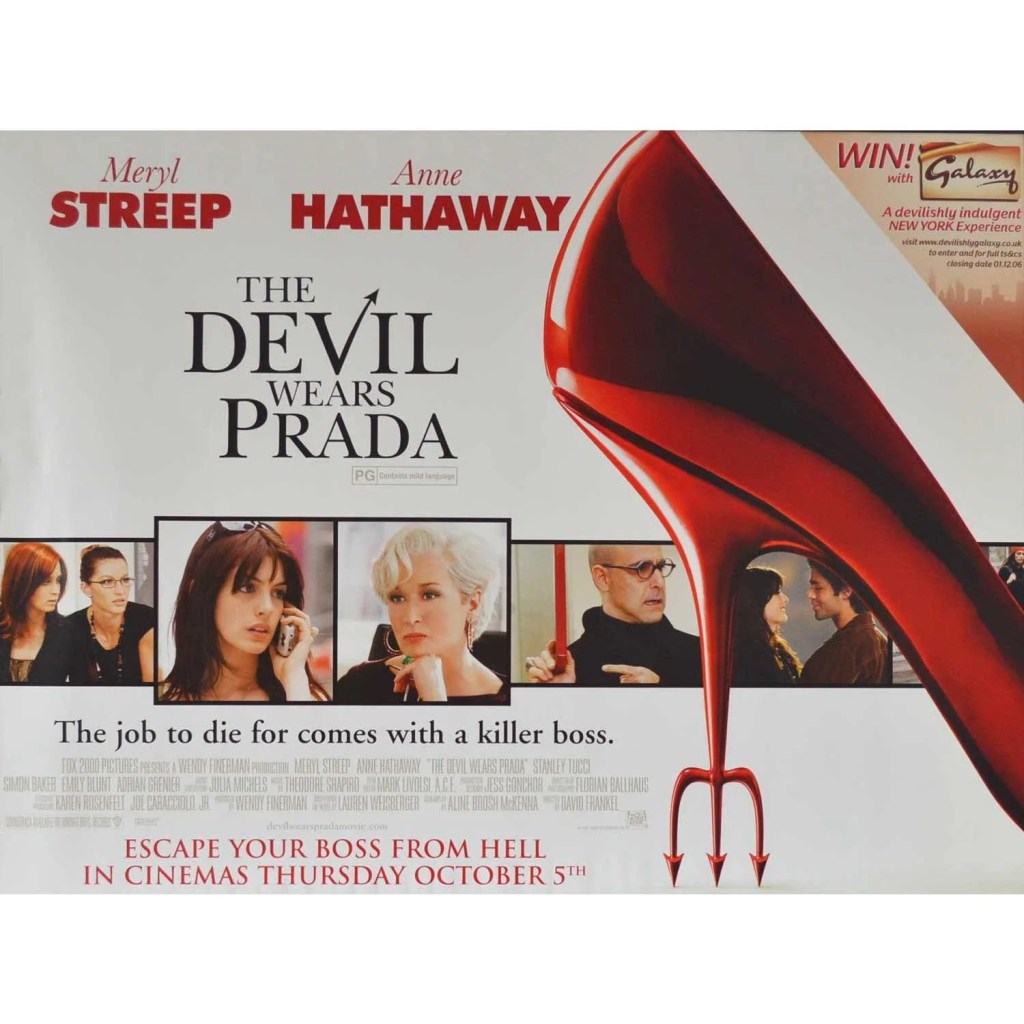
‘The Devil Wears Prada’ is ostensibly a comedy about the fashion industry, but underneath the designer clothes and glossy surfaces it is really a film about workplace politics, bullying, ambition and the compromises people are prepared to make in pursuit of success. Miranda Priestly (Meryl Streep), the formidable editor of Runway magazine, humiliates and intimidates her staff, yet they seem simultaneously terrified of her and desperate for her approval. There is almost an S&M quality to the relationship, minus the physical element: Miranda exerts power, her employees submit to it, and somehow the cruelty only seems to increase the prestige attached to serving her.
Into this world comes Andy Sachs (Anne Hathaway), a young woman who wants to be a serious journalist and has barely even heard of Runway when she arrives for her interview. At first she regards the fashion world with a mixture of indifference and contempt. She is badly dressed by its standards, seemingly immune to its hierarchies and rather baffled by the seriousness with which everyone treats clothes. Yet gradually she changes. In that respect the film reminded me of Barbra Streisand in ‘The Mirror Has Two Faces’, in which an apparently dowdy woman undergoes a transformation and suddenly becomes glamorous and desirable. The interesting question in both cases is what is gained and what is lost. When somebody changes their appearance and behaviour to gain entry to an elite world, are they simply becoming more confident and sophisticated, or are they surrendering part of themselves in the process?
That is the central moral dilemma of ‘The Devil Wears Prada’. Andy becomes increasingly good at her job precisely because she begins to play by Miranda’s rules. She acquires the clothes, learns the language and understands the strange etiquette of Runway. Tasks that initially seem absurd become tests of competence. The most memorable example is Miranda’s demand that Andy somehow obtain an advance copy of the latest ‘Harry Potter’ novel for her twin daughters. It is an impossible request, and failure will effectively mean dismissal. Andy succeeds, and from that moment Miranda begins to regard her differently. It is one of the film’s more intriguing propositions: treat somebody badly enough, force them to change themselves in order to please you, and eventually something resembling mutual respect may develop.
There is also something distinctly ‘All About Eve’ about the film. Success does not merely require talent; it may require being willing to step over somebody else. Andy’s relationship with Emily (Emily Blunt) reaches its moral crisis when Miranda chooses Andy to accompany her to Paris Fashion Week instead. Andy knows exactly how important Paris is to Emily and how desperately she has worked for it, but she takes the opportunity anyway. The question is no longer whether Andy can survive in Miranda’s world. It is whether she is becoming Miranda.
The film therefore has something Faustian about it as well. The ‘devil’ of the title is not simply Miranda Priestly. The devil is temptation: prestige, access, beautiful clothes, luxurious hotels, powerful people and the intoxicating sensation of suddenly mattering. Andy begins as an outsider who thinks the whole world is ridiculous, yet before long she is seduced by it. Her boyfriend Nate (Adrian Grenier) and her old friends consequently start to look provincial and rather boring beside the extraordinary world now opening up to her. Even her potential affair with the glamorous writer Christian Thompson (Simon Baker) seems to belong to this new version of herself.
The crucial moment comes near the end, in the limousine in Paris. Miranda has just demonstrated the ruthlessness required to retain her position, sacrificing Nigel’s (Stanley Tucci) long-awaited promotion in order to protect herself from a younger rival. Andy is appalled. Miranda, however, points out that Andy has effectively done exactly the same thing to Emily by accepting the trip to Paris. ‘You chose to get ahead’, is essentially Miranda’s argument. Andy suddenly sees the logic of the world she has entered carried through to its conclusion. It is the closest the film comes to a Faustian moment in which the heroine recognizes that professional success may come with a price she no longer wants to pay.
Meryl Streep’s performance is crucial because she refuses to turn Miranda into a pantomime villain. This is not Glenn Close in ‘101 Dalmatians’, raging extravagantly at everyone around her. Miranda’s power comes from restraint. She rarely needs to shout because everybody is already listening. A glance is enough to terrify a room, and her quietly condescending ‘That’s all’ becomes a masterclass in understated menace. Streep understands that the most powerful person in the room is often the person who does not need to raise her voice. It is hardly surprising that she received an Oscar nomination for the role.
The film also gives Miranda just enough vulnerability to complicate our judgement of her. She is juggling one of the most demanding jobs imaginable with motherhood, another collapsing marriage and the knowledge that younger rivals are constantly waiting to replace her. In Paris, when Andy briefly sees Miranda without the armour of immaculate clothes, make-up and professional certainty, the character suddenly becomes human. Her brutality does not disappear, but we understand some of the pressures that have created it. Miranda has spent years surviving in a world that appears to punish weakness, and she has concluded that ruthlessness is not an unpleasant personality trait so much as a professional necessity.
This makes ‘The Devil Wears Prada’ closer to ‘Wall Street’ than ‘Sex and the City’. Its real subject is not fashion but power. Miranda could almost as easily be running an investment bank, a newspaper or a multinational company. The clothes simply make the exercise of power more glamorous.
Yet there is an interesting contradiction at the heart of the film. It appears to critique the fashion industry while simultaneously functioning as an extraordinarily effective advertisement for it. We are meant to be horrified by the working conditions at Runway, but the film makes the office, the clothes, Paris Fashion Week and Miranda’s entire universe look enormously seductive. We do not necessarily leave the film thinking how dreadful it would be to work there. Part of us understands perfectly well why hundreds of people would queue for Andy’s job.
That ambiguity is ultimately what makes the film interesting. ‘The Devil Wears Prada’ does not simply tell us that ambition is bad or that glamorous industries are morally corrupt. It asks a more uncomfortable question: how much of ourselves are we prepared to change in order to become successful, and at what point does adaptation become surrender?
Andy eventually decides there is a line she will not cross. Miranda, perhaps surprisingly, appears to respect her for finding it. Their final exchange – Miranda seeing Andy on the street, permitting herself the faintest private smile and then immediately returning to her imperious public persona – suggests that she understands Andy’s decision even though she could never make the same one herself.
Perhaps that is the film’s final irony. Andy walks away from Miranda because she does not want to become her. Miranda respects Andy precisely because, for the first time, Andy has done something Miranda herself would recognize: she has made a decisive choice about the kind of life she intends to lead.
That’s all.


Leave a Reply