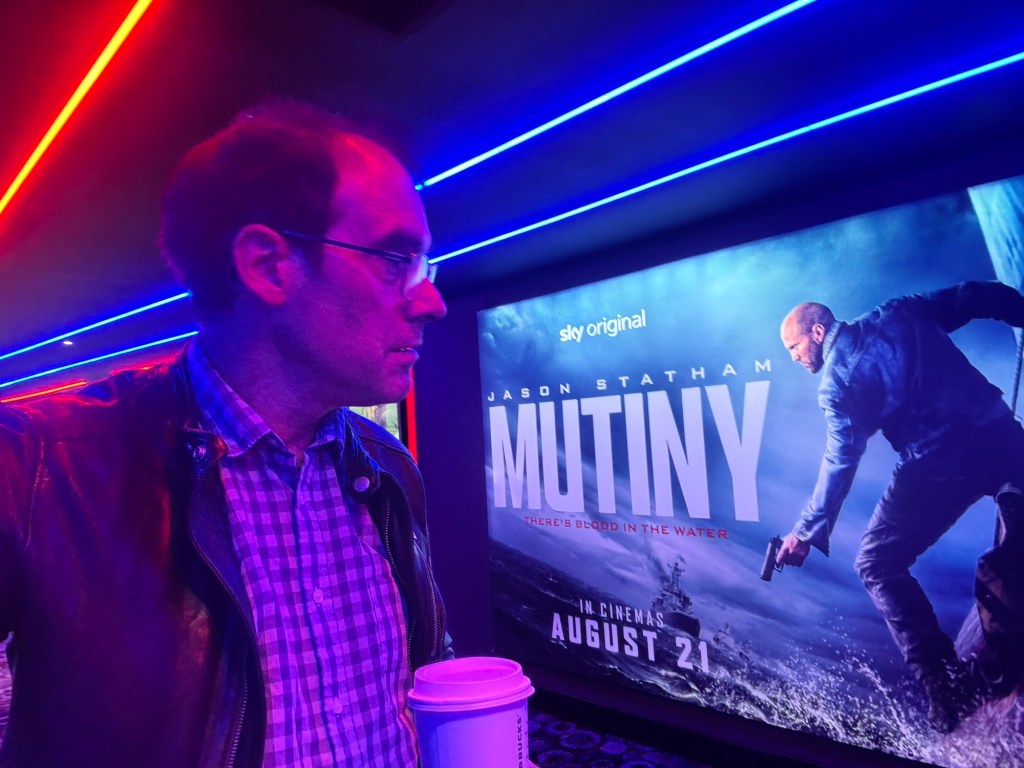
Jason Statham is quite a phenomenon. Across his films, family and vengeance are essentially two sides of the same coin, while the plots themselves can often feel almost deliberately interchangeable. Give him a murdered friend, employer or relative, reveal that somebody has underestimated him, provide a succession of increasingly unpleasant henchmen and then stand back. The pleasure is not really in wondering what will happen. It is in watching Statham do the thing that only Statham seems able to do quite like this.
In ‘Mutiny’, he plays Cole Reed, a private bodyguard whose shipping-magnate employer Tibu (Ramon Tikaram) is assassinated. Reed, inevitably, is framed for the murder. He is also, inevitably, not simply a bodyguard. He is a former highly decorated police officer, which immediately establishes that he is both a good guy and someone possessing a very particular set of skills that the villains are going to regret discovering.
There is something amusingly consistent about Statham’s screen persona in this respect. He always seems to be an ex-something. ‘The Beekeeper’ gave us another variation on the same idea: the apparently ordinary man whose previous occupation turns out to have equipped him with virtually superhuman capabilities. These films understand that part of Statham’s appeal lies in revelation. Other characters look at the bald bloke standing quietly in the corner and see a middle-aged man. The audience knows they are looking at a catastrophic error of judgement.
Here Reed sneaks aboard a cargo ship in an attempt to discover who killed Tibu. The vessel is embarking on a three-and-a-half-week journey from Bangkok to California, and its confined environment gives ‘Mutiny’ one of its most effective qualities. There is something of ‘Die Hard’ about the way the film uses the ship’s passageways, compartments and industrial spaces. The setting becomes a maze through which Statham can stalk his opponents, with the narrow corridors contributing a welcome sense of claustrophobia.
Of course, comparing Reed with John McClane also highlights one of the curious developments in the action hero. McClane became compelling partly because he seemed vulnerable. Statham’s characters tend to operate according to a different principle. Reed is ridiculously resilient. The question is rarely whether he can defeat the next group of men sent after him. It is how efficiently he will do it.
The film even gives us an early game of chess between Reed and his boss, just in case we have failed to understand that he is a strategist. It is an economical piece of Statham shorthand. Reed is not merely physically tougher than everybody else; he is several moves ahead of them. Thereafter he seems instinctively to know what his opponents will do and how the environment around him can be turned into a weapon.
Hooks, chains and padlocks consequently become extensions of Statham himself. Put him inside an industrial environment and practically anything within reach can be repurposed as an instrument for dispatching a goon.
There is an almost tactile quality to his violence. We do not merely watch somebody being punched. We feel the crack as bones appear to snap. The choreography understands that the pleasure of a Statham fight lies in its brutal efficiency. He does not dance around his opponents or indulge in elaborate displays of martial-arts elegance. He identifies the shortest route between an approaching thug and that thug becoming unconscious, incapacitated or dead.
At one particularly absurd moment, he smashes the thug he is holding, pauses to machine-gun another, coldcocks the original man and then guns down two more. The whole operation takes approximately nine seconds. It is ridiculous, obviously, but ridiculousness is almost beside the point. By this stage Statham has established a cinematic universe in which such behaviour feels perfectly reasonable. Watching him methodically eliminate a roomful of armed men is less an action sequence than a demonstration of professional competence.
There is something reassuringly old-fashioned about that. Reed belongs to the tradition of the action hero who knows exactly what to do while everyone else is panicking. He does not need to undergo a profound emotional journey before discovering the strength within himself. He arrived with the strength already installed.
The more troubling element involves the discovery of a crate containing victims of human trafficking. On one level, this raises the stakes and establishes the moral depravity of the people Reed is fighting. But the migrants themselves are treated largely as narrative props. They are introduced as evidence of evil and then disappear remarkably quickly from the story, occasionally resurfacing when the plot requires them.
That feels like a missed opportunity. If a film chooses human trafficking as part of its machinery, the people being trafficked ought to possess some existence beyond demonstrating that the villains are bad. Instead, their suffering becomes another item on the checklist required to justify Reed’s subsequent violence. We know these are terrible people because they murder his boss, frame Reed and traffic human beings. Therefore we can enjoy watching Statham break them into pieces without experiencing too many moral complications.
Perhaps that is the underlying formula of the modern Statham film. Before the violence can begin, the screenplay establishes an ethical licence for it. Somebody has violated the code – threatened a family, killed a friend, exploited the vulnerable – and Statham becomes the instrument through which balance is restored.
Family and vengeance consequently become almost indistinguishable. Loyalty is the moral currency of these films, and betrayal is the unforgivable sin. Reed is not fighting because of some abstract commitment to justice. He is fighting because somebody killed a man to whom he was loyal and then attempted to destroy him as well.
There is little ambiguity about any of this, but ambiguity is hardly what we have come to a Jason Statham film looking for.
The remarkable thing is how durable the formula remains. Change the profession, change the murdered person, change the criminal conspiracy and change the location. This time put him on a cargo ship travelling from Bangkok to California. Next time it could be almost anywhere. What matters is preserving the central ritual: somebody believes they have trapped Jason Statham, only to discover that they have actually trapped themselves in an enclosed environment with Jason Statham.
‘Mutiny’ understands that bargain perfectly well. Its hero is indestructible, strategically brilliant and capable of turning whatever happens to be lying around into a weapon. Its villains exist largely to discover these qualities individually and painfully.
The plot may be interchangeable, but perhaps that is precisely the point. Nobody goes to a Statham film primarily to discover what Jason Statham is going to do.
We go to discover what he’s going to do it with.





Leave a Reply