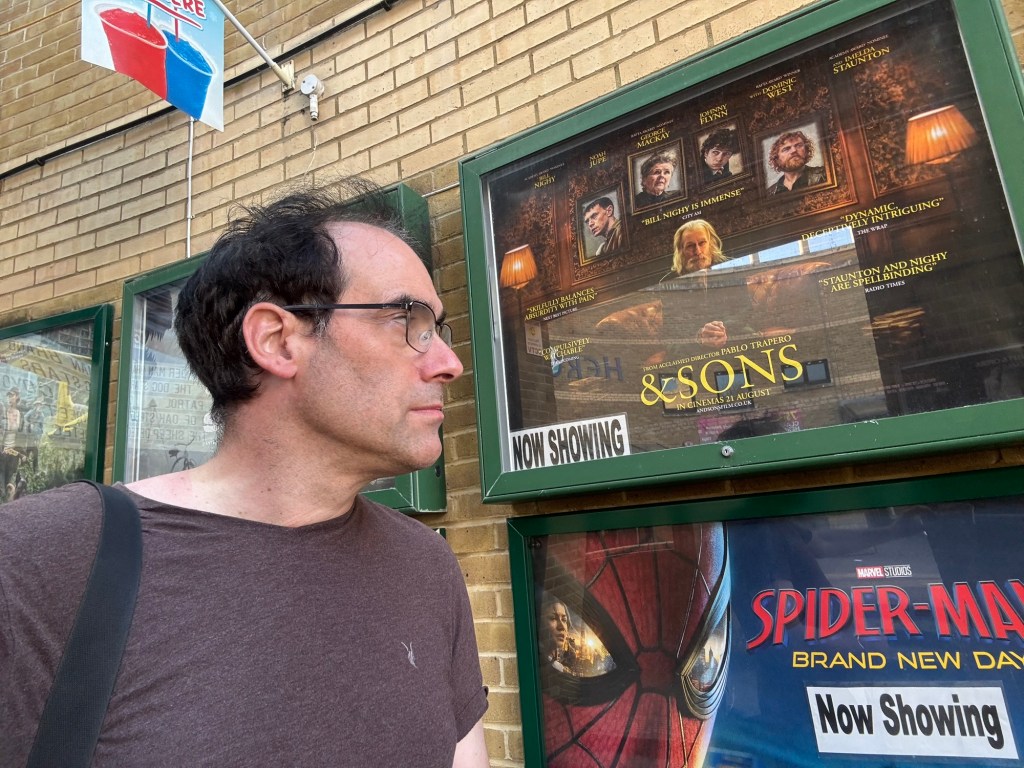
‘& Sons’ has one immediate practical problem: a title beginning with an ampersand makes the film almost impossible to alphabetize. That peculiarity is nothing, however, compared with the wholly preposterous premise sitting at the centre of an otherwise intimate and emotionally serious family drama.
Bill Nighy plays Andrew Dyer, a once-acclaimed literary figure who has published nothing significant for years and now lives a hermit-like existence in his Oxfordshire mansion. He drinks too much, plays jazz albums too loudly, shouts at the walls and has largely withdrawn from the world. It is the sort of role Nighy plays extremely well and recalls both ‘Sometimes Always Never’ and ‘Living’, the latter of which earned him an Oscar nomination. He specializes in men who initially appear emotionally inaccessible – sometimes cantankerous, sometimes simply withdrawn – before we gradually discover the sadness and regret underneath.
Andrew is estranged from his sons, who understandably resent him for what he did to their mother. Yet their relationship with their famous father is more complicated than simple hostility. They have also spent years trading, consciously or otherwise, on his reputation. His name opens doors. One of them is even on the verge of making a film based on Andrew’s most acclaimed novel without having bothered, it seems, to tell him.
Then Andrew, approaching the end of his life, begins revealing what he claims actually happened to their family.
The story everybody has believed is that Andrew had an affair with a woman in the Czech Republic, she became pregnant, and the resulting betrayal destroyed his marriage. Except, according to Andrew, there was no affair. His youngest son is not the product of adultery at all.
At this point, what unfolds introduces what sounds like a science-fiction premise into perhaps the least science-fiction-like surroundings imaginable. We have an Oxfordshire mansion, literary resentments, failed marriages, difficult fathers, adult sons and decades of accumulated emotional damage – and suddenly something from the world of science fiction has wandered into the drawing room.
The remarkable thing is how matter-of-factly the film presents it.
Sarah Polley, who co-wrote the screenplay and previously directed Julie Christie in the wonderful ‘Away from Her’, understands emotional ambiguity, and ‘& Sons’ has considerable emotional heft. The revelation is so ridiculous that it threatens to overwhelm everything around it, yet I found myself surprisingly willing to swallow it. The film does not suddenly become a conventional science-fiction story interested in laboratories or technology, but, rather, asks what this revelation means to a family.
And the most important question becomes devastatingly simple: do you tell the boy? And what happens to someone’s sense of identity when they discover that the story of their own birth is fundamentally untrue?
The cleverest element is that the film leaves open another possibility. Andrew is elderly, increasingly unreliable and potentially suffering from dementia. Perhaps none of this happened.
Perhaps the seemingly fanciful story is simply the final fiction of a novelist who has spent his life constructing stories.
That possibility makes the apparent absurdity considerably more interesting. Andrew has been emotionally incapable of communicating with his family in ordinary terms. Fiction, however, is something he understands. Perhaps this extraordinary tale is therefore his final attempt to make peace with his sons, his former wife and himself. He cannot simply tell them that he loves them, regrets what happened and wants their forgiveness. Instead, he constructs a story sufficiently extraordinary to force everyone back into the same room.
In this respect ‘& Sons’ reminded me of Tim Burton’s ‘Big Fish’. That film was also about the stories fathers tell their sons and the difficulty of distinguishing fabrication from emotional truth. A story can be factually ridiculous while nevertheless expressing something profoundly true about the person telling it.
The film refuses to provide us with the comfortable distance of simply dismissing Andrew as an unreliable old man. Even his ex-wife comes to believe him after meeting the young man, and suddenly something she had regarded as an outrageous lie begins to acquire the possibility of truth.
That is where Imelda Staunton becomes particularly important. She is brilliant as Andrew’s former wife because the revelation has consequences for her that are arguably even more profound than they are for him. If Andrew is telling the truth, then the last however many years of her life have been based upon a lie. She believed her husband had betrayed her sexually. She ended a marriage and built an entirely different life around that belief.
Now she has to contemplate the possibility that the betrayal was something else entirely.
And was it necessarily less of a betrayal?
Andrew may not have slept with another woman, but he apparently made an extraordinary decision involving their family without allowing his wife to participate in it. The absence of adultery does not magically restore trust. If anything, the truth may be even stranger and more destabilizing than the lie it replaces.
This is where ‘& Sons’ becomes more than the gimmick suggested by its premise. It is fundamentally interested in the stories families tell about themselves. Every family develops its own mythology: who betrayed whom, why the marriage ended, why the father disappeared, who was responsible and which version of events everybody has agreed to accept. Eventually those stories become indistinguishable from memory.
Andrew’s revelation detonates the family mythology.
The sons must reconsider the father they have spent years resenting. Their mother must reconsider the event that transformed her life. Andrew himself must confront the consequences of having allowed everybody to believe one story because he was unwilling or unable to tell them another.
And yet the film never entirely resolves whether the new story is any more reliable than the old one.
That ambiguity rescues what could otherwise have been an impossibly silly twist. The premise remains preposterous, but perhaps preposterousness is precisely the point. Sometimes truth really is stranger than fiction. Alternatively, sometimes fiction is the only language available to someone who has spent a lifetime avoiding the truth.
Nighy’s performance allows both interpretations to coexist. Andrew can be an ageing man finally confessing an extraordinary secret, a novelist creating one last story, or somebody whose failing mind has begun confusing imagination and memory. The emotional consequences are genuine whichever explanation we choose.
That ultimately makes ‘& Sons’ a poignant film about fathers, sons and the peculiar narratives through which families understand one another. Its science-fiction element is almost an intrusion from another movie, but the film is less interested in whether it is scientifically plausible than in what happens when an impossible story becomes emotionally plausible.
Perhaps Andrew has finally decided to tell his family the truth.
Perhaps he has written them one final piece of fiction.
Or perhaps, after a lifetime spent turning experience into stories, he no longer knows the difference.



Leave a comment