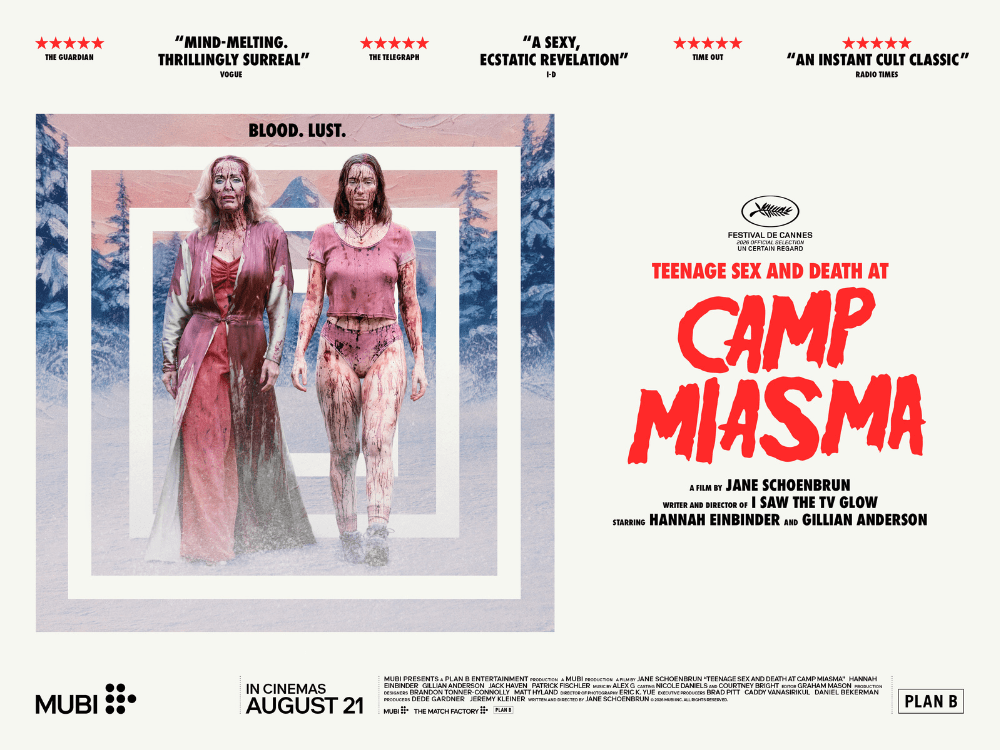
‘Teenage Sex and Death at Camp Miasma’ is a supremely meta movie, and one of its most interesting ideas is the tension between two completely different ways of engaging with cinema. On the one hand there is the academic impulse to analyze a text after the event, teasing out its politics, ideology and cultural significance. On the other there is the primary experience of watching a horror film: the thrill, fear, disgust and excitement that made people want to see the thing in the first place. The film understands that these two responses are not necessarily compatible, and much of its comedy comes from watching them collide.
Kris (Hannah Einbinder) is a filmmaker who has won over Hollywood with her proposal to resurrect Camp Miasma, a disreputable little horror franchise from decades earlier, and give it a contemporary spin. We learn that the film which brought her to Hollywood’s attention was ‘Psycho’ retold from the perspective of the shower curtain. She is clever, self-conscious and determined to interrogate the assumptions of the films she loves. Her new ‘Camp Miasma’ is therefore going to be intelligent, political and probably rather pretentious.
But there is a problem. The original ‘Camp Miasma’ was not designed to be a dissertation. It was designed to be a splatter movie.
Kris consequently goes in search of Billy (Gillian Anderson), the reclusive star of the original film, now in her sixties and living alone on the site where the first ‘Camp Miasma’ was made back in the 1970s. Played by Anderson, Billy initially seems to have become a horror-movie version of Norma Desmond in ‘Sunset Boulevard’. She inhabits this strange Gothic world as though the intervening decades have barely happened. Even more unnervingly, she sometimes appears to be inhabiting her old character. When Kris first encounters her, there is the disconcerting possibility that Billy genuinely believes they are still inside a horror film.
This is where the movie starts playing with the boundary between studying a genre and surrendering to it.
Kris has a complicated relationship with ‘Camp Miasma’. She has an aversion to sex, yet seeing the original film when she was young – essentially a video nasty filled with sex, blood and bodily fluids – awakened something in her. She is both attracted to and repelled by it. She subsequently approaches the franchise almost like a PhD student, determined to understand and reinterpret the very thing that once disturbed her.
There is something recognizable in that relationship with cinema. I remember seeing ‘Taxi Driver’ at age 17 at the university I attended and feeling that same combination of attraction and repulsion. It seemed like the entry into a forbidden world. Half a dozen years later, I found myself studying that very film academically. Something that had initially operated on an instinctive and emotional level had become an object of intellectual analysis.
Kris seems caught in precisely that process. She knows she is doing something clever with ‘Camp Miasma’, but the horror genre operates according to a rather different form of intelligence. The original movie did not make its impact because somebody could write an interesting thesis about it. It made its impact because something about its sex, violence and excess got under people’s skin.
Perhaps Kris has therefore constructed an elaborate academic enterprise around something fundamentally carnal. Her intellectualization of ‘Camp Miasma’ may even be a means of avoiding the very desires she claims to be interrogating. The more she analyzes sex, gender and horror, the more the film seems determined to strip away the analysis and confront her with something primitive underneath it.
That becomes particularly apparent when the boundaries between ‘Camp Miasma’ and the ‘real’ world begin to dissolve. By the gloriously gory finale, Kris and the other characters appear to have crossed a threshold. Suddenly they are no longer sophisticated people discussing an old video nasty from the 1980s. They seem to be inhabiting one. Everyone is blood-spattered, weapons are being brandished and the colours become wildly saturated. The academic analysis has effectively collapsed into the object being analyzed.
Yet the film never loses sight of how ridiculous all of this is. For all its ideas about sexuality, gender and popular culture, ‘Teenage Sex and Death at Camp Miasma’ is also an outrageous comedy. Its killer, Little Death, wears something on their head resembling an air-conditioning vent, giving them the unfortunate appearance of Count Binface. We can even see the eyes peeking through. The film knows how absurd the iconography of the slasher movie can be and has no intention of treating it with excessive reverence.
This makes its relationship with the original ‘Camp Miasma’ particularly interesting. Kris and Billy watch the old film within the new film, giving us another layer of spectatorship: we are watching characters watching the cultural object that has shaped both of their lives. The original movie contains a killer whose story involves gender transition, and Kris is acutely conscious of how transphobic and homophobic elements of the film now appear. As a gay woman herself, she feels that she is ideally positioned to reclaim the franchise and reinterpret it for a contemporary audience.
But the film is clever enough to ask whether reinterpretation is the same thing as understanding.
Kris can identify everything politically problematic about the original ‘Camp Miasma’. She can analyze its representation of gender and sexuality, explain why certain tropes have dated badly and devise a sophisticated contemporary response to them. What she cannot necessarily explain is why she remains so fascinated by the original film in the first place. Her relationship with it is emotional, sexual and perhaps even subconscious before it is political.
In that respect, ‘Teenage Sex and Death at Camp Miasma’ reminded me of ‘I Saw the TV Glow’, which I saw at Sundance. Both films are interested in the way apparently disposable popular culture can burrow deeply into our identities. A cheap television programme or disreputable horror movie can become enormously important to somebody because they encounter it at exactly the right, or wrong, moment in their development. Years later, they may construct an elaborate intellectual framework to explain that fascination, but the original emotional connection remains.
That may be the real subject of ‘Teenage Sex and Death at Camp Miasma’: not simply horror films, but what popular culture does to us.
We like to imagine that we watch films from a safe distance. We analyze them, criticize their politics and place them within historical contexts. But some films get inside us long before we possess the intellectual vocabulary to explain them. They frighten us, excite us, confuse us or awaken desires we do not yet understand. Only afterwards do we begin constructing explanations.
Kris believes she has returned to ‘Camp Miasma’ in order to remake it. Gradually, the joke is that ‘Camp Miasma’ appears to be remaking Kris.
By the time the film erupts into its blood-soaked finale, intellectual distance has become impossible. The critic has entered the text, the academic has become the participant and the respectable contemporary filmmaker has found herself inside the disreputable video nasty she thought she had come to deconstruct.
And perhaps that is the film’s most mischievous proposition. We may spend years explaining why the cultural objects of our youth are problematic, important or worthy of reinterpretation. But underneath all that scholarship may remain a much simpler truth.
Sometimes we love them because they did something to us before we knew how to explain why.


Leave a Reply