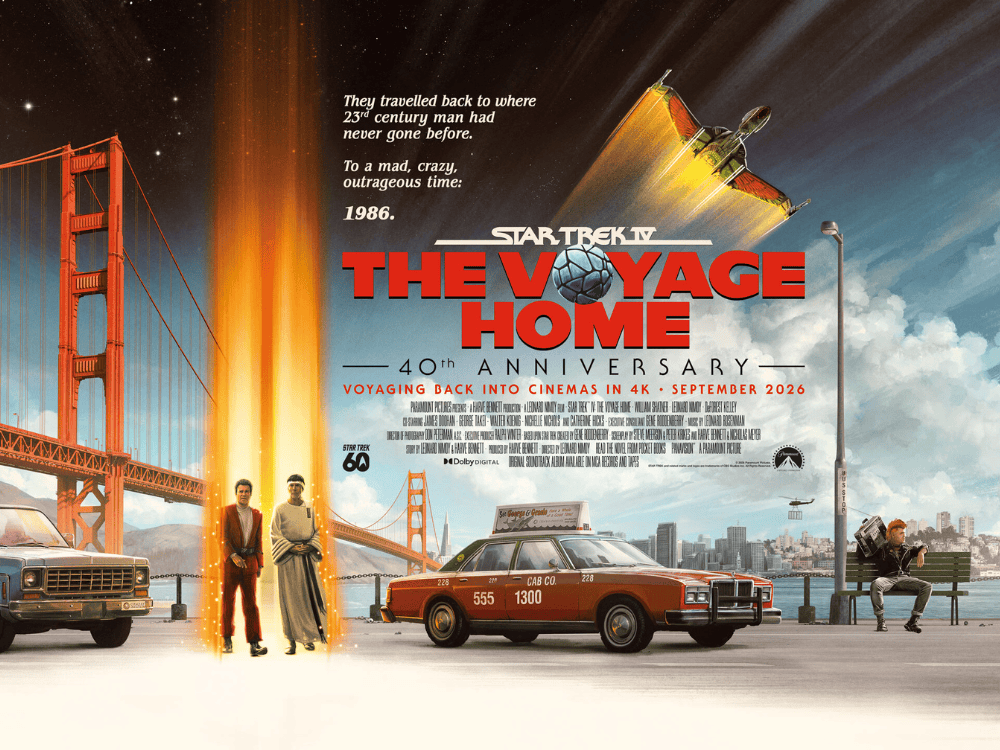
‘Star Trek IV: The Voyage Home’ is a curious one for me because I wouldn’t exactly describe myself as a ‘Star Trek’ fan, and yet there’s something rather irresistible about the idea of taking all these characters from the 23rd century and dumping them in present-day San Francisco – present day in this case being 1986.
These are people who can travel through space, teleport from one place to another and encounter alien civilizations, but put them on a bus in San Francisco and suddenly they haven’t got a clue what they’re doing.
The opening is actually rather less accessible because there’s a fair amount of unfinished business from the previous ‘Star Trek’ films to get through. Captain Kirk (William Shatner) and his crew are heading back to Earth to face a court martial for their actions, and if you’e not particularly immersed in ‘Star Trek’ mythology, there’s a sense that you’re arriving halfway through somebody else’s conversation.
But then Earth faces a rather different problem as a mysterious alien probe is attempting to communicate with the planet, and the message turns out to be intended not for humans but for humpback whales. Unfortunately, by the 23rd century, humpback whales are extinct.
There is, therefore, only one logical solution: travel back in time to 1986, find some whales and bring them into the future.
It’s completely bonkers, of course, but what’s rather charming about ‘The Voyage Home’ is that everybody involved seems to understand that. Rather than attempting to turn this into some enormously serious science-fiction epic, director Leonard Nimoy places much of the emphasis on comedy. The crew arrive in San Francisco and discover that navigating everyday life in the 20th century can be considerably more difficult than travelling through the galaxy.
The film also becomes something of a morality play about whale conservation. From the perspective of the 23rd century, 1986 Earth is technologically and socially primitive, and there’s a pointed irony in the idea that humanity has become sophisticated enough to contemplate the stars while remaining quite capable of wiping another species off the face of the planet.
Admittedly, subtlety isn’t necessarily the film’s strongest quality. The message is pretty obvious: perhaps we shouldn’t hunt whales into extinction. But there’s something rather likeable about the fact that a big mainstream science-fiction film is prepared to build its entire story around that idea.
The whales themselves are being looked after by marine biologist Gillian Taylor (Catherine Hicks), whose devotion to them appears to occupy practically her entire existence. Inevitably, she becomes involved with Kirk and the crew, and there’s the suggestion of a romantic connection between her and Kirk.
It does raise a rather amusing question about Gillian’s life, though. When the opportunity eventually arises to leave everything behind and head off with these people from the future, she doesn’t seem to require an enormous amount of persuasion. Apparently there isn’t much waiting for her outside the whales.
But the most interesting relationship remains the one between Kirk and Spock.
Leonard Nimoy’s Spock is half-human and half-Vulcan, and much of the pleasure comes from the strange interplay between his relentlessly logical view of the world and Kirk’s much more instinctive understanding of human emotions. William Shatner and Nimoy know these characters so well by this point that even fairly simple exchanges between them can be more entertaining than the mechanics of the plot.
And because the film was made in 1986, there’s now another layer to the joke. What was supposed to be the recognisable present day has itself become history. Watching it now means we’re observing the 23rd century looking back at the 20th century from the perspective of the 21st.



 Chris Deacy
Leave a comment