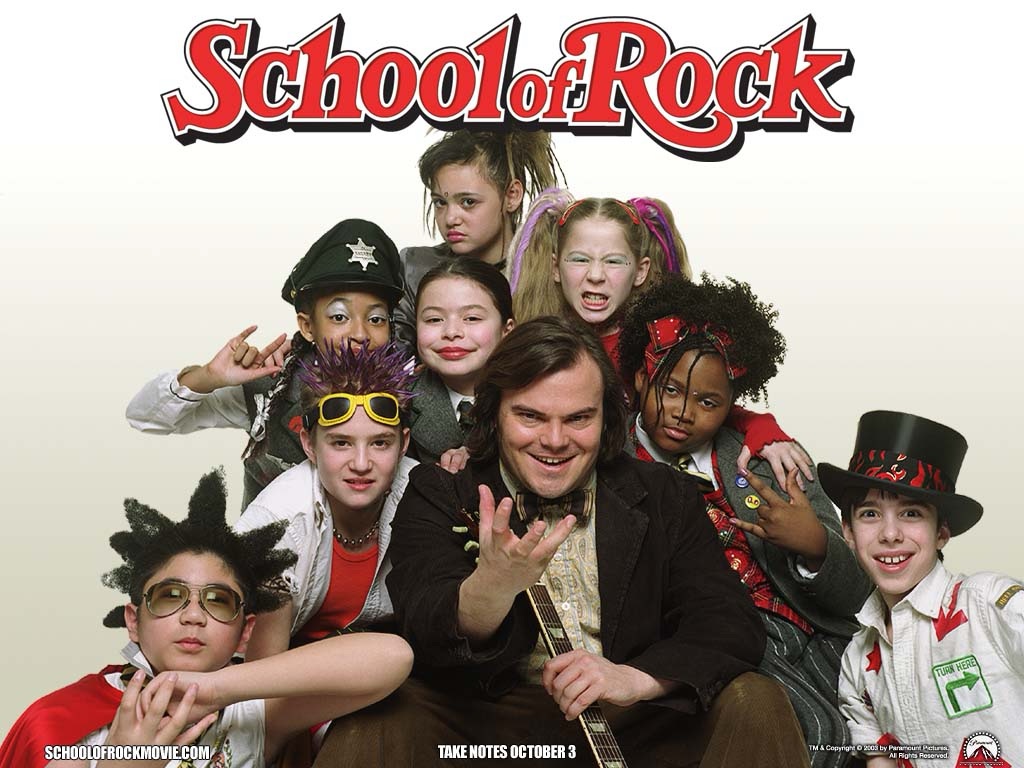
‘School of Rock’ is Richard Linklater making perhaps the most unapologetically mainstream movie of his career, and it’s also a comic tour de force for Jack Black.
It is, however, a film about a school with some quite spectacular safeguarding problems. Black plays Dewey Finn, a wannabe rock star who is thrown out of his band and desperately needs money. When an opportunity arises to impersonate his substitute-teacher flatmate at an expensive private school, Dewey takes it.
So our inspirational teacher is actually a fraud. And viewed in anything approaching the real world, what follows would probably result in criminal charges, an enormous safeguarding investigation and several people losing their jobs.
But that’s also part of the joke.
‘School of Rock’ takes the familiar inspirational-teacher movie – something like ‘Dead Poets Society’ or ‘Mr. Holland’s Opus’ – and turns it inside out.
Usually, these films give us a dedicated teacher confronted with an unruly group of children. The teacher gradually earns their trust, discovers their hidden potential and transforms their lives. Here, the children aren’t unruly at all. Indeed, they’re almost absurdly well behaved. These are privileged, highly educated children from wealthy families who know exactly how they’re expected to behave. They’re polite, disciplined, academically capable and completely institutionalised.
The unruly person is the teacher. Indeed, Dewey Finn arrives like a hand grenade. Initially, he isn’t particularly interested in educating anybody. He doesn’t know anything about teaching and doesn’t especially want to learn. He’s lazy, selfish, dishonest and still obsessed with becoming a rock star.
Then he discovers that the children can play musical instruments. And suddenly he has an idea. He will turn the class into a rock band and enter them into a Battle of the Bands competition.
This is supposedly an educational project. It is actually Dewey attempting to revive his failed music career using somebody else’s children.
And yet something rather lovely begins to happen. Dewey discovers that these uptight children have abilities and personalities that their highly structured education hasn’t necessarily encouraged them to explore. One can sing. Another can play guitar. Somebody else can design costumes. Others become roadies, security, lighting technicians or band managers.
The joke is that Dewey’s motives may be entirely dubious, but his educational instincts are surprisingly good. He looks at children whom everybody else sees primarily in terms of academic achievement and asks a different question: What are you actually good at?
That’s where ‘School of Rock’ touches ‘Dead Poets Society’ territory. There are parents who have very definite ideas about what their children should become and how they should behave. They don’t necessarily want anybody arriving and disrupting the carefully constructed path they have laid out for them. Dewey represents disruption in its purest form.
But unlike Robin Williams’s John Keating, Dewey isn’t some wise educator introducing his students to poetry and independent thought. He’s a douchebag who wants to win a rock competition. That’s what makes the film so funny.
Jack Black throws himself into the role with real gusto. Dewey doesn’t simply like rock music. Rock is effectively his religion. He has his own canon, his saints, his sacred texts and his heretics. And gradually he converts the children.
There’s also something of a Scrooge narrative here, although, as with some of the more interesting redemption stories, Dewey doesn’t completely transform into another person. He’s still Dewey at the end. He doesn’t suddenly become responsible, restrained and respectable. The film understands that making him conventionally sensible would destroy the character.
What changes is that he begins to care about the children. Initially, they’re useful to him. They’re his route back onto a stage.
Eventually, their success matters independently of his own, and that distinction is important. Dewey may never become a model teacher – not least because he isn’t actually a teacher – but he does discover something resembling a vocation.
In that sense there’s a little of ‘Mr. Holland’s Opus’ in the idea that music becomes a means through which an adult helps young people discover something about themselves.
Except Mr. Holland presumably had teaching qualifications. And didn’t abduct his class.
At one point Dewey loads the children into his vehicle and takes the entire class off school premises without permission. On another occasion, they simply escape from school. Eventually, after Dewey’s fraud has been exposed, the children leave school again, travel to his apartment and collect him so they can go to a rock concert.
An entire class of children has effectively disappeared. Again.
Watching it now, you can’t help wondering what the subsequent enquiry would look like. But, applying real-world safeguarding procedures to ‘School of Rock’ is rather like applying employment law to ‘Willy Wonka’s Chocolate Factory’.
The film operates according to the logic of a children’s fantasy. And within that fantasy, Dewey offers these children something the adults around them haven’t, namely, Permission to make noise. Permission to fail. Permission to be ridiculous. Permission, perhaps, to disappoint their parents. The Battle of the Bands element is very much of its era, and the film doesn’t linger particularly deeply on the tensions it raises about privilege, parental expectation or education.
It doesn’t need to. This is fundamentally a comedy, and Linklater keeps it light enough that the more serious themes never overwhelm the fun.
But there is an interesting educational idea underneath everything. The children don’t become ‘better’ because Dewey teaches them discipline. They already have discipline. What they need is somebody to introduce a little chaos.
And Dewey doesn’t become ‘better’ because the children teach him to behave himself. Rather, they teach him to care about something beyond himself. So teacher and pupils meet somewhere in the middle. They become a little less uptight. He becomes a little less selfish. And everybody gets to play very loud music.
Perhaps that’s why ‘School of Rock’ remains so enjoyable. It takes the inspirational-teacher movie and gives us possibly the least appropriate inspirational teacher imaginable. Dewey Finn lies his way into a school, impersonates somebody else, abandons the curriculum and repeatedly takes children off the premises without permission.
He should be an educational disaster. But, instead, completely by accident, he turns out to be rather good at it. And Jack Black makes the whole ludicrous thing irresistible.



Leave a comment