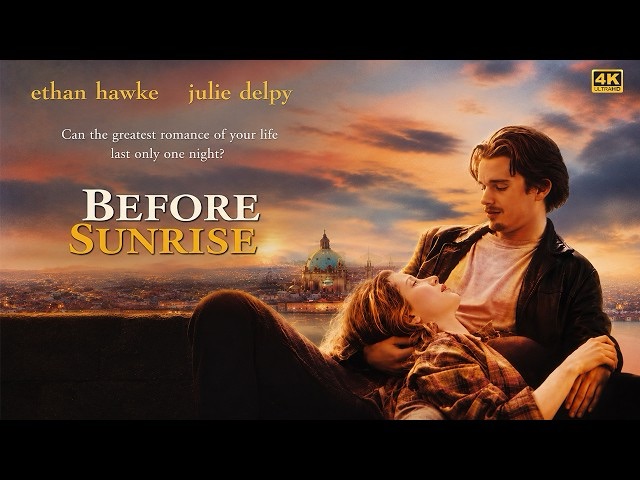
I came to ‘Before Sunrise’ rather unusually, having watched its 2004 sequel, ‘Before Sunset’, before seeing the original. And perhaps that makes Richard Linklater’s captivating romantic drama even more fascinating, because I already knew something about the consequences of a chance encounter that, for the characters themselves, might never be repeated.
Ethan Hawke plays Jesse, a young American travelling through Europe, who strikes up a conversation with Céline, played by Julie Delpy, on a train. There’s an immediate spark between them. When Jesse reaches Vienna, he persuades Céline to get off the train and spend the night exploring the city with him before he catches his flight home the following morning.
It’s an enormous gamble. After all, she’s abandoning her plans to spend several hours with somebody she’s only just met. But there’s something wonderfully romantic about that decision. Both recognize that an opportunity has presented itself, and neither wants to spend the rest of their life wondering what might have happened.
What follows is almost miraculous in its simplicity. They walk around Vienna. They travel on trams. They visit cafés, wander through streets and talk. And talk. There are no villains, no great betrayals, no disasters and almost no conventional dramatic conflict. The film’s entire premise rests upon the possibility that watching two people getting to know one another might be sufficiently compelling in itself.
Their conversations move effortlessly between the trivial and the philosophical. At one point, Jesse wonders about reincarnation: if the world’s population keeps increasing, he muses, where do all the additional souls come from? They want to know everything about one another, but they also want to impress each other with their ideas. And underneath all this conversation is the unspoken question of whether their attraction will become physical. Will they sleep together? Will they fall in love? And, perhaps more importantly, what happens when morning comes?
What makes ‘Before Sunrise’ particularly poignant is that it belongs to a world before smartphones and social media. Today, Jesse and Céline might exchange numbers, follow one another online and remain permanently connected. Indeed, they might never have started talking in the first place, because they’d probably both have been staring at their phones.
But in 1995, a chance encounter really could disappear forever. That gives the film something of the romantic yearning of ‘An Affair to Remember’ or ‘Sleepless in Seattle’. Is this the person they’re destined to be with? And if they separate, will they spend the rest of their lives wondering whether they’ve squandered their one opportunity for happiness?
Linklater has always been fascinated by the passage of time, most obviously in ‘Boyhood’, which follows its characters across twelve years. Here, time is equally important, but in a different way. Jesse and Céline have only a few hours together, and that limitation makes every conversation, every hesitation and every missed opportunity matter.
At the end, they agree to meet again in Vienna six months later, without exchanging contact details. It’s an almost absurdly romantic gesture, particularly given that Jesse lives in America. Will either of them actually return? Will the other be there? And what happens if one arrives and the other doesn’t?
Those questions would eventually be explored in ‘Before Sunset’, released nine years later, but ‘Before Sunrise’ stands beautifully on its own. It’s a film about the extraordinary significance we sometimes attach to the briefest encounters. Most romances are about two people finding one another and overcoming obstacles to remain together. Here, the obstacle is simply life itself.
Perhaps the most romantic thing about ‘Before Sunrise’ isn’t the possibility that Jesse and Céline have found true love. It’s that, for one night, they allow themselves to believe that they might have.




Leave a Reply