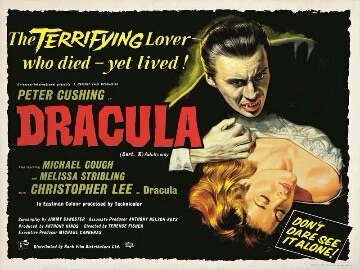
Beautifully restored by the BFI, Hammer’s 1958 ‘Dracula’ remains a wonderfully handsome piece of Gothic horror, even if it lacks the transcendent otherworldliness of Francis Ford Coppola’s 1992 interpretation. This is a much more physical, almost practical kind of vampire movie. There are no elaborate dreamscapes or extravagant flights of supernatural imagination. Instead, we have plush interiors, imposing staircases, shadowy corridors and the rather lovely Berkshire countryside standing in for Transylvania.
It’s a beautifully handmade film, and that remains a large part of its appeal. What immediately struck me was how differently it approaches the familiar story. We begin with Jonathan Harker (John Van Eyssen), who arrives at Dracula’s castle ostensibly to take up employment as a librarian. But Harker isn’t the innocent visitor we might expect. He’s actually an amateur vampire hunter, determined to destroy his aristocratic employer.
It’s an interesting reversal: the man who appears to be the victim is initially the aggressor, entering the castle with murderous intentions. Unfortunately, he discovers that killing Dracula is rather more difficult than anticipated. And instead of destroying the vampire, he becomes one of his victims. The consequences bring us into the world of Harker’s fiancée and her family, before Peter Cushing’s Doctor Van Helsing emerges as the film’s principal force for good.
Cushing is marvellous: brisk, intelligent, purposeful and reassuringly authoritative. His Van Helsing approaches vampirism almost as a medical problem requiring careful diagnosis and decisive treatment. Although his medical advice isn’t always entirely convincing as we see in a scene where he recommends that somebody recovering from a blood transfusion should drink plenty of tea, coffee – or, better still, wine. One suspects that contemporary medical professionals might take a slightly different view.
But what really distinguishes the film is Christopher Lee. Where Bela Lugosi’s Dracula became an almost theatrical embodiment of the vampire, complete with hypnotic stare and iconic cape, Lee gives us something altogether more unsettling. His Dracula is a debonair aristocrat, outwardly sophisticated and seductive, whose charm makes the violence beneath the surface considerably more disturbing. He doesn’t need to spend the entire film displaying his fangs. His presence is threatening enough. And there’s an unmistakable eroticism to the performance.
Vampirism has always been a particularly suggestive metaphor, combining bodily invasion, forbidden desire, addiction and the transmission of something dangerous through intimate contact. Watching ‘Dracula’ today, it’s easy to see parallels with drug dependency and sexually transmitted disease. The vampire offers an intoxicating experience, but the consequences are potentially fatal. Hammer makes these undercurrents unusually explicit for its period.
There’s also plenty of genuine horror: crucifixes burning into flesh, stakes driven through undead hearts and the disturbing transformation of apparently respectable people into creatures driven by uncontrollable appetites. What makes these moments effective is their physicality. The horror feels tangible, almost painfully so. It’s an elegant, economical piece of filmmaking that knows exactly what kind of story it wants to tell.


Leave a Reply