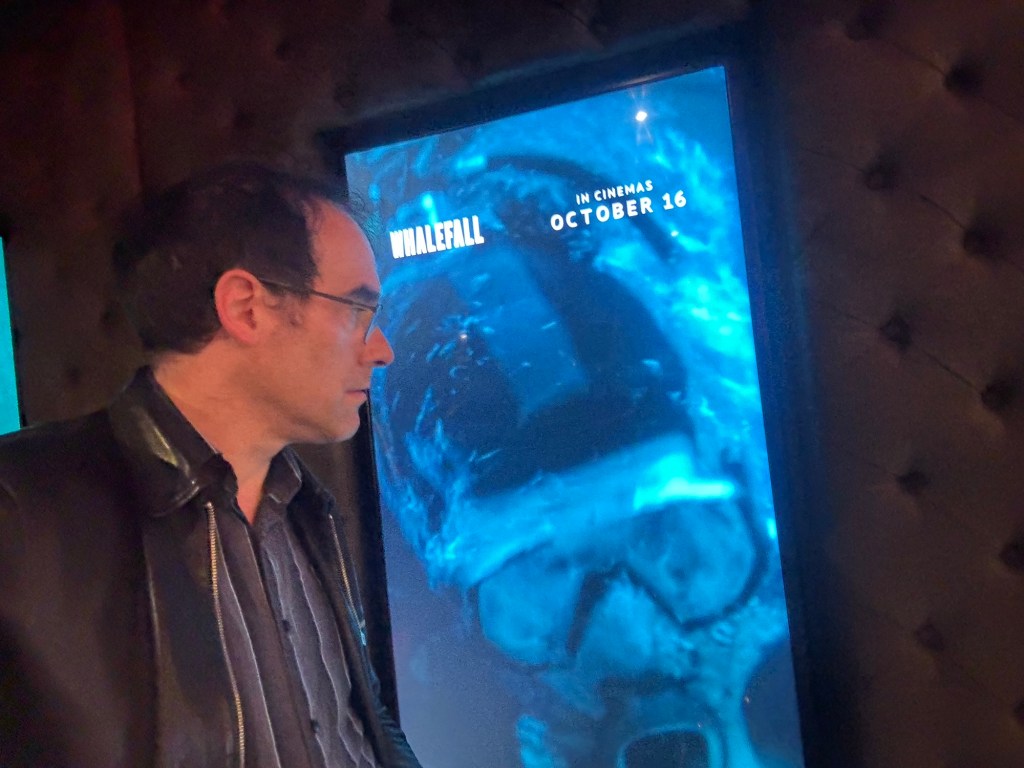
‘Whalefall’ is another survival adventure in the tradition of ‘Heart of the Beast’, although this time the wilderness is underwater and the relationship at its centre is between a father and son, one of whom is already dead.
Jay (Austin Abrams) is a young scuba diver who ventures into the ocean to recover the body of his father, Mitt (Josh Brolin). Their relationship was complicated, to say the least. Mitt was a larger-than-life sailor, something of a Captain Ahab figure, whose appetite for adventure left his son feeling disappointed and emotionally neglected. But Jay’s attempt to recover his father’s body takes an unusual turn when he’s swallowed by a sperm whale. Suddenly, he’s trapped inside a living creature, with an oxygen supply that will last barely an hour.
It’s certainly an ingenious premise for a survival thriller, although one that rather stretches credibility. The film then becomes an extended exercise in underwater problem-solving as Jay attempts to escape his predicament, drawing upon lessons taught by the very father whose influence he’s spent much of his life resisting.
And that’s really what ‘Whalefall’ is about. Father and son may have seemed fundamentally different, but when confronted by almost certain death, Jay discovers that he possesses precisely the instincts, determination and survival skills he once associated with his father. I was reminded of ‘Frequency’, the 2000 film in which a father and son communicate across different periods of time and effectively save one another.
There’s an obvious mythological dimension to all this. Being swallowed by a whale immediately evokes Jonah, while Jay’s journey through the belly of the beast resembles the symbolic death and rebirth described by Joseph Campbell in ‘The Hero with a Thousand Faces.’ There’s something almost Dantean about it, too. Jay descends into a dark, seemingly inescapable underworld, suspended between life and death, where he’s forced to confront his past before he can return to the world of the living.
It’s essentially a near-death experience made literal. The film even finds time for Jay to develop an unlikely relationship with a jellyfish, while his breathing apparatus becomes a constant reminder that every moment brings him closer to suffocation.
But for all these intriguing possibilities, ‘Whalefall’ doesn’t have quite as much depth as the ocean in which it’s set. It remains a rather conventional single-premise survival movie, punctuated by flashbacks designed to provide emotional significance to Jay’s predicament. And despite the apparently impossible odds, there’s never much doubt that he’s going to survive.
The film’s most interesting metaphor is contained in its title. Mitt explains that when a whale dies and its carcass sinks to the ocean floor, it creates an entire ecosystem, sustaining other forms of life long after the animal itself has perished. It’s a beautiful image, and one that clearly reflects the relationship between father and son. Mitt may be dead, but his experiences, knowledge and love continue to sustain Jay.
In that sense, the father’s death becomes the means through which the son discovers how to live. It’s also a rather elaborate form of emotional closure. Jay enters the ocean hoping to recover his father’s body, but what he really needs to recover is his relationship with him. The film’s journey out of the whale therefore becomes a journey out of grief.
Unfortunately, the symbolism is considerably more sophisticated than the storytelling, which remains fairly predictable. Still, there’s something affecting about the central idea. Jay goes into the ocean to bring his father back from the dead. Instead, it’s his dead father who teaches him how to return to the living.




Leave a Reply