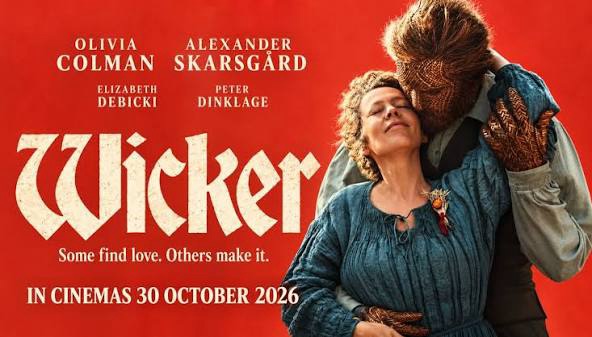
I ended up seeing ‘Wicker’ on two consecutive nights, at different cinemas, both times as part of an advance mystery screening. And I can hardly imagine a more appropriate film to encounter without knowing what to expect. It’s a gloriously offbeat, thoroughly bonkers fairy tale for adults, set in a village that appears to exist somewhere between the Middle Ages and an unspecified later period.
Olivia Colman plays a downtrodden fisherwoman, cruelly mocked by the other villagers, whose prospects of finding a loving husband appear virtually nonexistent. So she takes matters into her own hands. She commissions a mysterious basket-maker, played by Peter Dinklage, to weave her a husband. What emerges is quite literally the man of her dreams: a handsome, sensitive, considerate wicker man who turns out to be considerably more accomplished at being a husband than any of the actual men in the village.
He’s affectionate, practical, attentive and apparently an exceptional lover. Indeed, he seems to possess virtually every quality the village’s human men conspicuously lack. And that’s the central joke as here is a man constructed from wicker who turns out to be more human than the human beings surrounding him.
For a while, it’s a fairy tale come true. The fisherwoman’s fortunes improve, her confidence grows and she experiences a happiness that previously seemed unimaginable. But, inevitably, the villagers begin to resent this extraordinary newcomer. I was reminded of ‘Edward Scissorhands’, another story about an artificial man whose innocence and unusual abilities initially fascinate a community before provoking jealousy, suspicion and ultimately hostility.
The wicker husband doesn’t deliberately challenge the village’s social order. He simply behaves differently. He tends the home while his wife goes out to work. He treats her as an equal rather than a subordinate. And he seems entirely comfortable with a partnership in which both contribute according to their abilities rather than their prescribed gender roles.
Unfortunately, this is a society in which the men expect to dominate and the women have learnt to expect very little. Even people’s identities are defined by their occupations, with couples known principally by the trades they perform. Nobody is particularly encouraged to imagine a different life. And then along comes this extraordinary creation who demonstrates that marriage needn’t involve the humiliation and subordination of women.
The men are threatened by him, while the women begin to recognise what they’re missing. Resentment spreads through the village, and the couple’s happiness becomes increasingly precarious.
What makes the satire effective is that the wicker man isn’t really trying to change society. He’s simply being a decent husband. Yet in this community, that turns out to be an almost revolutionary act.
There’s something wonderfully absurd about the whole premise, but beneath the comedy is a sharp critique of patriarchy and the ways communities punish those who refuse to conform. That said, I did wonder whether the film might have explored the philosophical implications of its creation a little further. Does the wicker man possess a soul? Is he genuinely capable of love, or has he simply been constructed to fulfil the fisherwoman’s desires? And if his entire purpose is to please her, can their relationship really be considered equal?
These are intriguing questions, but the film is more interested in the social consequences of his existence than in examining what he actually is. Perhaps that’s fair enough insofar as this is a fairy tale, and fairy tales don’t necessarily need to explain their magic.
Ultimately, ‘Wicker’ is a strange, funny and surprisingly pointed story about the danger of getting exactly what you wish for – particularly when your happiness exposes everybody else’s dissatisfaction. The villagers may regard the wicker husband as unnatural, but the film’s delicious irony is that he’s the only man among them who seems to understand how to behave like a human being.



Leave a Reply