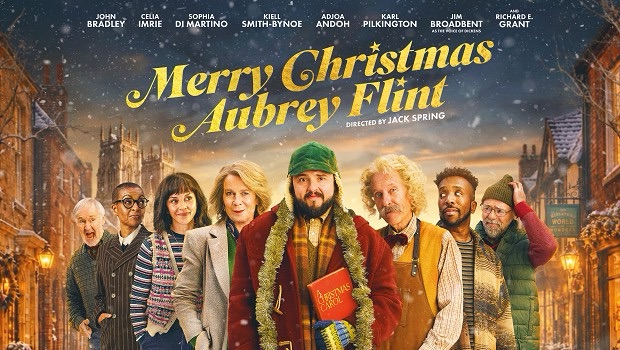
‘Merry Christmas Aubrey Flint’ is a thoroughly predictable Christmas film, and I mean that almost entirely as a compliment. It’s a variation on Dickens’s ‘A Christmas Carol’, with something of ‘The Thursday Murder Club’ thrown in, although without the murders. It even features Celia Imrie, once again playing a resident of a retirement home whose future is threatened by people with rather less sentimental ideas about the value of elderly people and their surroundings.
The story begins in 1996, when a young boy named Aubrey, whose mother is French, arrives in Britain and starts at a new school. Then, on Christmas morning, tragedy strikes. His mother dies, leaving him with an emotional wound that will shape the rest of his life. Thirty years later, Aubrey (John Bradley) has become a solitary, socially awkward man who regards most human interaction as an inconvenience. He lives alone, surrounded by model soldiers and figurines from the Napoleonic Wars, and seems considerably more comfortable contemplating historical military campaigns than navigating ordinary human relationships.
He believes in history, not fiction, which is rather unfortunate, given that he’s about to find himself living through one of the most famous fictional Christmas stories ever written. Aubrey is a wonderfully peculiar character. He’s cold, pedantic and frequently exasperating, but also witty, endearingly awkward and capable of genuine affection, particularly towards Mr. Hopkins, the elderly proprietor of a model shop, played by Richard E. Grant.
Their friendship provides an early indication that Aubrey isn’t quite the misanthrope he appears to be. He’s simply somebody who has found it easier to organize his life around things that cannot disappoint or abandon him. Napoleon’s soldiers, after all, are unlikely to let him down.
Through a series of circumstances, Aubrey finds himself reluctantly involved with a care home whose elderly residents face eviction because a businessman has designs on the building. The residents decide to stage a production of ‘A Christmas Carol’, hoping that the performance will help secure arts-related accreditation and preserve the home. Naturally, Aubrey gets drawn into the enterprise. And naturally, he resists.
One of the film’s nicest jokes is that he initially rejects Dickens on the grounds that fiction is inherently less worthwhile than history. Then he discovers that Dickens was also a social historian, documenting the injustices and inequalities of Victorian Britain. Suddenly, ‘A Christmas Carol’ becomes a little more respectable.
It’s an amusing way of introducing a man who has spent his life studying the past to a story that might finally help him confront his own. And that’s really what the film is about. Aubrey has never properly recovered from losing his mother, and his rejection of Christmas is less a matter of intellectual conviction than emotional self-preservation. By refusing to participate in the rituals of the season, he has also protected himself from the possibility of further disappointment.
The irony is that this protection has become a form of imprisonment. The elderly residents, meanwhile, face a different kind of abandonment: a society that increasingly regards them and their homes as obstacles to commercial development. Their Christmas production becomes an assertion that community, memory and companionship possess a value that cannot be calculated in property prices.
Of course, the film isn’t remotely subtle. When we learn that the residents are putting on ‘A Christmas Carol’ at five o’clock on Christmas Eve, we can predict almost every emotional beat that follows. We know that Aubrey will rediscover the importance of human connection, that the elderly residents will demonstrate their worth, and that the Christmas spirit will eventually prevail. But somehow none of this matters.
The film is set in York, which provides an appropriately picturesque backdrop, and its combination of eccentric characters, gentle humour and unabashed sentimentality is utterly beguiling. There’s something reassuring about a Christmas film that understands its own formula and doesn’t feel obliged to subvert it.
After all, nobody watches ‘A Christmas Carol’ wondering whether Scrooge will become a better person. We watch because we want to see him do it again. Aubrey Flint spends his life studying the battles of the past. The film’s gentle charm lies in watching him discover that the most important victory is learning how to live in the present.






Leave a Reply