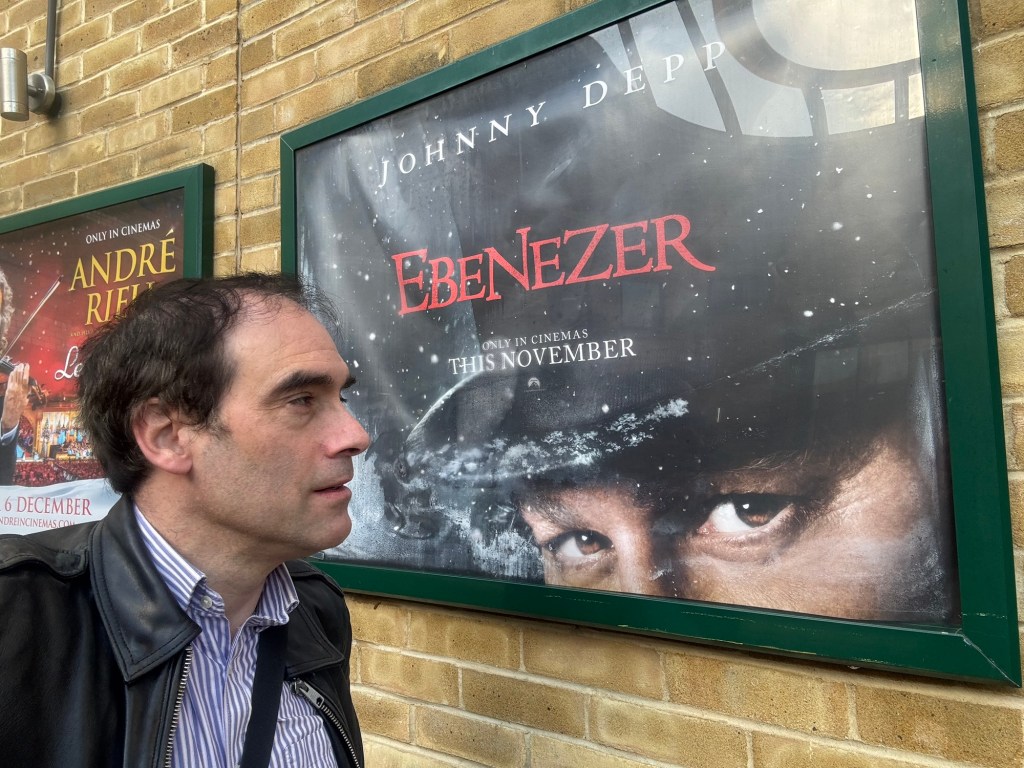
There have been so many adaptations of Dickens’s ‘A Christmas Carol’ that it’s difficult to imagine anybody finding a genuinely new approach to the material. But ‘Ebenezer’, directed by a filmmaker more closely associated with horror, certainly makes an effort.
This is a considerably darker, more macabre interpretation of the familiar story, complete with jump scares, grotesque apparitions and a vision of Victorian London that seems closer to a nightmare than a Christmas card. Johnny Depp plays Ebenezer Scrooge, the notorious miser whose contempt for Christmas is matched only by his apparent contempt for humanity.
But what’s interesting about this version is that it makes a greater effort to explain how Scrooge became the man we know. We see something of his earlier relationship with Jacob Marley (Ian McKellen), whose influence appears to have helped shape his increasingly mercenary understanding of the world.
Rather than presenting Scrooge as somebody who was simply born unpleasant, the film suggests that his cruelty has developed through disappointment, loss and a gradual withdrawal from human relationships. He hasn’t always been a bad man. He’s become one. And that’s perhaps the film’s most intriguing idea.
Scrooge’s obsession with money isn’t simply greed. It’s a way of protecting himself from the emotional uncertainties of life. Money doesn’t abandon you. It doesn’t die. It doesn’t demand affection or expose you to the possibility of rejection. By devoting himself to accumulating wealth, Scrooge has effectively insulated himself from everything that makes existence worthwhile.
The tragedy is that his apparent self-preservation has become a form of spiritual suffocation. The supernatural elements are certainly more frightening than in most adaptations. Andrea Riseborough’s Ghost of Christmas Past resembles something closer to a decaying corpse than a benevolent spirit, while Scrooge’s encounters with the other apparitions frequently become elaborate exercises in Gothic horror.
At one point, he even finds himself struggling to escape being buried alive. It’s an effective metaphor for somebody who has spent years entombing himself emotionally, although the film isn’t always quite so subtle about its symbolism. Indeed, there are moments when the horror threatens to overwhelm the human story.
Dickens’s original is frightening because Scrooge is forced to confront the consequences of his own choices, particularly the prospect of dying unmourned and unloved. You don’t necessarily need a succession of jump scares to make that prospect terrifying. And occasionally ‘Ebenezer’ seems more interested in startling us than in exploring the psychological implications of what we’re watching.
I also had reservations about Depp’s performance. He’s played lonely, isolated outsiders before, most memorably in ‘Edward Scissorhands’, but that character was essentially an innocent rejected by society. Scrooge is almost the opposite: a man who has actively rejected society before it can disappoint him.
It’s an interesting role for Depp, particularly given the possibilities of a story about public judgement, personal suffering and redemption. Yet he seems strangely subdued. There are traces of the mannerisms familiar from ‘Pirates of the Caribbean’, particularly the slurred delivery and slightly eccentric physicality, but without the flamboyant energy that made Captain Jack Sparrow so memorable.
I kept thinking that an actor such as Al Pacino might have attacked the role with considerably more ferocity, or that Robert De Niro might have brought a more intimidating intensity to Scrooge’s bitterness. Depp, by contrast, sometimes seems almost overwhelmed by the elaborate Gothic spectacle surrounding him. Rather than dominating the film, he retreats into it. And the pacing doesn’t always help. For all its supernatural excesses, ‘Ebenezer’ can feel surprisingly slow.
Of course, we know where the story is going. Scrooge will confront his past, witness the consequences of his present behaviour and glimpse the dreadful future awaiting him unless he changes. The question is whether this particular interpretation makes that transformation emotionally convincing.
I’m not entirely sure it does. A lifetime of emotional withdrawal isn’t necessarily going to be reversed by a single night of supernatural intervention, however traumatic. He may become more generous, more compassionate and more willing to connect with other people without suddenly becoming an entirely different person. And perhaps that’s a more credible understanding of redemption.The most interesting thing about ‘Ebenezer’ isn’t whether Scrooge can become a good man overnight. It’s whether a man who has spent his life protecting himself from humanity can finally risk becoming human again.



Leave a Reply