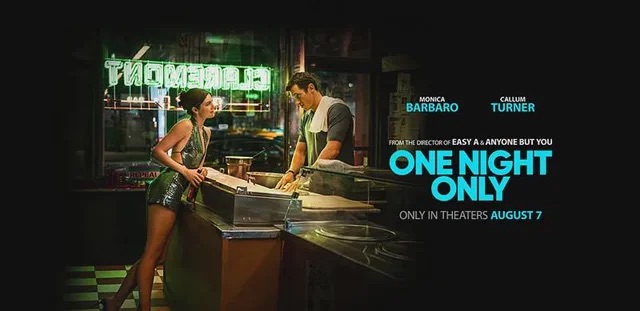
‘One Night Only’ is a dystopian romance with a potentially fascinating premise which the film unfortunately treats as little more than a gimmick. In this alternative America, the government has banned unmarried people from having sex for 364 days of the year. There is just one night when the restrictions are lifted and everybody is allowed to overindulge.
It is a temporary inversion of the normal social order, rather like those occasions when traditional hierarchies are ceremonially reversed – during wartime, for example, when officers might serve the troops their Christmas dinner.
But what kind of society would actually impose such a law? Is this one night an expression of freedom, or simply another mechanism through which authoritarian power is maintained?
The film barely seems interested.
We occasionally glimpse protesters carrying placards saying ‘Down with the mandate’, but otherwise there is surprisingly little exploration of what living under such a system would mean. Instead, the premise becomes an excuse to send lots of extremely horny people onto the streets of New York with twelve hours to find somebody.
At the centre are characters played by Callum Turner and Monica Barbaro. Turner has planned a romantic night with his girlfriend, only to discover that she regards the annual lifting of the embargo as an opportunity to sleep with somebody else.
Understandably gutted, he heads out looking for another partner.
Barbaro is similarly wandering New York in search of somebody, repeatedly encountering apparently perfect men who turn out to be losers, liars or cheats. Her first encounter with Turner isn’t exactly promising either: he has eaten something which disagrees with him and throws up on the pavement in front of her.
Romance is not immediately in the air.
Yet they keep encountering one another, and gradually the possibility emerges that the person each has been searching for might have been standing in front of them all along.
There are explicit references to ‘An Affair to Remember’, including the romantic mythology of meeting at the top of the Empire State Building, although much of ‘One Night Only’ is considerably less glamorous. Indeed, a surprisingly large proportion of the film involves the pair searching New York for what appears to be the city’s last available condom.
That creates some funny situations, but it also exposes a weakness in the premise. If everybody knows they have exactly one night a year when unmarried sex is permitted, wouldn’t they have been preparing for it for months?
This should surely be the most meticulously organised night in America. But, instead, everybody behaves as though the mandate has been unexpectedly lifted that afternoon.
What interested me more was the resemblance to Martin Scorsese’s ‘After Hours’. In that film, an ordinary man with a respectable daytime existence enters a bizarre nocturnal version of New York where increasingly strange things happen and escape becomes almost impossible. Eventually daylight returns and normality is restored.
‘One Night Only’ has something of the same structure. Night transforms the city into an alternative world governed by different rules. The protagonists wander through it encountering increasingly strange people and situations before morning restores the established social order.
Except that this is supposedly a dystopia, and the film never really challenges that order.
In fact, the ending comes surprisingly close to endorsing it.
For all its apparent edginess, the film ultimately suggests that perhaps sex really should be reserved for somebody special. Turner and Barbaro spend the night together but don’t actually have sex, and this becomes evidence that their relationship might mean more than the various casual encounters happening around them.
That is an unexpectedly conservative destination for such a provocative premise.
The film seems to spend its running time teasing the possibility that these two people will sleep together before effectively concluding that having sex with somebody you’ve only just met might not be such a great idea after all… which rather raises the question of what exactly it thinks is wrong with the mandate.
By the end, our protagonists appear prepared to wait another twelve months for the opportunity to sleep together. But if they really believe they’ve found the person they want to be with, why don’t they simply get married and have sex whenever they like?
There is even a cab driver near the deadline asking whether Turner wants to squeeze a little more ‘juice’ out of the evening before the restrictions return. Everybody is frantically trying to maximize their annual allocation of sexual freedom, but nobody seems particularly interested in questioning why the government should possess this extraordinary authority over their private lives in the first place.
And this is why ‘One Night Only’ ultimately feels toothless.
There is a much more provocative film hidden inside it about state power, sexuality and the strange psychology created when something ordinary is forbidden for almost the entire year. Would prohibition make sex more desirable? Would marriage become primarily a means of escaping government regulation? Would people marry for convenience? Would there be an enormous underground culture devoted to breaking the mandate?
The possibilities are endless. Yet the film explores almost none of them.
Instead, the dystopian setting becomes window dressing for a fairly conventional romantic comedy about two disappointed people wandering around New York and gradually discovering one another.
There is nothing inherently wrong with that, and Turner and Barbaro make the nocturnal misadventures enjoyable enough. But the film promises something considerably more subversive than it ultimately delivers.
‘One Night Only’ presents a society in which the government controls when unmarried people can have sex, but strangely ends up suggesting that perhaps abstinence isn’t such a bad thing after all.
For a film built around one night of sexual rebellion, it finally seems remarkably keen to get everybody safely back in bed – and preferably married – by morning.



Leave a Reply