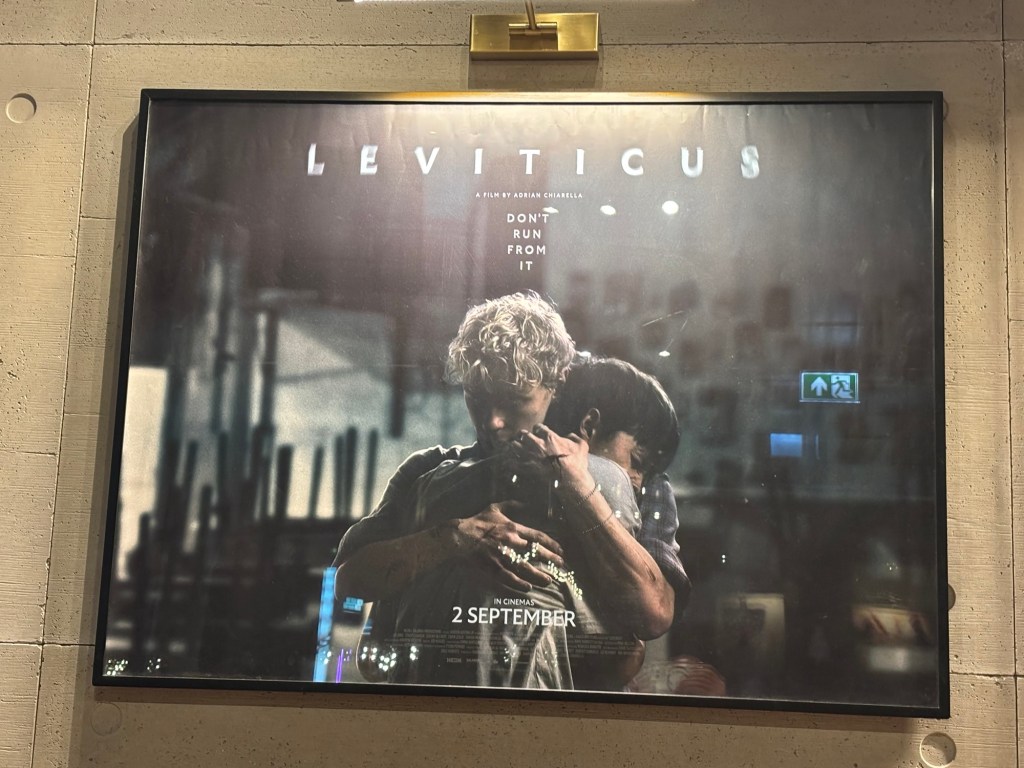
‘Leviticus’ is a horror film set in a small-town Australian community, though underneath the demons and supernatural terror it is really a queer drama about two school-age boys trying to understand their sexuality in an environment determined to tell them that what they feel is wrong.
The two boys begin a relationship, only to encounter disgust from the surrounding community. Instead of being allowed to work out who they are for themselves, they are sent to a pastor and deliverance healer who is supposed to ‘cure’ them.
But they aren’t cured. Rather, they’re cursed.
There are links here with ‘Maurice’, the 1987 adaptation of E.M. Forster’s novel, where homosexuality is treated as though it were an unfortunate condition that can somehow be removed, allowing the individual to return to the heterosexual conventionality society expects.
‘Leviticus’ takes this same idea and transforms it into horror.
The title itself invokes the Old Testament and those passages traditionally used to condemn homosexuality as sinful. The boys are taught that their desires are somehow rotten or corrupt, yet this condemnation doesn’t remove those desires. It merely changes the way they experience them.
After the attempted deliverance, demons begin appearing. But these aren’t conventional monsters. They take the form of the person each boy loves.
That is a terrific horror premise because it collapses the distinction between greatest desire and greatest fear. The person standing in front of you might be the person you love more than anybody else in the world. Or they might be something trying to kill you.
Suddenly intimacy itself becomes dangerous. Every loving encounter contains the possibility of violence and every gesture of affection has to be questioned. The boys can no longer trust their own perceptions, let alone each other.
There is something almost like supernatural gaslighting going on.
And this is where the horror metaphor becomes particularly effective. The community has told these boys that their love is dangerous, unnatural and potentially destructive. The curse then makes that prejudice physically real. Their greatest source of emotional comfort becomes indistinguishable from a monster.
The demons therefore seem less like an external evil than the manifestation of the fear which has been planted inside them.
That’s why ‘Leviticus’ goes considerably deeper than simply being a horror film about religious intolerance. It asks what happens psychologically when somebody is repeatedly taught to fear an essential part of themselves.
There are parallels in this sense with Peter Weir’s ‘Picnic at Hanging Rock’. Weir understood how unsettling the Australian landscape could become when the familiar suddenly feels unknowable. Broad daylight can be as frightening as darkness, and respectable communities can conceal anxieties and prejudices which are considerably more disturbing than anything supernatural.
‘Leviticus’ has something of that quality. The danger isn’t confined to whatever might be lurking in the shadows. It exists in churches, homes and community attitudes. People who believe they are protecting these boys may actually be creating the conditions which destroy them.
That, in turn, gives the film a particularly interesting theological dimension. For it asks who, exactly, needs deliverance?
This is a film which turns the traditional religious horror movie inside out. Usually the church provides sanctuary against demonic forces. Here religious certainty is implicated in creating them.
There is also a powerful metaphor at work for relationships damaged by shame. If somebody has been taught that desire is sinful, how can they ever completely trust desire when love and fear become intertwined.
And, there is also something radical here about the meaning of home. So many stories tell us that home represents safety. ‘The Wizard of Oz’ famously concludes that ‘there’s no place like home’, transforming Dorothy’s return into a celebration of family, familiarity and belonging.
‘Leviticus’ asks what happens when home is precisely the place from which you need to escape.
For these boys, the structures which are supposed to provide security – family, community and religion – have become mechanisms of control. Remaining within them means continuing to accept somebody else’s definition of who they are allowed to be.
Escape therefore becomes liberation.
That reverses the traditional coming-home narrative. The journey isn’t about discovering that everything you ever needed was waiting in your own backyard. It is about recognizing that sometimes the backyard is exactly what has been preventing you from becoming yourself.
The boys aren’t simply fighting demons. They are trying to determine which voices in their lives deserve to be trusted: the community telling them their relationship is wrong, the supernatural creatures using love as a disguise, or their own feelings for one another.
Ultimately, this is a queer love story disguised as a horror film – or perhaps a horror film demonstrating what can happen when other people persuade you that your love is something horrifying and where becoming who you are depends upon having the courage to leave the sanctuary of home.


 Chris Deacy
Leave a comment