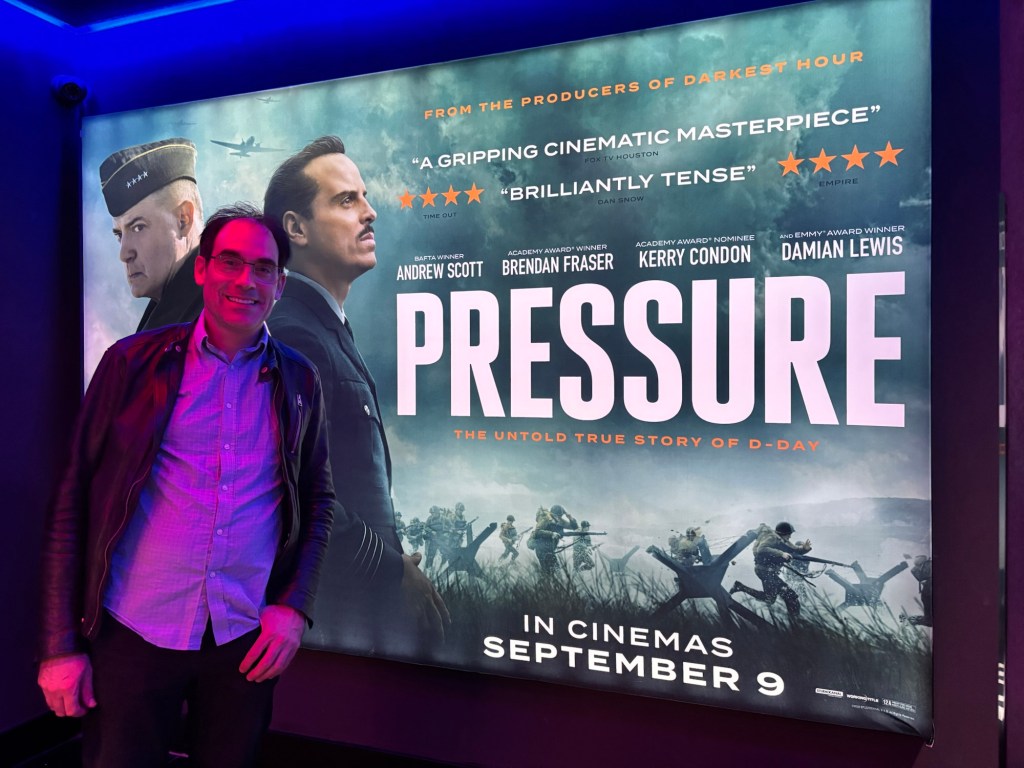
Set in the tense run-up to D-Day in 1944, ‘Pressure’ is based on the stage play about Scottish meteorologist James Stagg (Andrew Scott), who is charged by General Eisenhower (Brendan Fraser) with making one of the most consequential weather forecasts in history.
D-Day was originally planned for 5 June, but Stagg becomes increasingly convinced that the weather is about to take a serious turn for the worse and that the invasion should be postponed. The problem is that almost nobody around Eisenhower agrees with him.
Stagg is not exactly a natural people person. His manner is awkward, he is not particularly popular and, within Eisenhower’s inner circle, he is very much the outsider. More importantly, he is also an outlier scientifically. While Eisenhower’s former meteorological guru, played by Chris Messina, relies heavily on historical weather patterns, Stagg puts his faith in the latest forecasting information. His argument is simple but crucial: what happened twenty years ago is no guarantee of what will happen this time.
That disagreement becomes the dramatic heart of the film. If the Allies go ahead and Stagg is right about the approaching storm, the invasion could end in catastrophe. But postponing D-Day carries enormous risks of its own. The longer they wait, the greater the possibility that the Germans will discover their plans and the Allies will lose the element of surprise.
At the same time, Stagg is dealing with an intensely personal crisis. His wife is nine months pregnant and the hospital where she is staying is bombed, meaning that these enormous professional decisions are being made against a backdrop of considerable emotional strain.
There is something of ‘Hidden Figures’ or the story of Alan Turing in all of this: the largely unknown figure working behind the scenes whose decisions may prove decisive, while others occupy the foreground of history and sometimes receive the credit. Stagg is exactly that kind of character, and the film tells this enormous historical event from the perspective of an underdog most of us know very little about.
Of course, we already know how D-Day turned out, but that does not remove the tension. The journey towards that decision remains fraught with peril because the people involved do not know what we know. Every choice carries potentially disastrous consequences.
The film includes some wartime footage, but this is not really a conventional war movie. It is, for the most part, a story about men in rooms making decisions. Its battles are fought through forecasts, arguments, charts and competing interpretations of evidence rather than on the beaches of Normandy.
It also underlines just how different the world of 1944 was. Today we can take out a phone, open an app and see a weather forecast a week ahead. Here, predicting what the weather will do in the next few days becomes a matter of life and death, with thousands of soldiers depending on the judgement of a handful of meteorologists.
Ultimately, ‘Pressure’ is about the difference between the gung-ho attitude of ‘let’s go for it and deal with the consequences’ and the much less glamorous process of reasoning, examining evidence, weighing probabilities and being prepared to stand your ground when everyone around you thinks you are wrong.
That makes Stagg a fascinating central figure. He does not have charisma on his side, nor popularity, nor the comfort of consensus. All he really has is his belief in the evidence in front of him – and the courage to keep saying what he believes to be true when the stakes could hardly be higher.


 Chris Deacy
Leave a comment