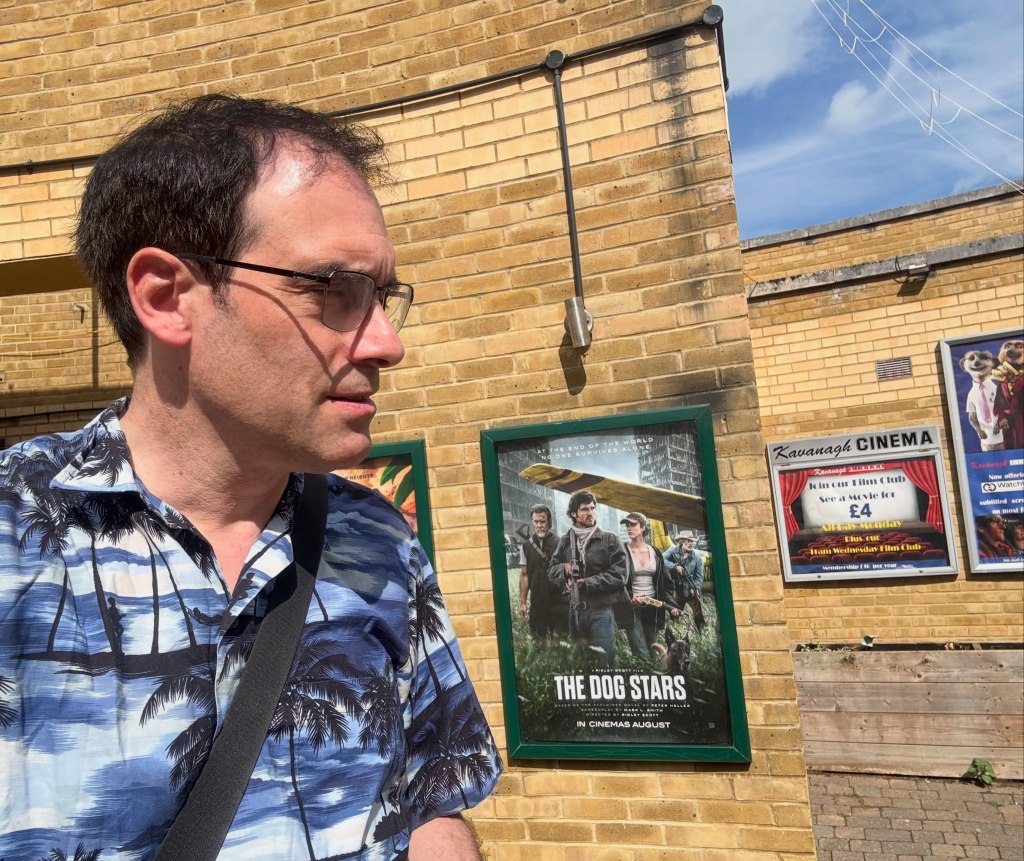
Ridley Scott’s ‘The Dog Stars’ is a pandemic thriller, but I found it intensely moving because underneath its dystopian trappings it is really a film about family: losing one, rebuilding another, and discovering the dangers of holding onto a past which no longer exists.
Civilization has been devastated by a pandemic. Buildings, cities and the remnants of multinational corporations remain, but most of the people have disappeared. It feels like the nightmare version of what the world might have become after Covid. Among the survivors are scavenging Reapers who descend in hordes looking for food, almost functioning as the film’s equivalent of zombies.
Hig (Jacob Elordi) lives with his dog and Bangley (Josh Brolin), a grouchy survivalist whose four essentials of life are power, food, water and weapons.
The two men have very different philosophies. Bangley has little time for sentimentality. Hig, however, remains emotionally attached to the world he has lost. He returns to the apartment where he lived with his wife, remembering a family that was destroyed even before the pandemic finally took her from him: their child died around a year before she succumbed to the virus.
In one extraordinary sequence, Hig takes his Cessna into the air, switches off the engine and allows the plane to fall.
For a moment, it appears that he wants to join his wife in death.
What keeps him going is partly the possibility of something beyond the life he already has. A mysterious radio communication from Grand Central offers the tantalising prospect that somewhere else might be better.
And that is where ‘The Dog Stars’ becomes a kind of hero’s journey. Hig receives the call, leaves the comparative security of home, encounters trials and threats and ultimately returns with a different understanding of what he left behind.
The grass, as they say, is always greener on the other side.
But sometimes we actually need to travel to the other side before we understand the value of what we already had.
The journey, indeed, raises the question running through the entire film: what exactly are these people surviving for?
Is continuing to exist sufficient? Do we simply acquire food, water and shelter and repeat the process tomorrow? Or does survival become meaningless without people to love and some larger sense of purpose?
That is why I profoundly disagree with descriptions of The Dog Stars as a ‘low-energy’ or ‘low-incident’ blockbuster. Its incidents are primarily emotional. Scott isn’t simply interested in how civilization survives; he is interested in whether individuals can rediscover reasons for wanting to.
Grand Central provides the film’s eeriest answer.
The airport sequence apparently wasn’t part of the original novel, but it is one of the film’s most memorable inventions. What initially appears to represent sanctuary instead exposes the ugliest side of humanity. Travellers are lured there only to discover the threat of cannibalism.
It reminded me unexpectedly of ‘Coma’ from 1978: a seemingly ordered institution concealing something grotesque underneath.
Allison Janney contributes to the surreal atmosphere as a former flight attendant, dressed in a vintage airline uniform and serving martinis as though civilisation had never collapsed: ‘Once a stewardess, always a stewardess!’
It’s funny, disturbing and deeply sad.
The old rituals survive after the society which gave them meaning has disappeared.
Yet perhaps the film’s best character arc belongs to Bangley. Initially he trusts nobody and is perfectly prepared to shoot anyone who enters his territory. His philosophy seems brutally sensible in this environment: attachment creates vulnerability and strangers represent danger.
But ‘The Dog Stars’ gradually challenges that worldview.
There is a particularly affecting reflection from Bangley about family and the terrible human tendency not to appreciate people sufficiently until they are gone. In a film filled with abandoned buildings and remnants of a vanished civilization, that thought becomes almost unbearably poignant.
Hig’s nostalgia is similarly complicated. His memories keep his wife alive, but they also prevent him from fully inhabiting the present. The past can sustain us, but it can also become somewhere we hide.
The journey therefore isn’t simply about finding Grand Central.
It’s about discovering whether paradise exists somewhere else at all.
What Hig finds is certainly not the salvation he imagined, and the film ultimately suggests that searching elsewhere may sometimes be necessary precisely because it allows us to recognize home when we return to it.
That is what makes ‘The Dog Stars’ so much more than another post-apocalyptic survival thriller. The Reapers, abandoned cities and empty infrastructure provide the dystopian spectacle, but Scott is interested in something much more intimate: grief, trust, memory and the families we create after the families we were given have disappeared.
At 88, Ridley Scott has made what I think is a masterpiece: tragic, eerie and certainly sentimental, but sentimentality isn’t necessarily a weakness when a film has earned its emotions.
‘The Dog Stars’ asks whether merely staying alive is enough.
Its answer seems to be no.
We need something to stay alive for – and sometimes we have to travel to the other side of the world before we realize it was waiting for us at home.




Leave a Reply